![[24]7.ai](https://www.247.ai/wp-content/uploads/2021/07/247ai-Black.svg)
![[24]7.ai](https://www.247.ai/wp-content/uploads/2024/09/247ai-Black.svg)
Table of contents
- Conversational AI for Business: What You Need to Know
- The Business Case: Why 2026 Is the Year for Conversational AI Investment
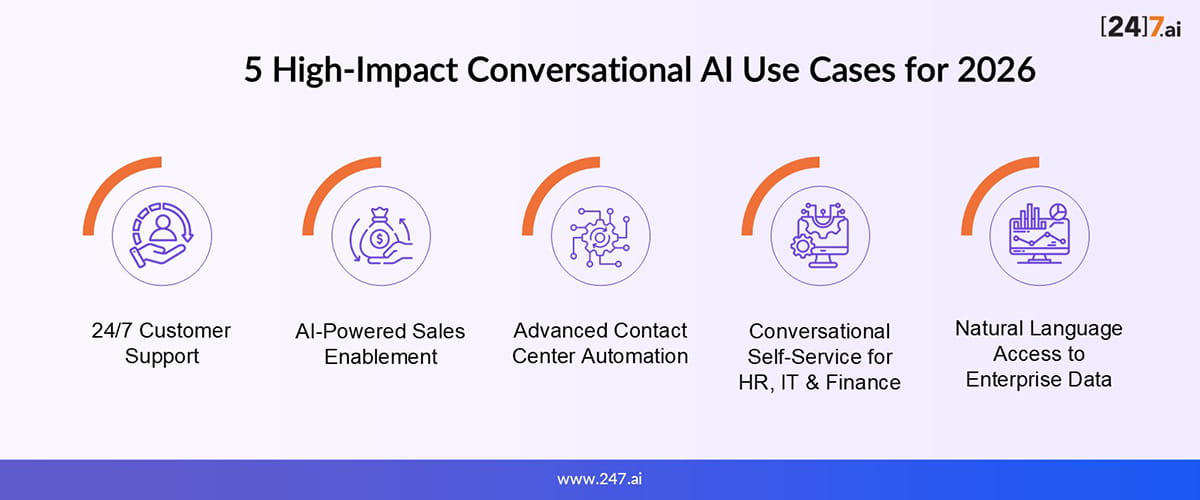
- 5 High-Impact Conversational AI Use Cases for 2026
- The Evolution of Conversational AI: What’s Next After 2026
- How Enterprise Leaders Are Selecting Conversational AI Platforms
- Platform Spotlight: Enterprise-Grade Conversational AI in Action
- Getting Started: Your Conversational AI Roadmap for 2026
- Ready to Unlock Conversational AI for Your Enterprise in 2026?
- FAQs
As interaction volumes increase, many enterprise service models are showing their limits. Conversational AI is emerging as a way to sustain responsiveness and consistency at scale. Human-only support cannot expand fast enough, stay consistent across channels, or operate economically when volumes spike. Conversational AI fills that gap by absorbing demand, maintaining response quality, and supporting employees in moments where speed and accuracy matter most.
Over the next few years, adoption will rise sharply as organizations confront tighter margins, limited hiring capacity, and customers who expect instant, informed responses across voice and digital touchpoints.

Conversational AI for Business: What You Need to Know
Conversational AI for business refers to intelligent systems that can understand, process, and respond to human language in a natural way. Unlike traditional chatbots or rule-based IVR systems, conversational AI uses advanced technologies to manage complex, real-world interactions.
These systems are powered by natural language processing, large language models, intent recognition, and orchestration layers that connect conversations to business systems. Together, they allow conversational AI to understand context, manage multi-step interactions, and take meaningful actions.
This is where conversational AI clearly outperforms legacy solutions. Traditional bots follow fixed scripts. Older IVR systems force users through rigid menus. Conversational AI adapts to what users say, understands intent even when phrased differently, and improves over time.
For enterprise leaders, success is measured by outcomes. These include faster resolution times, lower operational costs, higher customer satisfaction, improved employee productivity, and better use of data.
The Business Case: Why 2026 Is the Year for Conversational AI Investment
The business case for conversational AI is becoming increasingly clear. Enterprises are seeing measurable returns through reduced contact center costs, higher self-service adoption, and improved conversion rates in sales and service interactions.
Conversational AI scales without requiring a proportional increase in headcount. It can handle thousands of interactions simultaneously across channels, making it ideal for peak volumes and global operations.
At the same time, modern platforms are built to meet enterprise requirements around security, compliance, and governance. This makes conversational AI a viable long-term investment rather than a tactical experiment.
5 High-Impact Conversational AI Use Cases for 2026
Use Case 1: 24/7 Enterprise Customer Support Without Scaling Headcount
One of the most immediate benefits of conversational AI is the ability to deliver round-the-clock customer support. AI-driven assistants can handle common queries, guide users through troubleshooting, and resolve issues without human intervention.
When escalation is required, conversations are routed intelligently to the right agent with full context. This improves first-contact resolution, reduces average handle time, and allows human agents to focus on complex cases.
Use Case 2: AI-Driven Sales Enablement and Revenue Acceleration
Conversational AI is increasingly being used to support sales teams. It can qualify leads, identify buyer intent, and engage prospects in real time across chat, voice, and messaging platforms.
By personalizing interactions based on behavior and context, conversational AI helps businesses focus on high-value opportunities. It also supports conversational commerce, allowing customers to explore products, ask questions, and complete transactions within a single interaction.
Use Case 3: Next-Generation Contact Center Automation
Contact centers are moving beyond legacy IVR systems toward more natural, conversational voice experiences. Conversational AI enables customers to speak freely rather than navigate menus.
For agents, AI provides real-time guidance during calls. This includes suggested responses, next best actions, and access to relevant information. The result is higher productivity, lower burnout, and more consistent service quality.
Use Case 4: Self-Service HR, IT, and Finance Through Conversational Interfaces
Conversational AI is also transforming internal operations. Employees can use conversational interfaces to resolve HR, IT, and finance requests instantly.
Common use cases include leave balance queries, IT password resets, expense policy questions, and payroll information. This reduces internal ticket volumes and creates a more efficient digital workplace experience.
Use Case 5: Natural Language Access to Enterprise Data and Insights
Another emerging use case is natural language access to enterprise data. Executives and teams can ask questions in plain language and receive insights without relying on dashboards or technical tools.
This accelerates decision-making and makes data accessible to non-technical users. It also reduces dependency on specialized analytics teams for routine queries.
The Evolution of Conversational AI: What’s Next After 2026
Conversational AI is evolving from reactive task handling to proactive and predictive systems. Future platforms will anticipate customer and employee needs rather than waiting for requests.
Multimodal capabilities will become standard. Voice, chat, document processing, and action execution will work together in a single conversational flow. Deeper integration across enterprise systems will allow conversational AI to act as a central interface for work.

How Enterprise Leaders Are Selecting Conversational AI Platforms
Choosing the right platform requires careful evaluation. Scalability, security, and compliance are essential for enterprise deployment. Integration with legacy systems and flexibility for customization also matter.
Leaders are increasingly looking beyond generic tools toward platforms designed specifically for complex business environments. Calculating realistic ROI and understanding long-term impact are key parts of the selection process.
Platform Spotlight: Enterprise-Grade Conversational AI in Action
Leading conversational AI platforms share a few critical characteristics. They support sophisticated intent recognition across complex scenarios. They are proven at handling high interaction volumes across geographies. They integrate natively with contact centers and digital channels.
Enterprises using these platforms are achieving measurable improvements in efficiency, customer satisfaction, and competitive positioning.
Getting Started: Your Conversational AI Roadmap for 2026
For enterprises planning adoption, the focus should be on clear priorities and phased deployment. Early movers are already gaining advantages in customer experience and operational efficiency.
A sustainable implementation strategy includes aligning business goals, integrating with existing systems, and continuously optimizing based on performance data.
Ready to Unlock Conversational AI for Your Enterprise in 2026?
Leading organizations are using enterprise-grade conversational AI platforms to build intelligent, always-on conversations that reduce costs, drive revenue, and improve both customer and employee experiences.
To see how this transformation can work for your business, explore how [24]7.ai helps enterprises deploy scalable, secure, and outcome-driven conversational AI solutions.
Frequently Asked Questions
Deployment timelines vary, but many enterprises start seeing value within a few months through phased rollouts.
Yes. Conversational AI is designed to support agents, not replace them, by handling routine tasks and providing real-time assistance.
Modern platforms are built with compliance, security, and governance requirements in mind, making them suitable for regulated sectors.
Common metrics include resolution time, containment rates, customer satisfaction, cost savings, and revenue impact.
Yes. Continuous learning and tuning are important to improve accuracy, adapt to new use cases, and maximize long-term value.