![[24]7.ai](https://www.247.ai/wp-content/uploads/2021/07/247ai-Black.svg)
![[24]7.ai](https://www.247.ai/wp-content/uploads/2024/09/247ai-Black.svg)
Table of contents
- Why the Difference Matters More Than Ever
- What is a Chatbot?
- What is a Conversational AI Assistant?
- Conversational AI Assistant vs Chatbots: Core Differences
- Business Impact: Choosing Chatbots vs Conversational AI Assistants
- Enterprise Use Cases Where Conversational AI Assistants Win
- When a Chatbot Might Still Be Enough
- [24]7.ai in the Enterprise Conversational AI Landscape
- Key Evaluation Criteria for Conversational AI Assistant Platforms
- The Future of Conversational AI Assistants
- Final Thoughts
- FAQs
Why the Difference Matters More Than Ever
As enterprises accelerate automation across customer and employee interactions, terms like chatbots and conversational AI assistants are often used interchangeably.
While both aim to automate conversations, the difference between them is far more than semantics. Choosing the wrong solution can have real consequences for customer experience, operational efficiency, and ROI.
Many organizations adopt basic chatbots expecting intelligent automation, only to encounter limitations when scale, complexity, or personalization is required.
Understanding how conversational AI assistants differ, and where each fits, is critical as automation becomes a core part of enterprise operations rather than a side experiment.

What is a Chatbot?
It is a software application designed to simulate simple conversations with users, typically through predefined rules or scripted flows. Most chatbots follow decision trees that guide users through a limited set of responses.
There are two common types of chatbots. Rule-based chatbots operate entirely on if-then logic and fixed scripts. Slightly more advanced versions may use basic AI to recognize keywords, but their responses remain largely static.
Chatbots are commonly used for narrow tasks such as answering FAQs, providing order status updates, or guiding users through simple forms. While effective in controlled scenarios, they struggle in enterprise environments where conversations are unpredictable, multi-step, and context-dependent. When queries fall outside predefined paths, chatbots often fail, leading to poor experiences and frequent escalations.
What is a Conversational AI Assistant?
A conversational AI assistant is fundamentally different. It is an intelligent system designed to understand intent, maintain context across interactions, and engage in multi-turn conversations that feel natural and adaptive.
Unlike chatbots, conversational AI assistants rely on technologies such as natural language processing (NLP), natural language understanding (NLU), machine learning, and contextual memory. This allows them to interpret meaning rather than keywords, learn from interactions, and adjust responses dynamically.
Because they retain conversational context, conversational AI assistants can handle complex queries, follow-up questions, and intent shifts, making them suitable for enterprise-grade use cases across customer support, sales, and internal operations.
Conversational AI Assistant vs Chatbots: Core Differences
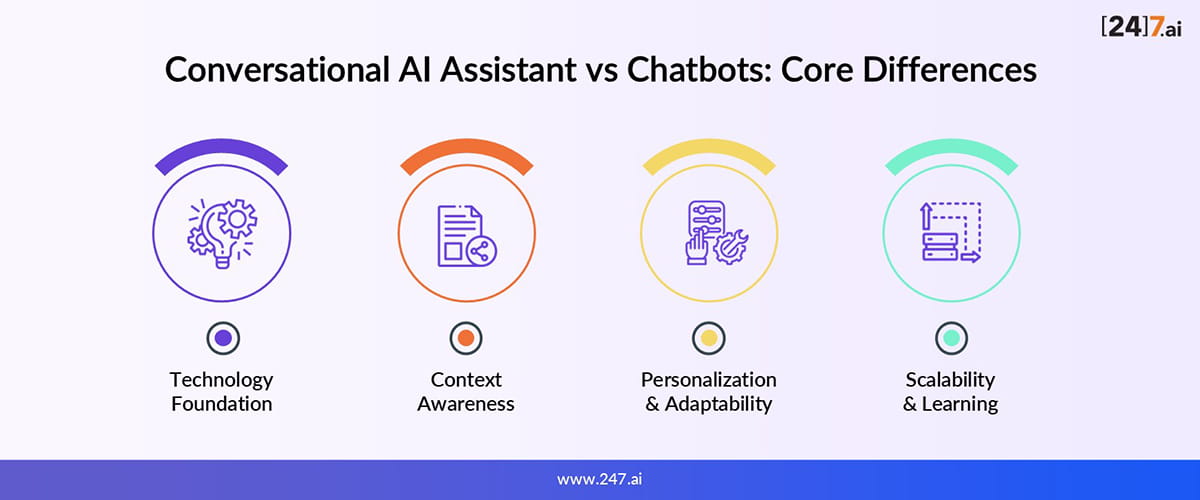
The distinction between chatbots and conversational AI assistants becomes clear across four dimensions.
- Technology Foundation: Chatbots rely on predefined rules and scripts, while conversational AI assistants use AI-driven intelligence that learns and evolves with data.
- Context Awareness: Chatbots respond one turn at a time, whereas conversational AI assistants maintain context and memory throughout the conversation.
- Personalization & Adaptability: Chatbots follow static interaction flows, while conversational AI assistants tailor responses using user history, intent, and behavior.
- Scalability & Learning: Chatbots require manual updates for new scenarios, whereas conversational AI assistants continuously improve as interaction volumes grow.
Business Impact: Choosing Chatbots vs Conversational AI Assistants
The choice between a chatbot and a conversational AI assistant directly impacts customer experience. Chatbots can resolve simple queries quickly but often break down under complexity, creating frustration. Conversational AI assistants, on the other hand, enable smoother, more consistent journeys by handling complexity without forcing customers to repeat themselves.
Operationally, chatbots reduce workload only within narrow boundaries. Conversational AI assistants drive deeper efficiency by automating larger portions of demand and supporting agents with context-rich handoffs. This improves agent productivity, reduces handling time, and lowers overall service costs.
From a long-term perspective, conversational AI assistants offer far greater scalability. As interaction volumes grow and customer expectations rise, enterprises need automation that evolves, something static chatbots cannot deliver.

Enterprise Use Cases Where Conversational AI Assistants Win
Conversational AI assistants excel in environments where conversations are complex and high-volume. In customer support, they handle end-to-end self-service journeys and intelligently escalate when human intervention is required.
In sales, they assist with lead qualification, product discovery, and follow-ups using natural language. Regulated industries such as banking and insurance benefit from their ability to manage nuanced conversations while maintaining compliance.
They are also well suited for omnichannel engagement, operating consistently across voice, chat, and messaging apps while preserving context across channels.
When a Chatbot Might Still Be Enough
Despite their limitations, chatbots still have a place. For narrow, transactional use cases, such as answering static FAQs or handling simple workflows, they can be effective and cost-efficient.
Chatbots may also suit early-stage automation efforts where organizations want to test basic demand deflection or face tight budget constraints. Chatbots work best when expectations are limited and complexity is low.
[24]7.ai in the Enterprise Conversational AI Landscape
[24]7.ai is an enterprise conversational AI provider rather than a traditional chatbot platform. We focus on intent understanding, contextual awareness, and multi-turn conversations designed for real-world complexity.
We emphasize orchestration across channels, enterprise systems, and workflows, enabling conversational AI assistants to function as part of a broader CX and operations ecosystem. This reflects a wider industry shift away from scripted automation toward intelligent, learning-driven assistants capable of scaling with enterprise needs.
As a result, enterprises often evaluate [24]7.ai alongside other enterprise-grade conversational AI assistant platforms rather than entry-level chatbot solutions.
Key Evaluation Criteria for Conversational AI Assistant Platforms
When evaluating a conversational AI assistant, leaders should consider accuracy in intent resolution, depth of enterprise integrations, and the ability to connect with CRMs, CCaaS platforms, and backend systems.
Security, compliance, and governance are critical, especially in regulated industries. Analytics and optimization capabilities also matter, as continuous improvement depends on visibility into performance, outcomes, and customer behavior.
The Future of Conversational AI Assistants
Conversational AI assistants are moving beyond reactive support toward proactive engagement by anticipating needs, guiding decisions, and preventing issues before they occur. AI copilots are emerging to assist both agents and customers in real time.
Generative AI will further expand capabilities, enabling richer conversations and faster adaptation. Leaders should prepare now by investing in platforms built for learning, scale, and orchestration.
Final Thoughts
Chatbots and conversational AI assistants serve different purposes. While chatbots handle simple tasks, conversational AI assistants are becoming the enterprise standard for managing complex, high-volume interactions.
For decision-makers, the takeaway is clear: automation investments should align with long-term CX and operational goals. Choosing a conversational AI assistant today lays the foundation for scalable, intelligent engagement tomorrow.
[24]7.ai helps enterprises make this shift, from scripted automation to intelligent, context-aware conversational AI assistants that operate seamlessly across channels, systems, and workflows.
Explore how 24]7.ai can transform enterprise conversations.
Frequently Asked Questions
Yes, but performance improves significantly as the system learns from interaction data over time.
No. They complement agents by handling routine demand and providing context-rich escalations.
Voice adds complexity, but modern conversational AI assistants are designed to handle both effectively.
Initial models can be deployed quickly, with accuracy improving continuously post-launch.
Most enterprise platforms support multilingual deployment and regional language adaptation.