![[24]7.ai](https://www.247.ai/wp-content/uploads/2021/07/247ai-Black.svg)
![[24]7.ai](https://www.247.ai/wp-content/uploads/2024/09/247ai-Black.svg)
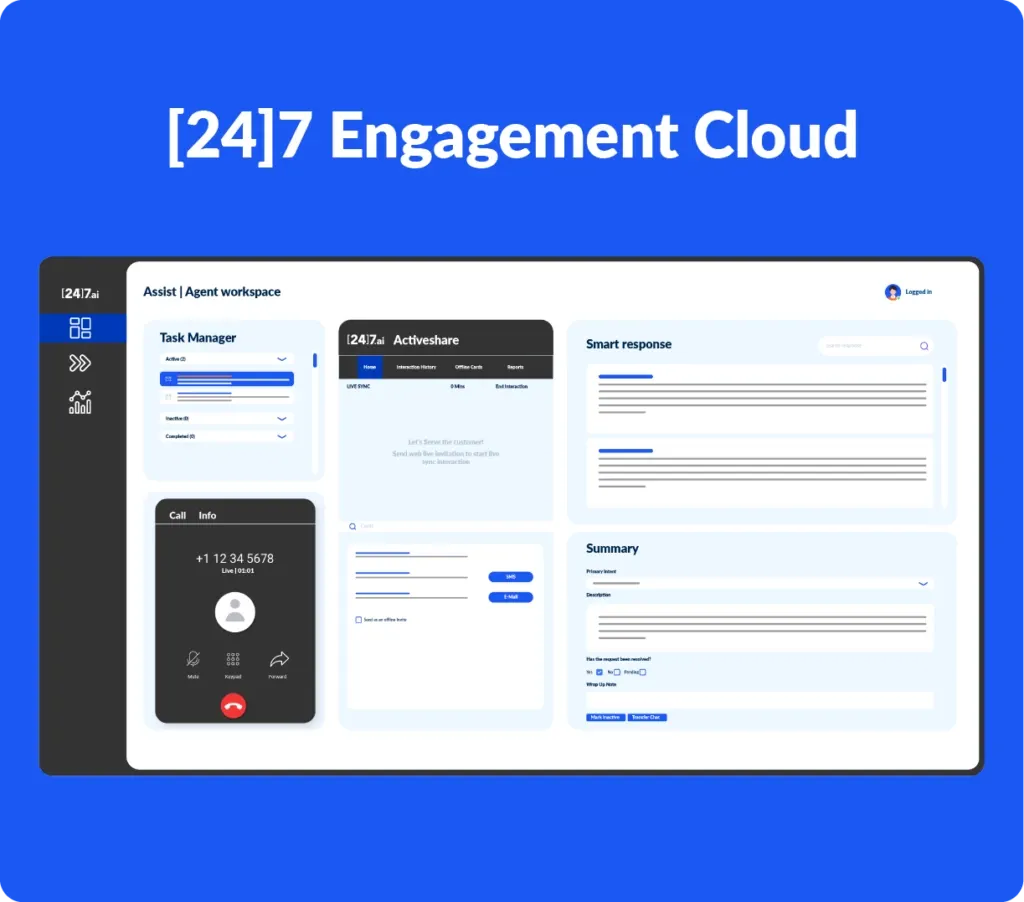
Table of contents
- Introduction
- What is Agentic AI in Customer Service?
- How Agentic AI Works in Customer Service Environments
- Key Benefits of Agentic AI in Customer Service
- Top Use Cases of Agentic AI in Customer Service
- Agentic AI vs Traditional Automation Models
- Best Practices for Implementing Agentic AI in Customer Service
- Challenges and Considerations
- The Future of Agentic AI in Customer Service
- How [24]7.ai Enables Agentic AI in Customer Service
- Final Thoughts
- FAQs
Customer service automation has been evolving for years. Early systems focused on call routing and basic IVR menus. Later, chatbots and self-service tools helped answer simple questions online. These technologies reduced workload for support teams, but they often struggled with more complicated requests.
Today, customer interactions are more complex. People expect quick resolutions, personalized responses, and seamless experiences across multiple channels. Static scripts and rule-based automation cannot always keep up.
This is where agentic AI in customer service is beginning to gain attention. Instead of responding only to predefined commands, agentic systems can analyze a request, determine the steps required to solve it, and take action. The shift is moving automation from simple responses toward goal-driven problem solving.
What is Agentic AI in Customer Service?
It refers to artificial intelligence systems designed to pursue a goal and complete tasks independently within defined boundaries. In customer service, this means an AI system capable of understanding a problem, deciding what needs to happen next, and carrying out actions across connected systems.
This approach differs from traditional chatbots or rule-based tools. Conventional automation usually follows fixed workflows and predefined responses. If a request falls outside those rules, the interaction must be transferred to a human agent.
Agentic AI is designed to handle more dynamic situations. It focuses on completing outcomes rather than delivering scripted answers.
Several characteristics typically define agentic AI in customer service:
- Autonomy: operating independently within established limits
- Goal orientation: focusing on resolving customer issues
- Reasoning: determining the steps needed to complete a task
- Action capability: executing updates, requests, or follow-ups across systems
These qualities make agentic AI particularly useful in environments where customer requests involve multiple steps or systems.
How Agentic AI Works in Customer Service Environments
Agentic AI systems begin by interpreting customer intent. Natural language understanding allows the system to determine what the customer wants to accomplish rather than just identifying keywords.
Once the request is understood, the AI evaluates available data and context. It may check previous interactions, account history, or related information stored in enterprise systems.
Next comes reasoning and decision-making. Instead of selecting from a static script, the system determines the sequence of actions required to solve the problem. For example, if a customer needs to change billing details, the system might verify identity, update records, confirm the change, and send a notification.
Integration is essential to this process. Agentic AI connects with tools such as CRM platforms, billing systems, support ticketing tools, and workflow engines. These connections allow the AI to perform tasks rather than simply providing instructions.
When uncertainty arises or human judgment is required, the system can escalate the interaction to an agent while passing along relevant context.
Key Benefits of Agentic AI in Customer Service
Agentic AI offers several advantages for organizations handling large volumes of support interactions.
First, it can resolve complex issues faster. By managing multi-step tasks independently, the system reduces delays caused by handoffs or manual processing.
Second, it helps reduce workload for support teams. Routine tasks and repetitive troubleshooting can be automated, allowing agents to focus on higher-value conversations.
Agentic AI can also improve first-contact resolution. When systems can access data and execute actions across multiple platforms, more issues can be solved during the initial interaction.
Another benefit is proactive engagement. Instead of waiting for customers to report a problem, AI systems can identify potential issues and notify customers in advance.
Finally, agentic AI supports scalable automation. Because it adapts to context rather than following rigid scripts, it can handle a wider range of situations.
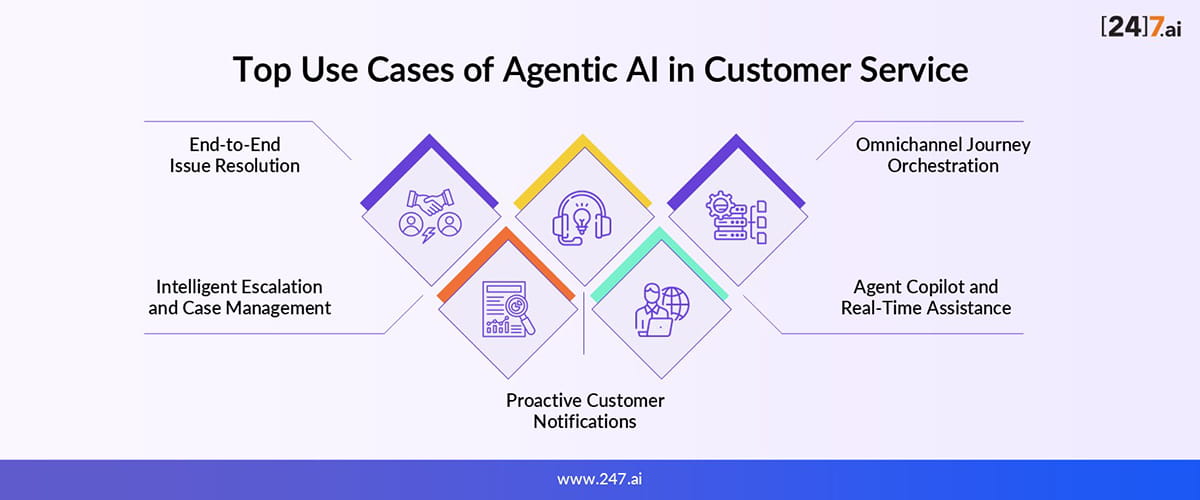
Top Use Cases of Agentic AI in Customer Service
End-to-End Issue Resolution
Agentic AI can manage complex requests such as account updates, subscription changes, or troubleshooting steps without manual intervention.
Intelligent Escalation and Case Management
When an issue requires human expertise, the system can escalate it with context and supporting data.
Proactive Customer Notifications
AI systems can detect potential service issues, billing alerts, or delivery updates and notify customers automatically.
Omnichannel Journey Orchestration
Customers often move between channels like chat, voice, and messaging. Agentic AI helps maintain continuity across these touchpoints.
Agent Copilot and Real-Time Assistance
AI can support agents during live conversations by retrieving information, suggesting next steps, or summarizing interactions.
Agentic AI vs Traditional Automation Models
Traditional automation tools typically rely on predefined rules and scripted flows. While they work well for repetitive tasks, they often struggle with unpredictable requests.
Agentic AI systems are designed to adapt. They analyze each situation, consider context, and determine appropriate actions.
Another difference is learning capability. Conventional systems require manual updates when new scenarios arise, whereas agentic systems can improve as they process more interactions.
These differences make agentic AI better suited for complex service environments where flexibility and reasoning are important.
Best Practices for Implementing Agentic AI in Customer Service
Organizations introducing agentic AI should start with clearly defined use cases. Focusing on high-impact scenarios allows teams to demonstrate value quickly.
System integrations should also be prioritized. The ability to interact with enterprise platforms determines how effectively AI can complete tasks.
Governance is another important consideration. Clear policies and safeguards ensure AI operates responsibly and within organizational guidelines.
Monitoring performance metrics such as resolution rate, response time, and customer satisfaction helps teams refine the system over time.
Finally, organizations should design human-AI collaboration thoughtfully so that agents remain central to complex or sensitive interactions.
Challenges and Considerations
Implementing agentic AI requires reliable data and structured workflows. Inaccurate or incomplete information can affect decision-making.
Organizations must also address risks related to autonomous actions. Safeguards and oversight are necessary to maintain trust and reliability.
Security and compliance requirements should also be considered, particularly when handling sensitive customer data.
Finally, support teams may need training and guidance to adapt to new AI-enabled processes.
The Future of Agentic AI in Customer Service
Agentic AI is still developing, but its potential is expanding rapidly. Advances in generative AI and reasoning capabilities are making systems more adaptable.
In the future, these technologies may shift from reactive support toward predictive assistance, identifying problems before customers even report them.
As organizations continue to modernize customer experience strategies, agentic AI may play an increasingly important role.
How [24]7.ai Enables Agentic AI in Customer Service
Modern customer engagement platforms are evolving to support agentic AI capabilities. These platforms combine conversational intelligence, workflow orchestration, and integrations with enterprise systems.
By connecting AI with operational tools and communication channels, organizations can move beyond simple automation and begin managing more complex interactions at scale.
Final Thoughts
Agentic AI in customer service represents a shift from scripted automation to systems capable of reasoning and taking action. By combining contextual understanding, integrations, and decision-making capabilities, these technologies can address more complex customer needs.
For organizations managing large service operations, agentic AI offers a path toward more efficient and responsive support experiences.
Frequently Asked Questions
Agentic AI focuses on completing tasks autonomously, while virtual assistants often provide information or guidance.
Yes, many systems are designed to integrate with existing CRM and support tools.
No. It is typically used to assist agents and automate routine tasks.
Implementation timelines vary depending on system integrations and organizational readiness.
Yes. Smaller teams can use it to automate routine requests and manage workload more efficiently.