![[24]7.ai](https://www.247.ai/wp-content/uploads/2021/07/247ai-Black.svg)
![[24]7.ai](https://www.247.ai/wp-content/uploads/2024/09/247ai-Black.svg)
Table of contents
- We've Been Putting Up With Bad Bots for Too Long
- So What Actually Makes an AI Agent Different?
- How AI Agents Work in Real Customer Service Environments
- 7 Real-World Examples of AI Agents in Action
- Key Benefits of AI Agents for Customer Service
- AI Agents vs. Traditional Customer Support Models
- What Makes AI Agents Effective?
- Common Challenges and How to Overcome Them
- How to Choose the Right AI Agent Solution
- How [24]7.ai Powers AI Agents for Customer Service
- FAQs
We've Been Putting Up With Bad Bots for Too Long
Be honest. How many times have you typed something into a company’s chat widget, got a completely useless response, and immediately looked for the “talk to a human” button?
That experience has been the reality of automated customer service for years. Basic bots that could only handle the most predictable questions, fell apart the moment anything got slightly complicated, and left customers more frustrated than before they started.
The good news is that’s genuinely changing. AI agents for customer service are a different animal entirely. Not a smarter FAQ search bar. An actual system that can reason through a problem, access your account information, and do something about it. That shift from answering questions to taking action is what makes this worth paying attention to.
So What Actually Makes an AI Agent Different?
To put it simply, an AI agent is a software entity that uses generative and predictive intelligence to accomplish specific goals autonomously. While a traditional chatbot might tell you how to change a flight, an AI agent actually changes the flight for you.
The core distinction lies in reasoning and execution. Unlike legacy automation, AI agents possess:
- Intent Understanding: They don't just look for keywords; they grasp the nuance of a customer's problem.
- Context Retention: They remember what was said five minutes ago, or even three months ago.
- Task Execution: They are connected to your backend systems to perform actions, not just talk about them.
- Multi-step Reasoning: They can figure out that to solve Problem A, they first need to verify Data B and update System C.
How AI Agents Work in Real Customer Service Environments
The “magic” happens through deep integration. An AI agent doesn’t live in a vacuum; it sits at the center of your tech stack. When a query hits the system, the agent identifies the intent and immediately queries your CRM, billing systems, or knowledge bases to build a resolution path.
If the agent hits a wall—an “edge case” it isn’t authorized to handle—it doesn’t just crash. It triggers a human-in-the-loop escalation, handing off the full context to a live agent so the customer never has to repeat themselves. This orchestration is what makes the experience feel fluid rather than robotic.
7 Real-World Examples of AI Agents in Action
1. Automated Order Resolution in Retail
Returns used to mean a conversation with an agent, a wait for an email, and a separate process to get your refund. AI agents in retail now handle the whole thing in a single chat. They check inventory, generate the return label, process the refund, and close the loop. All of it. During peak periods like Black Friday this alone takes enormous pressure off support teams.
2. AI Agents in Banking for Account Queries
Security makes banking support complicated, but AI agents handle it well. They authenticate users, help with transaction disputes, explain specific charges on a statement, and can lock a compromised card instantly. No hold music. No waiting for a phone representative. Just a fast, secure resolution.
3. Telecom Support for Network Issues
Telecom companies deal with enormous support volume and a lot of it is technical. AI agents here act as a first-line diagnostic. They can check your modem, identify whether there’s a wider outage in your area, and either trigger a remote reset or book a technician visit based on your specific plan. While keeping you updated the whole time.
4. Travel & Hospitality Booking Assistance
Anyone who’s tried to rebook a flight during a disruption knows how painful it can be. AI agents in travel take on that complexity directly. They navigate fare rules, find available options, make the change in the actual booking system, and confirm everything with the customer. What used to take forty minutes on hold takes a few minutes in a chat window.
5. Healthcare Appointment Management
Scheduling, reminders, rescheduling, follow-ups. Healthcare has a mountain of administrative work that doesn’t require clinical expertise but still eats up staff time constantly. AI agents handle all of it. Patients get a smoother experience and clinics see a meaningful reduction in no-shows, which is a bigger revenue issue than most people outside healthcare realize.
6. E-commerce Proactive Customer Support
This one changes the whole dynamic of support. Instead of waiting for a frustrated customer to chase up a delayed order, AI agents monitor delivery in real time. If something is flagged as delayed, the agent reaches out proactively with an update and often a goodwill gesture. A potential complaint becomes a loyalty moment before a single ticket is created.
7. Internal IT & HR Service Desk Automation
Key Benefits of AI Agents for Customer Service
Speed is the obvious benefit. Problems resolved in seconds rather than minutes or hours. But the deeper value is consistency.
Your best human agent has great days and difficult ones. They get tired. They occasionally miss a step. AI agents follow the same process every single time without exception. That consistency at scale is something human teams genuinely can’t replicate, and it shows up directly in your CSAT numbers.
First contact resolution improves because issues actually get resolved on the first try. Cost per interaction drops because fewer things need a human involved. And customers start to associate your brand with something rare in 2026: support that actually works.
AI Agents vs. Traditional Customer Support Models
Traditional bots were limited by what someone could anticipate and pre-program. AI agents are limited by what data they can access. That’s a fundamentally different ceiling.
Old automation managed conversations. AI agents execute outcomes. That shift from reactive script-following to autonomous problem-solving is what makes this genuinely new rather than just incremental improvement on the same idea.
What Makes AI Agents Effective?
Three things. Intent accuracy, integration depth, and context.
An AI agent that can’t see a customer’s account history is flying blind. It might sound capable but it can’t actually be helpful without the underlying data. The best implementations are deeply connected to the company’s existing CRM and support platforms. That’s what turns a smart interface into something that genuinely resolves things.
Common Challenges and How to Overcome Them
Data quality is almost always the first hurdle. If your knowledge base is disorganized or your customer data is inconsistent, the AI will reflect that. Getting your data in reasonable shape before you deploy is unglamorous work but it makes a significant difference to early performance.
Trust is the other one. Don’t try to hide that it’s an AI. Customers don’t mind talking to AI when it actually helps them. They mind when it’s pretending to be something it isn’t. Be transparent, and always make it easy to reach a human when someone genuinely needs one.
How to Choose the Right AI Agent Solution
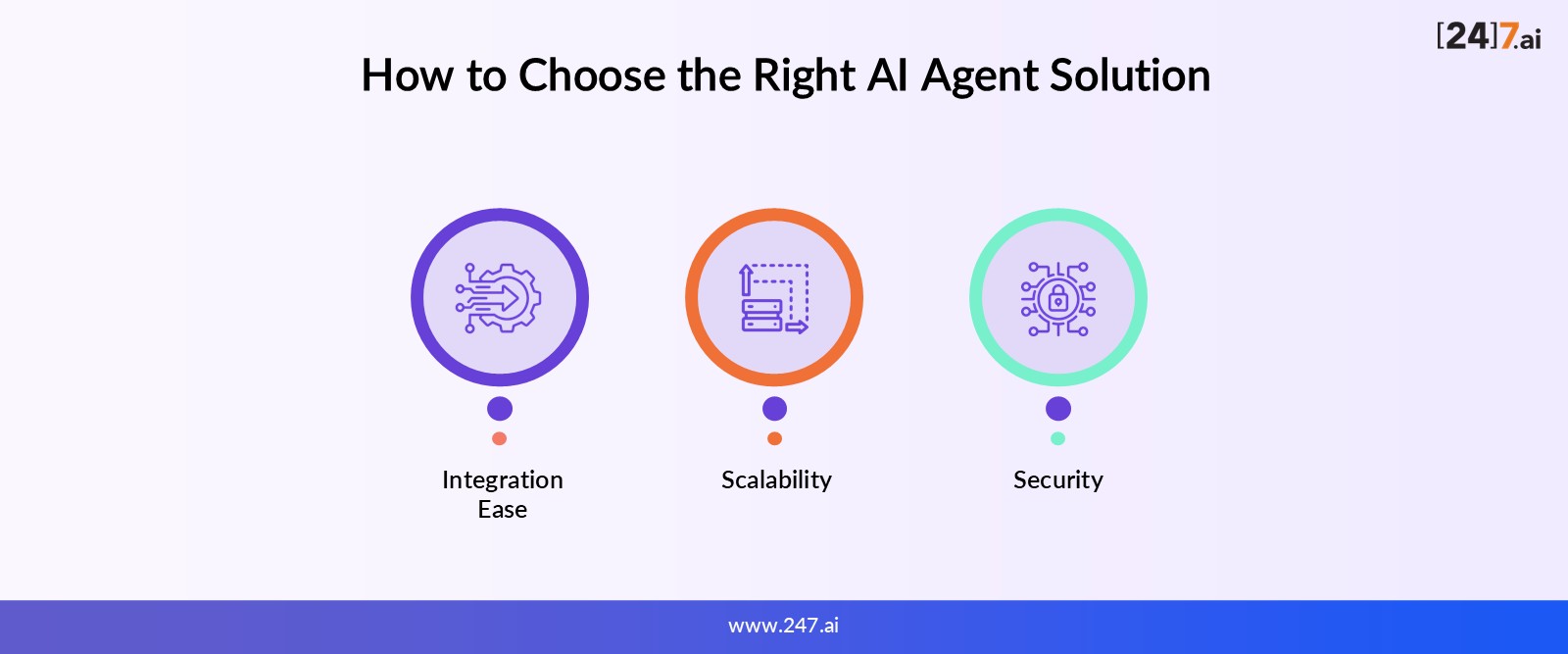
- Integration Ease: How fast can it connect to your specific CRM?
- Scalability: Can it handle a 10x spike in volume tomorrow?
- Security: Does it meet the compliance standards (SOC2, HIPAA, GDPR) for your industry?
How [24]7.ai Powers AI Agents for Customer Service
We built our platform around one idea. Understanding what a customer actually needs and then doing something about it.
Not just identifying intent and reporting back. Acting on it. Our platform combines real-time decision-making with enterprise-grade security and we’ve deployed it in some of the most demanding environments in telecom, finance, and retail. The results show up in CSAT and in the operational metrics that actually matter to the people running these operations day to day.
Contact us today!