![[24]7.ai](https://www.247.ai/wp-content/uploads/2021/07/247ai-Black.svg)
![[24]7.ai](https://www.247.ai/wp-content/uploads/2024/09/247ai-Black.svg)
- What is Contact Center as a Service (CCaaS)?
- How does Contact Center as a Service work?
- What are the key features of CCaaS solutions?
- What are the benefits of CCaaS solutions?
- How does a CCaaS solution reduce operational costs for customer support teams?
- What features should you should look for when choosing a CCaaS platform?
- How does CCaaS compare to on-premise contact center systems?
- How does AI improve customer experience in a CCaaS platform?
- Does CCaaS offer omnichannel support (voice, chat, email, social)?
- Can CCaaS help with workforce optimization and agent scheduling?
- How long does it take to implement a CCaaS platform?
- What ROI can businesses expect after switching to CCaaS?
- How much does implementing a CCaaS platform cost?
- Why CCaaS Is Crucial for Customer Experience
- How [24]7.ai Supports Modern CCaaS Transformation
- Frequently Asked Questions
A Complete Guide to CCaaS: Understanding Cloud Contact Centers
In the last decade, customer interactions have evolved faster than traditional contact centers can keep up. The old setup, large rooms packed with servers, hardware phones, and rigid workflows, struggles to meet today’s expectations for instant replies, meaningful personalisation, and digital-first communication. And with 49% of consumers making impulse purchases when experiences feel personalized, the business impact of getting it right has never been clearer.
This shift has accelerated the rise of Contact Center as a Service (CCaaS), a cloud-native model built for scale, flexibility, and AI-driven intelligence. As enterprises manage growing volumes across voice, chat, email, and social channels, CCaaS offers the adaptability they need. It supports remote workforces, integrates seamlessly with existing systems, and delivers faster, more personalized, and more reliable customer experiences.

What Is Contact Center as a Service (CCaaS)?
It is a cloud-based model that delivers all the capabilities of a modern contact center, including routing, reporting, omnichannel engagement, and workforce tools, without any on-premise hardware. The platform is hosted by a service provider and accessed through the internet, giving organizations the freedom to scale operations instantly.
Since everything runs centrally from the cloud, customer interactions across voice, messaging, social media, and email flow into one unified environment. This replaces disconnected systems with a cohesive infrastructure that makes both agent workflows and customer journeys smoother and more manageable.
How Does CCaaS Work?
In a CCaaS architecture, all core functions, such as call routing, agent desktops, analytics engines, and interaction logs, are managed from the provider’s cloud infrastructure. Organizations simply connect through a web browser or lightweight client.
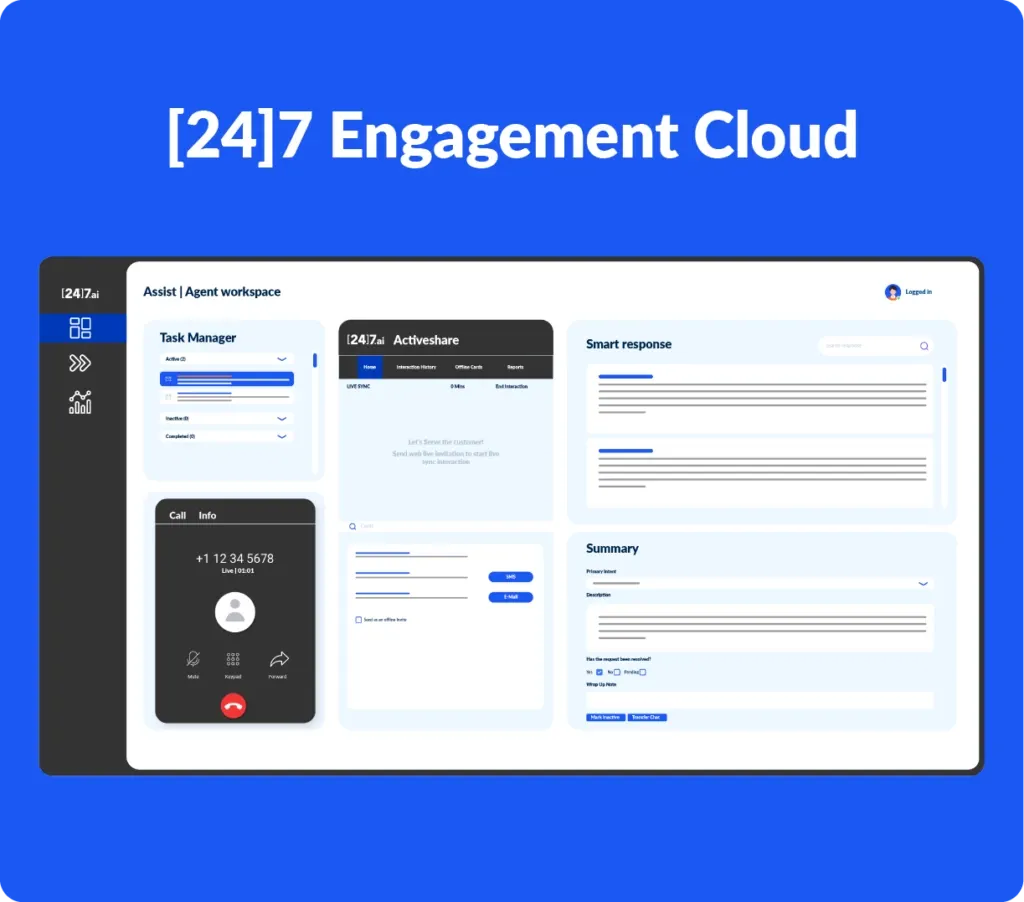
When a customer contacts the business, the CCaaS platform uses intelligent routing to direct the interaction to the best resource, whether that’s a self-service bot or a live agent. These agents access the system from a centralized interface that shows customer details, past interactions, and recommended next steps.
The platform also integrates seamlessly with CRMs, ticketing tools, and enterprise back-end systems through APIs. This ensures that when agents speak to customers, they’re connected to the entire business ecosystem.
Key Features of CCaaS Solutions
A robust CCaaS platform comes with an array of capabilities that go beyond simple call handling:
- Omnichannel routing ensures every interaction is managed consistently.
- IVR and Automated Call Distribution guide customers to the right destination without manual intervention.
- AI-driven virtual assistants automate common queries and reduce wait times.
- Workforce management tools help leaders forecast staffing needs, automate schedules, and track performance.
- Real-time insights give supervisors visibility into queues, agent workload, and customer sentiment.
- Enterprise-grade security protects data across geographies and ensures compliance with regulatory standards.
Business Benefits of CCaaS Solutions
Organizations moving to CCaaS often see improvements across several dimensions:
- They can expand or shrink teams quickly without infrastructure changes.
- Deployment cycles shorten dramatically compared to traditional systems that require hardware setup.
- Customers enjoy a more consistent experience across channels.
- Agents receive real-time assistance and intelligent recommendations that help them resolve issues faster.
- Cloud environments offer better uptime and resilience through distributed architecture.
This results in a customer service organization that adapts easily to spikes in demand and continuously improves experience quality.

How CCaaS Reduces Operational Costs for Support Teams
Cost efficiency is one of the biggest motivators for moving to CCaaS. Since the platform provider manages the hardware and software, organizations avoid spending on servers, upgrades, and maintenance. IT teams no longer need to manage complex phone systems or coordinate large-scale infrastructure changes.
Automation also plays a major role in cost reduction. AI bots deflect routine inquiries, allowing agents to focus on high-value tasks. And because training modules, workflows, and scripts can be embedded directly into the agent desktop, new hires ramp up faster. The pay-per-use model further aligns expenses with actual business needs.
What Features Should You Look for in a CCaaS Platform?
When evaluating CCaaS providers, enterprises should assess capabilities that will support long-term growth:
- Advanced automation and AI-driven decisioning
- Engagement across voice, digital, and emerging channels
- Smooth integration with CRMs, knowledge bases, payment systems, and operational tools
- Detailed analytics for customer journeys, agent behavior, and operational efficiency
- Strong security posture and compliance certifications
- Ability to scale globally without performance drops
These areas ultimately determine whether the platform can keep up with evolving customer expectations.
CCaaS vs Traditional On-Premise Contact Centers
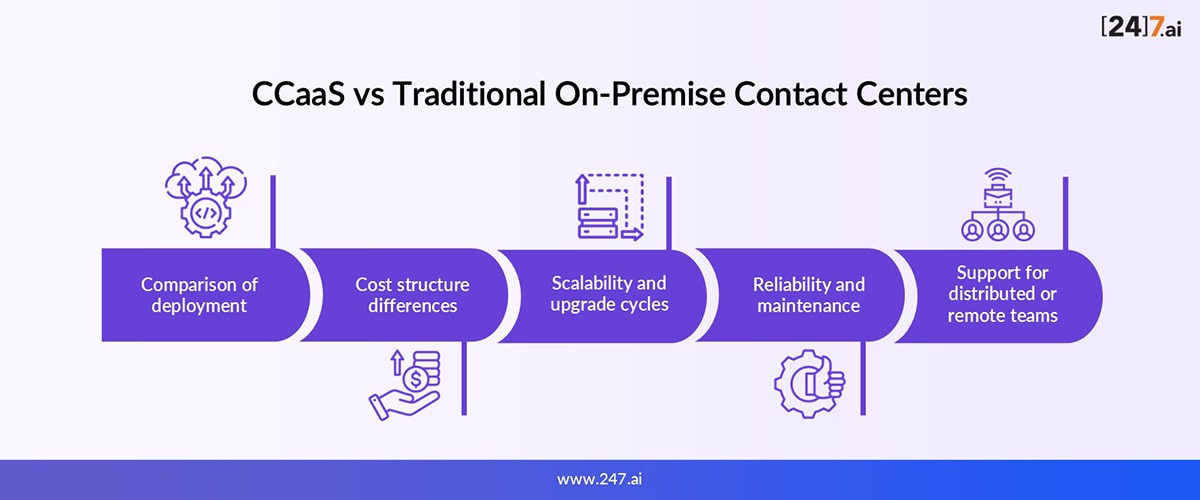
The differences between cloud and on-premise models are stark:
- Deployment: Cloud implementations take weeks, not months, as there is no physical hardware to install.
- Cost Structure: On-premise systems require significant upfront capital, while CCaaS operates on a subscription basis.
- Scalability: Traditional systems struggle with seasonal surges; cloud platforms scale effortlessly.
- Upgrades: The cloud provides automatic updates, eliminating maintenance windows and disruptive migrations.
- Work Models: CCaaS inherently supports remote and hybrid operations, while on-premise setups require more complex connectivity.
How AI Enhances Customer Experience in a CCaaS Platform
AI is the engine behind the modern contact center. With predictive models and natural language understanding, AI can:
- Route customers to the best resource based on intent or profile
- Engage with customers conversationally before handing off to a live agent
- Detect sentiment and adjust escalation paths in real time
- Provide live agents with context-sensitive prompts, knowledge snippets, or recommendations
- Trigger automated workflows that speed up issue resolution
Together, these capabilities elevate both speed and personalization.
Understanding CCaaS and Omnichannel Support
Omnichannel engagement is one of the core strengths of CCaaS. Every conversation flows into a unified system where agents and supervisors can view a single, connected timeline for each customer.
This continuity matters, especially when customers switch channels mid-conversation. With orchestration tools handling these transitions, businesses can maintain consistency without requiring customers to repeat themselves.
Workforce Optimization and Agent Scheduling in CCaaS
Modern CCaaS platforms bring science into scheduling and quality management. With forecasting engines, teams can predict call volumes and assign the right mix of agents. AI-driven scheduling automates shift creation, reducing manual effort.
Quality teams benefit from automated call scoring, coaching recommendations, and insights that highlight training opportunities. For agents, continuous feedback loops help them refine skills and maintain performance standards.
CCaaS Implementation Timeline: How Long Does It Take?
Most CCaaS deployments follow stages such as discovery, configuration, integration, testing, and rollout. Basic implementations can go live in a few weeks, while more complex enterprise migrations may take a few months.
Factors that influence timelines include number of channels, customization needs, data migration requirements, and integration depth with existing systems.
Expected ROI After Switching to CCaaS
Businesses typically see returns in multiple ways:
- Reduced operational overhead
- Higher resolution rates due to automation and intelligent routing
- Improved customer satisfaction scores
- Lower agent attrition through better tools and simpler workflows
- Faster resolution that boosts overall productivity
The combination of efficiency and experience improvements leads to sustainable ROI across the contact center ecosystem.
How Much Does a CCaaS Platform Cost?
CCaaS operates on a subscription-based model where organizations pay for the number of agents, channels, features, and usage. Costs vary depending on scale, AI add-ons, and support requirements.
Enterprises often find the model appealing because it replaces large capital investments with predictable operating expenses.
Why CCaaS Is Crucial for Customer Experience
The future of customer engagement is defined by immediacy, personalization, and omnichannel fluidity. CCaaS supports all three by combining the power of cloud infrastructure with AI-driven intelligence. For enterprises looking to modernize, CCaaS provides the agility and resilience needed to serve customers wherever they are.
How [24]7.ai Supports Modern CCaaS Transformation
[24]7.ai delivers a next-generation CCaaS platform designed specifically for large enterprises that require scale, reliability, and advanced AI capabilities. Its cloud-native architecture enables seamless engagement across voice and digital channels while integrating effortlessly with core enterprise systems.
Key strengths include:
- Intelligent routing and automation that reduce workload and improve resolution times
- Conversational AI and agent assist tools that enhance both self-service and live interactions
- Unified omnichannel experiences that allow customers to move smoothly across touchpoints
- High scalability and global footprint, ideal for enterprises serving millions of customers
[24]7.ai can help accelerate your cloud transformation journey with an AI-first CCaaS platform.
Frequently Asked Questions
Yes. CCaaS is scalable and can adapt to organizations of any size.
Leading providers comply with standards like PCI DSS, ISO 27001, SOC 2, and GDPR.
Absolutely. Cloud access allows agents to log in from anywhere with secure authentication.
IT involvement reduces, but teams still play a role in integrations, governance, and optimization.
AI bots and automated workflows resolve queries instantly, reducing dependence on live agents.