![[24]7.ai](https://www.247.ai/wp-content/uploads/2021/07/247ai-Black.svg)
![[24]7.ai](https://www.247.ai/wp-content/uploads/2024/09/247ai-Black.svg)
- Introduction
- What Is Conversational AI in Customer Support?
- Key Features to Look for in a Conversational AI Platform
- How to Choose the Right Conversational AI Platform
- Conversational AI Use Cases in Customer Support
- Benefits of Using Conversational AI Platforms
- Challenges to Consider Before Implementation
- Looking Ahead: Conversational AI in Customer Support
- Why Enterprises Choose [24]7.ai
- Final Thoughts
- Frequently Asked Questions
Best Conversational AI Platforms for Customer Support
When was the last time you enjoyed contacting customer support? Nobody does. You reach out because something went wrong and instead of a quick fix, you get hold music, a confused bot, and an agent reading from a script.
Customers in 2026 have zero patience for that. Businesses still running the support the old way are feeling it in their numbers. Conversational AI has become one of the most practical fixes available, and this guide helps you figure out what actually matters when choosing a platform.
What Is Conversational AI in Customer Support?
A basic chatbot is just a flowchart. Fixed answers, fixed paths, and the moment someone asks something outside the script, it completely falls apart.
Conversational AI actually understands what someone means, not just the words they typed. It holds context across a whole conversation. It handles the messy way real people write when they’re frustrated. And it gets smarter over time because every interaction teaches it something.
One deflects customers. The other helps them. That difference matters enormously in practice.
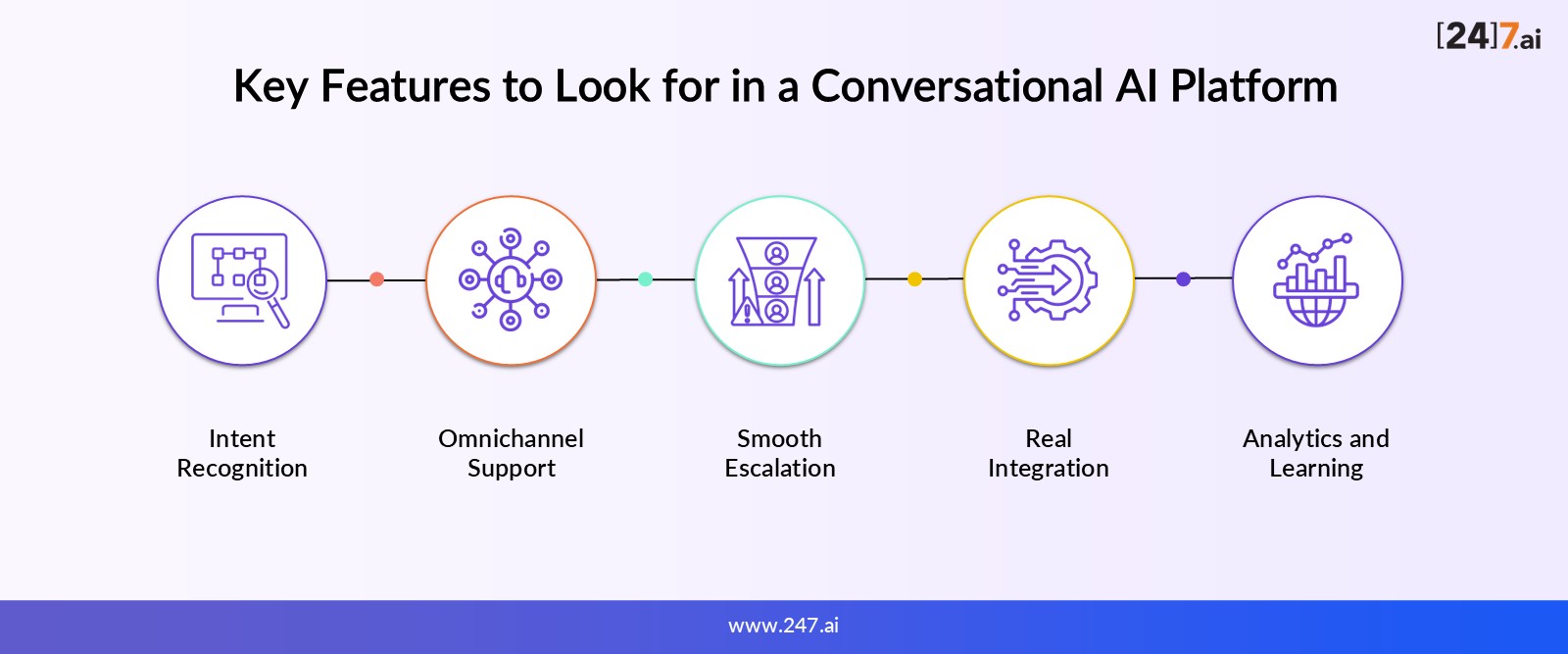
Key Features to Look for in a Conversational AI Platform
- Intent Recognition: Can it understand "still broken after last week's update, really frustrated"? Real customers don't write neat tickets. The platform needs to handle real language.
- Omnichannel Support: Customers switch between chat, voice, and messaging constantly. A platform strong on one channel but weak on others creates gaps your team fills manually.
- Smooth Escalation: When AI hands off to a human, the agent should already have full context. If the customer repeats themselves, the handoff has failed regardless of everything before it.
- Real Integration: An AI that can't see your customer's account history is guessing. Proper CRM integration isn't optional, it's foundational.
- Analytics and Learning: You need visibility into where conversations break down, and the platform should use that data to keep improving on its own.
How to Choose the Right Conversational AI Platform
Start with your own situation before looking at a single demo.
How complex are your queries really? What’s your current tech stack? How much capacity does your team have for implementation right now? These answers completely change which platform makes sense.
Straightforward high-volume queries? An out-of-the-box solution might get you most of the way there quickly. Complex multi-region operation with deep integrations? You need something built for that environment, not a simpler tool stretched beyond its design.
Also run the real numbers. License fees are just the beginning. Implementation, training, and ongoing tuning add up fast. The affordable option in a demo sometimes looks very different 18 months later.
Conversational AI Use Cases in Customer Support
Routine Support and FAQs handle questions your team answers on autopilot every day. They never needed a human. Automating them frees agents for work that actually requires them.
Order Tracking and Account Management cuts inbound volume fast. The impact shows up almost immediately after deployment.
Billing and Subscription Support is predictable and process-driven. Most customers just want a quick accurate answer and to move on.
Proactive Outreach surprises people most. Reaching out about a problem before the customer even knows it exists completely changes the interaction dynamic.
Internal Help Desks for IT and HR queries often see faster results than customer-facing deployments because the scope is tighter and easier to tune.
Benefits of Using Conversational AI Platforms
Always-on support without building shift structures or managing offshore teams. The system runs regardless of the hour.
Speed customers actually feel. Six minutes to six seconds isn’t incremental. Customers notice immediately and satisfaction scores follow quickly.
Agents who do better work. When your team stops grinding through repetitive tickets all day, they perform better on conversations that genuinely need them. Morale improves too, which has real cost implications when it comes to retention.
Volume spikes without chaos. Seasonal rushes, product launches, unexpected surges. The AI absorbs them without emergency hiring or quality dropping under pressure.
Challenges to Consider Before Implementation
Data readiness matters more than people expect. The AI learns from your data. If it’s messy or incomplete going in, early performance will show that.
Edge cases need a plan. Conversational AI handles common scenarios well. The unusual, emotionally charged interactions still need thought. They won’t sort themselves out.
Integration timelines slip. Every vendor says their integration is straightforward. Get the scope from the implementation team, not the sales team, before committing to anything.
Your team needs honest communication. Some agents will welcome the change. Others will feel unsettled. Address it early. Projects that ignore this part always take longer than they should.
Looking Ahead: Conversational AI in Customer Support
Why Enterprises Choose [24]7.ai
Enterprise support is rarely clean. High volume, complex queries, messy tech environments, real compliance requirements. Many platforms handle simple situations well. [24]7.ai was built for the complicated ones.
Our intent detection is trained on real customer language. Our omnichannel setup holds up across every channel consistently. Our integrations work with what you already have rather than asking you to rebuild around us. We’ve done enough deployments to know exactly where things go wrong and we plan for those moments before they happen.