![[24]7.ai](https://www.247.ai/wp-content/uploads/2021/07/247ai-Black.svg)
![[24]7.ai](https://www.247.ai/wp-content/uploads/2024/09/247ai-Black.svg)
- Why Conversational AI Is Now a Customer Service Imperative
- What Is Conversational AI for Customer Service?
- How Conversational AI Works: A Technical Overview
- Key Use Cases of Conversational AI in Customer Service
- Benefits of Using a Conversational AI Service
- Conversational AI vs Traditional Customer Support Models
- Challenges and Considerations Before Implementation
- How Leading Enterprises Use Conversational AI at Scale
- Conversational AI in Action: How [24]7.ai Powers Customer Service
- Future of Conversational AI in Customer Service
- Transform Your Customer Service with Conversational AI
- Frequently Asked Questions
Why Conversational AI Is Now a Customer Service Imperative
Customer service has shifted from being reactive to always-on. Customers no longer reach out only when something goes wrong. Now, they expect instant answers, personalized support, and consistent experiences across every channel, at any time of day. Traditional support models, built around fixed agent capacity and linear workflows, are increasingly unable to meet these expectations at scale.
This is where conversational AI service platforms have become central to modern customer experience (CX) strategies. By enabling intent-driven, automated conversations across digital and voice channels, conversational AI allows enterprises to respond faster, personalize interactions, and maintain service quality, even as volumes grow and customer journeys become more complex.

What Is Conversational AI for Customer Service?
Conversational AI for customer service refers to intelligent systems that can understand, process, and respond to customer requests in natural language across multiple channels. Unlike basic automation, a conversational AI service is designed to interpret intent, maintain context, and manage multi-step interactions.
It differs significantly from chatbots and live chat. Chatbots typically rely on predefined scripts and limited logic, while live chat depends entirely on human agents. A conversational AI service combines automation with intelligence by handling routine issues independently while escalating complex cases to agents with full context.
For enterprises, the core value lies in scale and consistency. A conversational AI service can manage high interaction volumes, reduce repetitive workloads, and deliver a uniform experience without proportional increases in cost or staffing.
How Conversational AI Works: A Technical Overview
A conversational AI service is built on several foundational components that work together to enable intelligent interactions.
Natural Language Processing (NLP) and Understanding (NLU)
NLP and NLU allow the system to interpret customer inputs beyond keywords. The AI identifies intent, extracts relevant entities (such as order numbers or locations), and understands context across multiple turns in a conversation.
Machine Learning and Continuous Improvement
Conversational AI models are trained using historical customer interactions. Over time, feedback loops help improve accuracy, expand intent coverage, and reduce failure rates, therefore allowing the system to perform better as it handles more conversations.
Dialogue Management and Orchestration
Dialogue management controls how conversations progress. It enables multi-turn interactions, manages branching scenarios, and determines when to escalate to a human agent, ensuring customers don’t hit dead ends.
System Integrations
Conversational AI services integrate with CRMs, ticketing platforms, knowledge bases, and backend systems. This integration depth determines effectiveness, as it allows the AI to take real action, such as retrieve account details, update tickets, or trigger workflows, instead of offering generic responses.
Key Use Cases of Conversational AI in Customer Service
Conversational AI services are used across a wide range of service scenarios, including customer support automation for FAQs and common issue resolution. They are also widely adopted for order tracking, account inquiries, billing support, and subscription management.
Many enterprises use conversational AI for proactive notifications, such as delivery updates or service alerts. Internally, conversational AI services support IT and HR service desks by handling repetitive employee queries, freeing human teams to focus on higher-value work.
Benefits of Using a Conversational AI Service
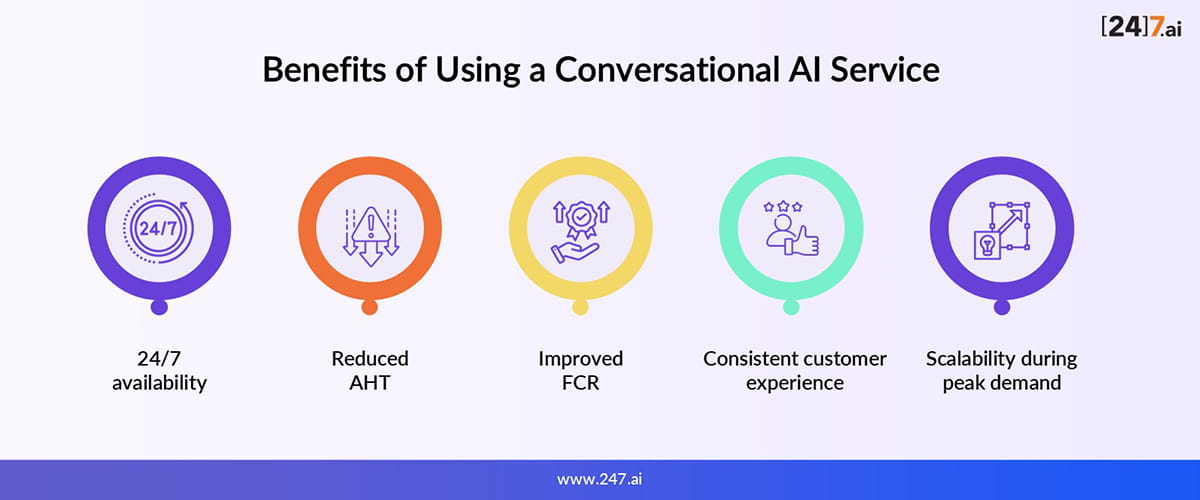
A conversational AI service delivers clear operational and experience benefits. It provides 24/7 availability without requiring additional headcount, helping organizations meet global customer demand. By resolving issues faster, it reduces average handling time and improves first-contact resolution.
Customers experience greater consistency across touchpoints, as the same intelligence operates across channels. For enterprises, scalability is a major advantage. Conversational AI absorbs demand spikes during peak periods without degrading service quality.
Conversational AI vs Traditional Customer Support Models
Traditional customer support models rely heavily on human agents, making them costly and difficult to scale. While they offer empathy and flexibility, they struggle with speed and consistency during high-volume periods.
Conversational AI services complement human agents rather than replacing them. Routine and repetitive interactions are automated, while agents focus on complex, high-empathy cases. This AI-augmented model improves efficiency without sacrificing service quality or personalization.
Challenges and Considerations Before Implementation
Implementing a conversational AI service requires preparation. Data quality is critical. Poor historical data can limit intent recognition and accuracy. Enterprises must also plan for edge cases where AI confidence is low.
Security, privacy, and compliance are essential considerations, especially in regulated industries. Change management is another factor; support teams need training to work effectively alongside AI and trust its recommendations.

How Leading Enterprises Use Conversational AI at Scale
Successful enterprises deploy conversational AI services across multiple channels, ensuring customers can engage consistently via chat, voice, and messaging platforms. Performance is tracked using metrics such as containment rate, resolution accuracy, CSAT, and deflection impact.
Most importantly, leading organizations align conversational AI initiatives with business KPIs, such as cost reduction, revenue protection, or customer retention, rather than treating them as isolated technology projects.
Conversational AI in Action: How [24]7.ai Powers Customer Service
[24]7.ai delivers an enterprise-grade conversational AI service designed for complex, high-volume customer environments. Its platform focuses on accurate intent detection, contextual understanding, and seamless orchestration across channels and systems.
Across industries such as retail, banking, telecom, travel, and insurance, [24]7.ai enables automated self-service, intelligent routing, and real-time agent assistance. Key differentiators include deep personalization, high intent accuracy, and the ability to scale without compromising experience or control.
Future of Conversational AI in Customer Service
The next phase of conversational AI will be shaped by generative AI and large language models. Customer interactions will become more predictive and personalized, moving from reactive support to proactive engagement.
Conversational AI services are also playing a role in upsell, retention, and revenue-driving conversations. For enterprises, this marks a shift from automation as cost control to automation as strategic growth enablement.
Transform Your Customer Service with Conversational AI
Now is the right time to invest in a conversational AI service. Rising expectations, growing interaction volumes, and pressure on support teams make intelligent automation essential.
Explore how 24]7.ai can help modernize your customer service with enterprise-ready conversational AI.
Frequently Asked Questions
Yes. Most enterprise platforms are designed to integrate with existing infrastructure through APIs.
Initial deployments can take weeks, with accuracy and coverage improving post-launch.
Leading platforms offer multilingual and locale-specific language support.
Metrics include containment rate, CSAT, intent accuracy, and resolution quality.
Yes. Many enterprises deploy the same platform for external and internal service use cases.