![[24]7.ai](https://www.247.ai/wp-content/uploads/2021/07/247ai-Black.svg)
![[24]7.ai](https://www.247.ai/wp-content/uploads/2024/09/247ai-Black.svg)
Table of contents
- Introduction
- What is Hyper-Personalized Social Advertising?
- How AI Powers Modern Social Ad Targeting
- Social Platforms Through a Targeting Lens
- Core Strategies for Hyper-Personalized Social Advertising
- AI-Driven Optimization Strategies
- Creative Strategy in a Personalization-First World
- Measuring What Actually Matters
- Common Mistakes in Modern Social Ad Targeting
- The Role of Privacy and First-Party Data
- The Future: From Targeting to Prediction
- How [24]7.ai Enables Hyper-Personalized Social Advertising
- Final Thoughts
- FAQs
For years, social advertising was built around broad targeting, such as age groups, locations, interests. It worked when platforms had abundant third-party data and audiences were easier to segment. However, that’s no longer the case.
Users today expect relevance. If an ad doesn’t feel tailored, it gets ignored instantly. At the same time, privacy changes and signal loss have made traditional targeting less reliable.
This shift is forcing brands to rethink how they approach social advertising. Instead of targeting groups, the focus is moving toward understanding intent in real time. The brands that win are the ones that can meet users with the right message, at the right moment.
What is Hyper-Personalized Social Advertising?
Hyper-personalized social advertising is about delivering ads that reflect an individual user’s behavior, context, and intent.
Traditional targeting might group users into segments like “fitness enthusiasts” or “working professionals.” Hyper-personalization goes deeper. It looks at how someone interacts with content, what they engage with, when they are active, and what signals they leave behind.
This approach relies heavily on first-party data, platform signals, and AI models that can interpret patterns at scale. The goal is to make every ad feel relevant enough to act on.
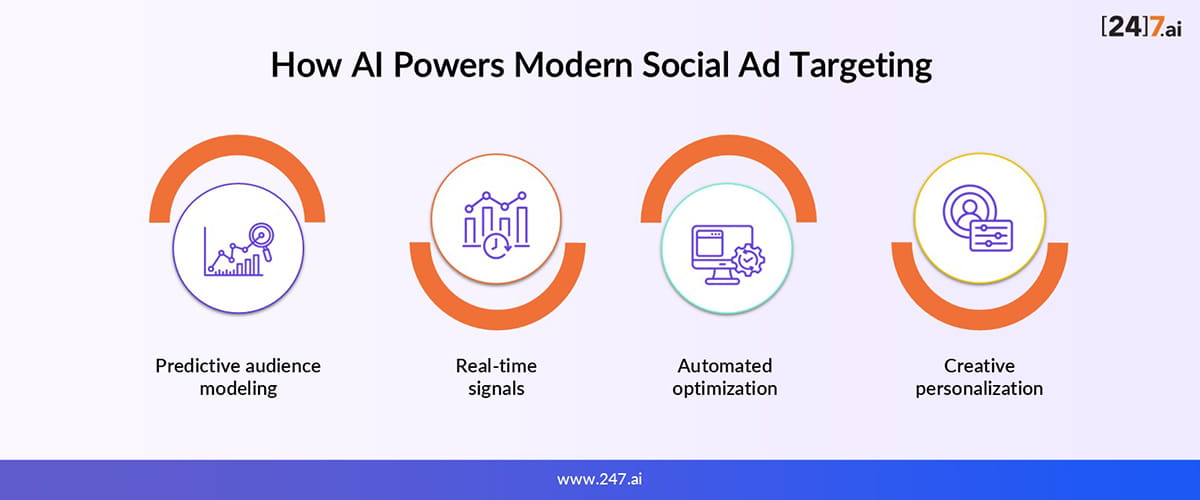
How AI Powers Modern Social Ad Targeting
- Predictive audience modeling allows platforms to identify users who are likely to convert, even before they explicitly show intent. Instead of relying only on past actions, AI predicts future behavior.
- Real-time signals add another layer. These include what a user is currently engaging with, how long they spend on content, and even the time of day. Ads can be adjusted based on these signals, making them more timely and relevant.
- Automated optimization removes much of the manual work. AI systems continuously shift budgets, refine audiences, and adjust bids based on performance.
- Creative personalization is where things become visible to the user. Different users may see different versions of the same ad based on their behavior, preferences, or stage in the buying journey.
Social Platforms Through a Targeting Lens
- Meta (Facebook & Instagram) remains one of the strongest ecosystems for behavioral targeting. Its data depth allows for precise retargeting and lookalike modeling, making it effective for scaling personalization.
- LinkedIn stands out for B2B use cases. Its firmographic data, such as job roles, industries, and company size, makes it ideal for account-based targeting.
- TikTok relies heavily on content consumption patterns. Its algorithm surfaces ads based on what users watch and engage with, often outperforming traditional interest-based targeting.
- YouTube blends intent and content. Ads can align with what users are actively searching for or watching, making it strong for mid-funnel engagement.
- X (Twitter) is useful for real-time targeting. Brands can align messaging with trending topics or live conversations.
Core Strategies for Hyper-Personalized Social Advertising
Moving toward hyper-personalization requires a shift in strategy.
Instead of relying on static audience segments, brands are focusing on intent-based segmentation. This means grouping users based on product views, engagement patterns, or time spent.
Full-funnel personalization is also key. A user discovering a brand for the first time should not see the same message as someone ready to convert. Messaging needs to evolve with the journey.
Retargeting has become more behavior-driven. It’s no longer just about who visited a page, but how they interacted with it.
Another effective approach is sequential storytelling, where users are shown a series of ads that build on each other over time.
AI-Driven Optimization Strategies
AI is also changing how campaigns are managed. Instead of manually adjusting budgets, systems now allocate spend dynamically based on performance. High-performing segments receive more investment automatically.
Audience refinement happens continuously. Underperforming segments are deprioritized, while new high-intent users are identified.
Predictive models can score users based on their likelihood to convert, allowing brands to focus efforts where it matters most.
This reduces the need for constant manual intervention and allows campaigns to adapt in real time.
Creative Strategy in a Personalization-First World
Users respond to content that feels relevant. This means aligning visuals, messaging, and tone with the user’s context. A first-time viewer may need a simple introduction, while a returning user might respond better to a specific offer.
Dynamic creatives allow multiple variations of an ad to be tested and optimized automatically. Over time, patterns emerge around what works best for different audiences.
Creative fatigue is another factor. Repeating the same ad too often leads to declining performance. Regular iteration is necessary to keep engagement high.
Measuring What Actually Matters
Metrics need to evolve alongside strategy. Click-through rates and impressions only tell part of the story. What matters more is conversion quality, customer intent, and return on ad spend.
Tracking should focus on how different audience cohorts behave over time. Attribution models also need to account for multiple touchpoints rather than a single interaction.
Continuous optimization is key. Instead of waiting for campaign results at the end, adjustments should happen throughout the campaign lifecycle.
Common Mistakes in Modern Social Ad Targeting
- Over-targeting can limit reach, while under-targeting can dilute relevance. Finding the balance is important.
- Ignoring first-party data is another missed opportunity. Owned data is becoming more valuable as third-party tracking declines.
- Creative is often under-prioritized, even though it directly impacts performance.
- Slow optimization cycles can hurt results.
The Role of Privacy and First-Party Data
With the decline of third-party cookies, brands are relying more on first-party data, such as information collected directly from users through websites, apps, and interactions.
Consent-driven data strategies are becoming essential. At the same time, technologies like server-side tracking and clean rooms are helping maintain measurement and targeting capabilities.
Balancing personalization with privacy will be one of the biggest challenges moving forward.
The Future: From Targeting to Prediction
Instead of reacting to user behavior, AI systems will increasingly anticipate it. Ads will be served based on what users are likely to need next, not just what they’ve done before. Campaign management will also become more autonomous, with AI handling optimization end-to-end.
At the same time, conversational and interactive ad formats will grow, making engagement more dynamic.
How [24]7.ai Enables Hyper-Personalized Social Advertising
Modern social advertising depends on the ability to understand customer intent, unify data across touchpoints, and act on real-time signals.
[24]7.ai helps brands move toward this level of precision by combining AI-driven insights, behavioral data, and cross-channel orchestration. This allows businesses to go beyond static audience segments and deliver more relevant, context-aware engagement at scale.
By aligning data, automation, and decisioning, [24]7.ai enables marketers to respond to customer intent faster and create more meaningful interactions across social channels.
Final Thoughts
Social advertising is all about reaching the right audience, at the right moment, with the right message.
Hyper-personalized targeting, powered by AI and real-time signals, is becoming the foundation of high-performing campaigns. Brands that invest in data, creative agility, and continuous optimization will be better positioned to drive meaningful results.