![[24]7.ai](https://www.247.ai/wp-content/uploads/2021/07/247ai-Black.svg)
![[24]7.ai](https://www.247.ai/wp-content/uploads/2024/09/247ai-Black.svg)
- What is customer experience (CX) and why is it important?
- How does customer experience differ from customer service?
- What are the key components of a great customer experience?
- What factors influence customer experience the most?
- What are the biggest challenges of customer experience?
- What is customer experience management?
- What is a customer journey and how do you map it?
- What is an omnichannel experience and how do you deliver it?
- What are the best ways to improve customer experience?
- How do businesses create a successful customer experience strategy?
- What are the most important CX metrics (NPS, CSAT, CES)?
- How do you measure customer satisfaction effectively?
- How do I choose the right customer experience platform?
- What is the ROI of investing in customer experience?
- How [24]7.ai Enhances Enterprise Customer Experience
- Frequently Asked Questions
Understanding Customer Experience: Components, Challenges and How to Improve
The modern customer is a different customer. They move fast, expect clarity, and want brands to understand their needs without making them work for it. Every touchpoint, be it a quick scroll through a website or a conversation with an agent, helps them decide if a brand is worth their time.
This is why customer experience (CX) has become a true competitive battleground. With products looking increasingly similar, the experience surrounding them is what earns loyalty, drives advocacy, and fuels revenue. Companies that once focused purely on product are now realizing that the feeling they create is just as important as the offering itself.

What is Customer Experience (CX) and Why is it Important?
CX is the total perception customers form based on their interactions with a business. These perceptions are built across every touchpoint, such as marketing, sales conversations, onboarding, product usage, billing, and support.
CX matters because customers don’t judge companies by isolated moments. They judge by the entire experience, and that experience influences whether they stay, leave, or recommend the brand to someone else. Strong CX leads to long-term relationships, higher lifetime value, and differentiation in crowded markets.
How Customer Experience Differs From Customer Service
Customer service refers to specific moments when customers seek help. CX extends far beyond that by encompassing the whole journey. A company might offer exceptional service but still deliver poor CX if its app is confusing, checkout is slow, or communication is unclear.
To succeed, businesses must strengthen both the service interaction and the broader experience that surrounds it.
Key Components of a Great Customer Experience
Exceptional CX typically reflects a few essentials:
- Personalization: Experiences that feel tailored, not generic.
- Consistency: A unified experience across channels and devices.
- Speed and low effort: Customers shouldn’t repeat themselves or navigate complexity.
- Empathy: Human understanding strengthens trust.
- Proactive engagement: Anticipating needs before issues arise.
These elements turn everyday interactions into meaningful relationships.
Factors That Influence Customer Experience Most
Several factors heavily shape how customers judge a brand:
- Product quality and long-term reliability
- Digital usability, including websites, apps, and portals that are intuitive and responsive
- Clarity of communication throughout the customer lifecycle
- Support responsiveness, especially during critical moments
- Brand trust and transparency, which reduce uncertainty
These elements often determine whether a customer becomes loyal or leaves for a competitor.
Major Challenges in Delivering Strong Customer Experience
Despite its importance, CX remains difficult to execute well. Common obstacles include:
- Siloed systems that prevent a complete view of the customer
- Fragmented data scattered across multiple tools
- Inconsistent service between channels or teams
- Limited personalization due to outdated technologies
- Skill or resource shortages that restrict innovation
These challenges create friction, slow resolution, and erode satisfaction.
What is Customer Experience Management?
Customer Experience Management (CXM) is the discipline of aligning people, processes, and technology to shape better interactions. It involves measuring experiences, understanding customer expectations, identifying friction, and continuously improving the journey. CXM is an ongoing system of listening, learning, and optimizing.
What is a Customer Journey and How Do You Map It?
A customer journey outlines every stage a customer goes through, from discovering a brand to becoming a loyal user. Mapping this journey helps teams see where customers feel confused, frustrated, or delighted. By visualizing each touchpoint, companies can pinpoint pain points and redesign the journey for clarity, speed, and ease.
What is an Omnichannel Experience and How Do You Deliver It?
An omnichannel experience allows customers to move between channels, such as web, app, chat, email, social, and voice, without losing context. Delivering this requires integrating systems and maintaining a single customer view. When done well, customers never feel like they are “starting over,” regardless of where they switch channels.

Best Ways to Improve Customer Experience
Businesses can elevate CX by focusing on a few proven strategies:
- Actively listening to customer feedback through surveys, analytics, and frontline insights
- Reducing complexity in forms, processes, and communication
- Using personalization to tailor content, recommendations, and support
- Investing in digital self-service, including intelligent FAQs, chatbots, and guided workflows
- Empowering frontline agents with training, tools, and real-time guidance
Small improvements across multiple interactions often create the biggest overall impact.
How Businesses Create an Effective Customer Experience Strategy
A strong CX strategy is built on four pillars:
- A clear vision of what the brand wants customers to experience.
- Journey mapping to identify friction.
- Data and insights to guide decisions.
- Cross-functional collaboration to ensure every team contributes.
Successful strategies evolve continuously as customer behaviors and expectations change.
The Most Important CX Metrics (NPS, CSAT, CES)
Three core metrics guide modern CX programs:
- NPS measures loyalty and likelihood to recommend.
- CSAT captures satisfaction with a specific interaction.
- CES evaluates how much effort customers must exert.
Together, they highlight strengths, weaknesses, and improvement opportunities.
How to Measure Customer Satisfaction Effectively
While surveys remain important, they should be supported by deeper insights. Sentiment analysis, text analytics, behavioral patterns, repeat visits, and churn signals offer a more complete understanding of how customers actually feel. Organizations that combine structured and unstructured feedback gain more actionable intelligence.
How to Choose the Right Customer Experience Platform
When evaluating CX platforms, businesses should prioritize:
- Omnichannel engagement capabilities
- Deep integration with CRM, support systems, and back-office tools
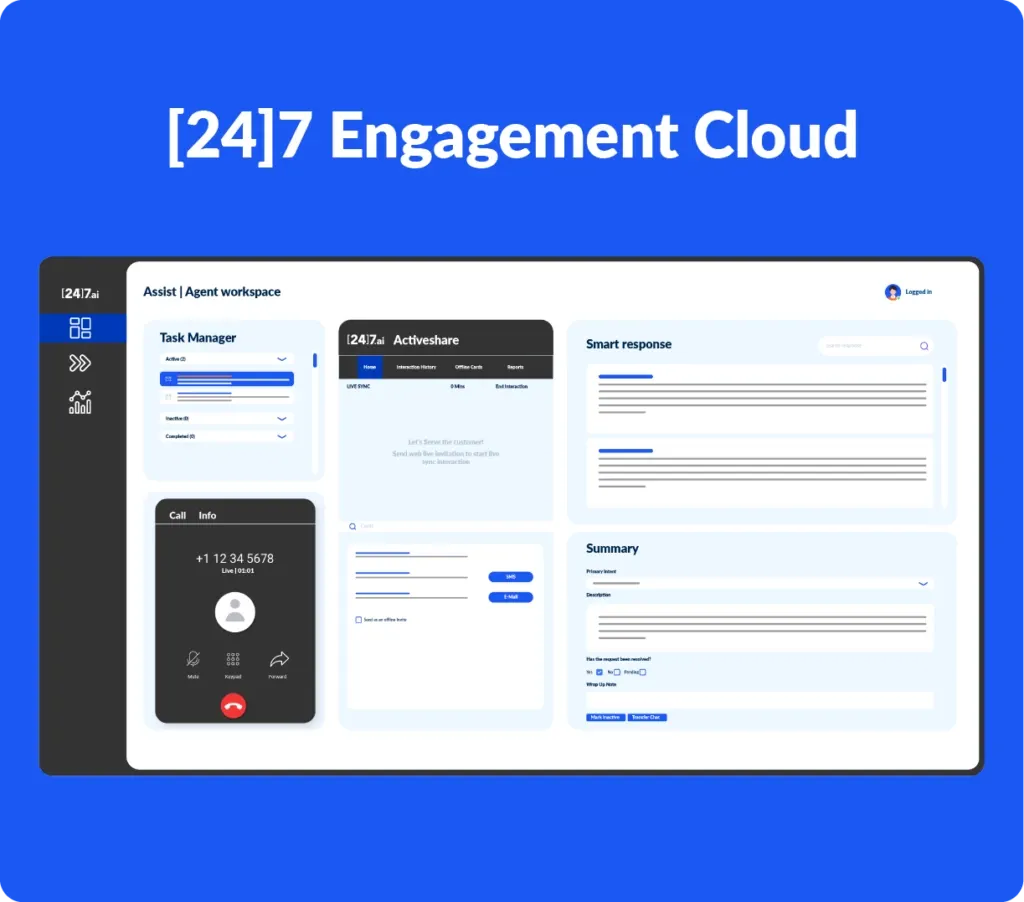
- AI-driven insights, routing, and automation
- Real-time analytics for both customers and agents
- Scalability, security, and flexibility for enterprise environments
The right platform becomes the central nervous system of a modern CX strategy.
The ROI of Investing in Customer Experience
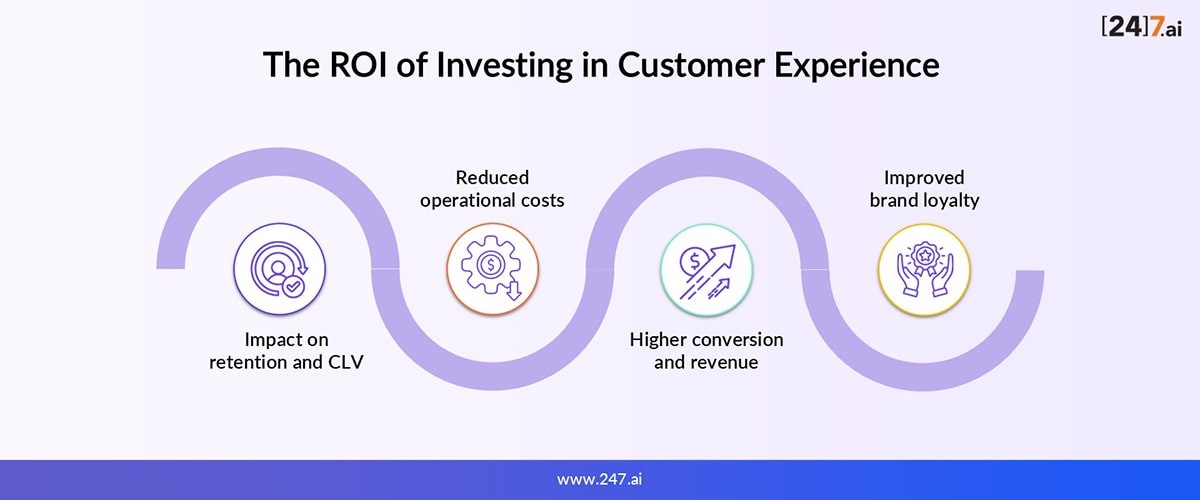
Improving customer experience consistently yields strong returns. Better experiences lead to higher retention, lower service costs, and greater conversion rates. Customers who enjoy interacting with a brand are more likely to return, spend more, and share positive word of mouth. Over time, CX investments compound into measurable financial impact.
How [24]7.ai Enhances Enterprise Customer Experience
[24]7.ai helps large enterprises redefine CX with an AI-first approach. The platform enables:
- AI-driven automation, intent prediction, and personalized engagement
- Omnichannel interactions across voice, chat, messaging, and digital channels
- Real-time agent assist that improves accuracy and reduces handle time
- Advanced analytics that reveal trends, sentiment, and journey bottlenecks
With decades of expertise and a cloud-native architecture, [24]7.ai empowers enterprises to deliver consistent, scalable, and intelligent experiences across millions of interactions.
Explore how [24]7.ai can help you create intelligent, unified journeys at scale.
Frequently Asked Questions
No, service is one part of the overall experience.
Digital usability and communication clarity often shape perceptions most strongly.
Yes. Removing minor friction points can dramatically improve satisfaction.
It makes experiences more relevant, efficient, and memorable.
Continuously, as customer needs and behaviors evolve.