![[24]7.ai](https://www.247.ai/wp-content/uploads/2021/07/247ai-Black.svg)
![[24]7.ai](https://www.247.ai/wp-content/uploads/2024/09/247ai-Black.svg)
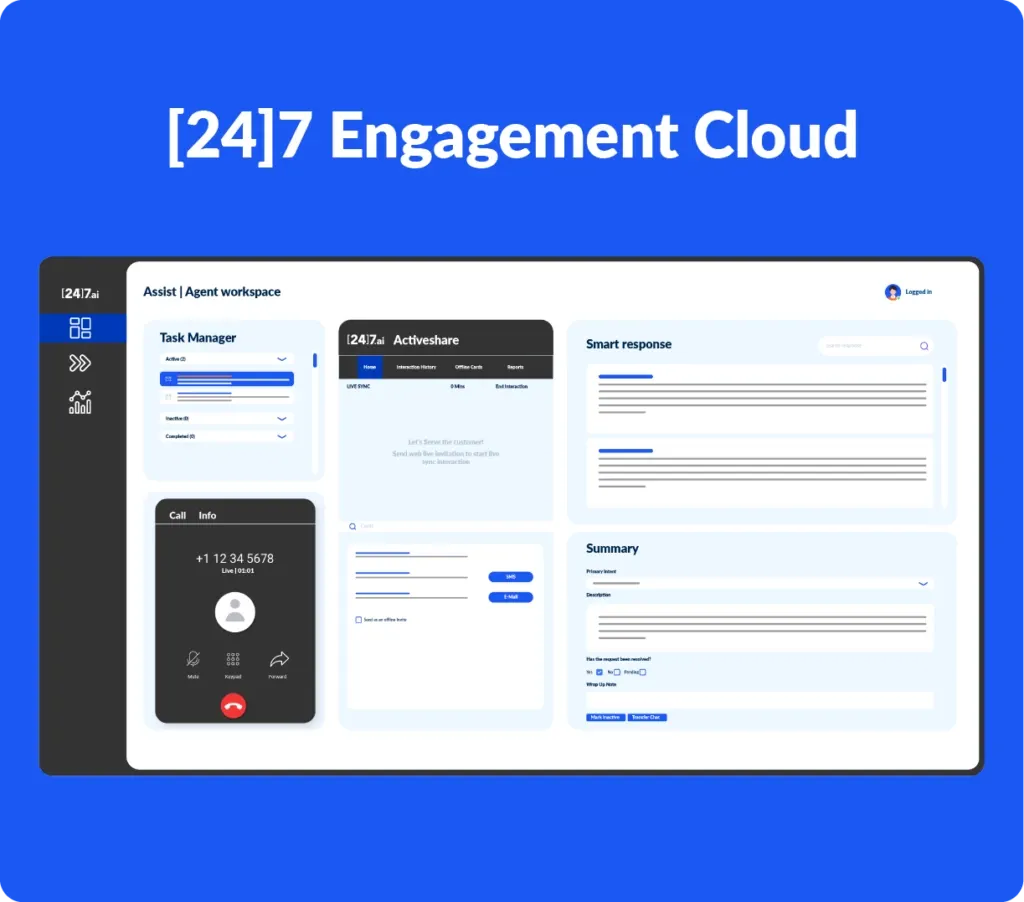
Table of contents
- Introduction
- What is Agent Assist?
- How Agent Assist Works
- Key Features of Agent Assist Solutions
- Benefits of Agent Assist
- Agent Assist vs Traditional Agent Support Tools
- Common Use Cases of Agent Assist
- Challenges and Considerations Before Implementation
- How to Evaluate an Agent Assist Platform
- The Future of Agent Assist
- How [24]7.ai Delivers Intelligent Agent Assist
- Final Thoughts
- FAQs
Customer service conversations have become far more complex than they used to be. Customers often contact support with detailed issues, multiple questions, or problems that require agents to search across several systems before providing a solution. This makes every interaction more demanding for the person on the other side of the call or chat.
At the same time, expectations have increased. Customers expect quick answers, accurate information, and consistent service regardless of which channel they choose. For agents, this creates constant pressure to respond faster while still delivering the right solution.
This is where AI-powered tools are beginning to play a bigger role. One of the most useful among them is agent assist. Instead of replacing human agents, agent assist technology works alongside them, offering real-time guidance, surfacing helpful information, and simplifying routine tasks. As a result, many enterprises are adopting agent assist to support their teams and improve the overall service experience.
What is Agent Assist?
It refers to AI-powered tools that support customer service representatives during live interactions with customers. The technology analyzes conversations in real time and provides helpful suggestions, information, or actions that assist the agent in resolving the issue quickly.
In contact centers, agent assist acts as a digital helper. It listens to conversations, understands customer intent, and offers relevant recommendations to the agent handling the interaction.
It is important to note that agent assist is not the same as full automation. Automation tools such as chatbots aim to resolve issues without human involvement. Agent assist, on the other hand, focuses on improving the effectiveness of human agents by giving them the right information at the right time.
This approach ensures that customer service remains human-led while benefiting from the speed and intelligence of AI.
How Agent Assist Works
Agent assist solutions combine several technologies to analyze conversations and provide useful guidance during customer interactions.
1. Real-Time Transcription and Conversation Analysis
Many agent assist systems begin by converting spoken conversations into text using speech-to-text technology. For chat interactions, the system analyzes the messages directly.
Once the conversation is captured, the platform identifies key topics, detects customer intent, and analyzes sentiment. This helps the system understand whether the customer is asking for help, requesting information, or expressing frustration.
2. AI-Powered Recommendations
Based on the conversation analysis, the platform can suggest helpful responses or actions to the agent.
This may include recommended replies, relevant help articles, or guidance on the next step in the conversation. By surfacing this information instantly, agents no longer need to search through large knowledge bases while a customer waits.
3. Context Awareness and Data Retrieval
Agent assist tools can also retrieve relevant data from integrated systems. For example, the system may automatically display customer details from a CRM, show order history, or highlight recent support tickets.
Having this information immediately available allows agents to understand the situation faster and provide more accurate answers.
4. Workflow Automation
Another valuable capability is workflow automation. Agent assist tools can automatically fill forms, generate support tickets, or summarize the conversation once it ends.
These small automation features reduce manual tasks and allow agents to focus more on helping customers.
Key Features of Agent Assist Solutions
Modern agent assist platforms typically offer several core capabilities:
- Live response suggestions during conversations
- Real-time knowledge base retrieval
- Automated call and chat summaries
- Compliance prompts and guidance
- Sentiment detection to identify frustrated customers
- Integration with CCaaS platforms and CRM systems
Together, these features help agents manage conversations more efficiently while maintaining service quality.
Benefits of Agent Assist
One of the most noticeable benefits of agent assist is the reduction in average handling time (AHT). Because agents receive immediate suggestions and relevant information, they can resolve issues more quickly.
Agent assist also improves first-contact resolution (FCR). When agents have better visibility into customer data and receive helpful guidance during the interaction, the chances of resolving the issue in a single conversation increase.
Another advantage is improved agent confidence. New agents often struggle during their first few months because they need to learn complex systems and procedures. Agent assist tools guide them through conversations, making it easier to deliver accurate support.
Organizations also benefit from more consistent customer experiences and reduced compliance risks, especially in industries with strict communication requirements.
Agent Assist vs Traditional Agent Support Tools
Traditional agent support tools rely on static scripts, knowledge bases, and manual searches. Agents must actively look for information while speaking to the customer, which can slow down conversations.
Agent assist works differently. Instead of requiring agents to search for answers, it delivers the most relevant information automatically based on what the customer is saying.
The difference becomes especially clear in fast-paced environments. Traditional tools react after the agent searches for help, while agent assist provides proactive recommendations that guide the interaction in real time.
Common Use Cases of Agent Assist
Agent assist is valuable in many service scenarios.
In complex support situations, the technology can guide agents through multi-step troubleshooting processes. It ensures that the right steps are followed without forcing agents to memorize long procedures.
In sales conversations, agent assist can recommend personalized offers or products based on customer history and behavior.
Industries with strict compliance requirements, such as finance or healthcare, also benefit from agent assist. The system can remind agents to include required statements or follow specific communication guidelines.
High-volume contact centers use agent assist to maintain consistent service quality across large teams.
Challenges and Considerations Before Implementation
Before implementing agent assist, organizations should consider several factors.
Data quality is important because AI systems rely on historical interactions for training. If the data is incomplete or inconsistent, the recommendations may not be accurate.
Integration is another key factor. Agent assist solutions should connect smoothly with CRM systems, knowledge bases, and other service tools.
Organizations must also support agents during the transition. Proper training and clear communication help teams understand how the technology supports their work.
How to Evaluate an Agent Assist Platform
When evaluating an agent assist platform, businesses should look closely at intent recognition accuracy and how quickly the system provides recommendations.
Integration capabilities are also important, as agent assist must work alongside existing service systems.
Analytics and reporting tools can help organizations measure performance improvements, while strong security and compliance features ensure that sensitive customer data remains protected.
The Future of Agent Assist
Generative AI is making it possible to create smarter digital copilots that help agents craft responses, summarize conversations, and identify the next best action.
Personalization will continue to improve as systems learn from customer history and preferences. Over time, agent assist is expected to become a central part of modern customer experience strategies.
How [24]7.ai Delivers Intelligent Agent Assist
[24]7.ai offers agent assist solutions designed to support contact center teams in real time. Its platform provides AI-driven recommendations, context-aware guidance, and seamless integration with enterprise systems.
By delivering insights during live interactions, [24]7.ai helps agents respond faster, improve accuracy, and maintain consistent service quality across channels.
Final Thoughts
Customer service teams are under increasing pressure to deliver faster and more accurate responses. Agent assist helps address this challenge by giving agents the tools and information they need at the exact moment they need it.
Rather than replacing human agents, agent assist strengthens their capabilities. For organizations focused on improving customer experience while supporting their workforce, it has become an important part of modern service operations.
Frequently Asked Questions
Yes. Most agent assist solutions support voice, chat, email, and messaging channels.
Implementation timelines vary depending on integrations and data preparation, but many organizations can deploy initial capabilities within a few weeks.
Historical interaction data improves accuracy, but many platforms can begin with smaller datasets and improve over time.
Yes. Agent assist systems can be tailored to industry-specific workflows, terminology, and compliance requirements.
Yes. Because most solutions are cloud-based, agents can access agent assist tools from any location.