![[24]7.ai](https://www.247.ai/wp-content/uploads/2021/07/247ai-Black.svg)
![[24]7.ai](https://www.247.ai/wp-content/uploads/2024/09/247ai-Black.svg)
Table of contents
- What Is Dynamic Creative Optimization and Why It Matters for Smarter CX
- The Concept Behind Dynamic Creative Optimization
- How DCO Elevates CX and Engagement
- The Role of AI in Modern DCO
- Real-World Use Case
- Getting Started with DCO: Best Practices for Brands
- The Future of DCO and AI-Powered Advertising
- Conclusion
- FAQs
What Is Dynamic Creative Optimization and Why It Matters for Smarter CX
Personalization has taken center stage in digital marketing as a “name of the game”. Today, customers don’t have the time or bandwidth to engage with ads that are purely generic, they are only interested in content that meets their specific needs, moods and moments.
And this is where DCO or Dynamic Creative Optimization comes in: A cutting-edge process of automatically personalizing ad creatives based on the ‘who’, the ‘when’, and ‘context’ of the ad, in real time by swapping images, headlines, calls to action, or otherwise modifying ad creatives.
Essentially, DCO flips customer experience (CX) from reactive to intelligently proactive. Every impression feels timely, relevant, and personal to that person. Instead of brands pushing messages, brands begin providing moments that matter to the specific customer.

The Concept Behind Dynamic Creative Optimization
Traditional ad creatives are static, a single version built for everyone, regardless of context. But DCO flips that script.
Dynamic Creative Optimization (DCO) systems pull live data (location, device, browsing history, time of day, and even the weather) to dynamically produce the optimal “creative” permutations. For example, a coffee retailer might say to a user on a cold winter’s morning in New York, “Hot Latte near you.” However, that same coffee retailer might talk to a user located in Los Angeles, “Iced Cold Brew to beat the heat.”
Most of these automated systems are designed based on ML or machine learning. Instead of relying on a human being’s informed guess about which creative executions will enhance engagement, DCO algorithms are learning about engagement by continuously testing and learning through machine learning.
Over time, DCO will gradually optimize its creative rationale around messaging, creative, and calls to action based upon the optimal engagement and conversion action around each micro-segment of that audience. To summarize: static ads make assumptions; DCO makes decisions.

How DCO Elevates CX and Engagement
Performance is when personalization and precision meet, and brands who leverage DCO experience meaningful increases across different criteria – whether that’s higher engagement, improved conversion rates, or enhanced customer satisfaction.
For instance, [24]7 Target campaigns have demonstrated an approximately 5.75% increase in CTR and a 3% increase in sales attributed to hyper-personalized creative variations responding to customer behavior as it occurs.
This degree of relevance increases more than just performance metrics; it strengthens relationships. When audiences feel that a brand truly “gets” them both personally and contextually, they perceive the brand as more supportive and relevant.
This connection drives stronger brand loyalty, more efficient ad spend, and deeper engagement throughout the customer journey over time.In an era of digital noise, DCO gives brands the chance to engage in a relevant, contextual way that earns attention rather than demanding it.
The Role of AI in Modern DCO
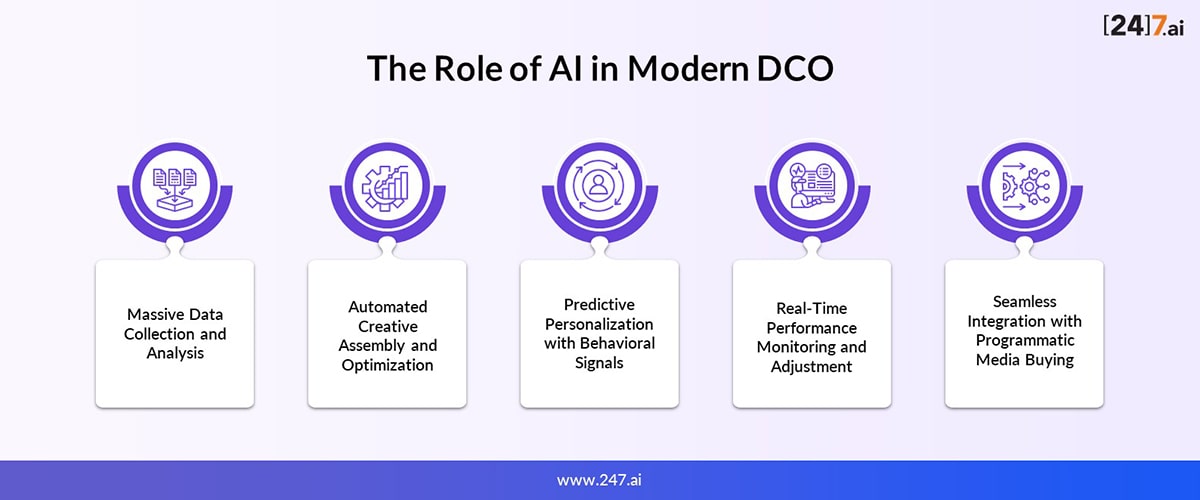
AI is the beating heart of modern Dynamic Creative Optimization. It’s what enables brands to transform thousands of creative assets and billions of data points into meaningful, personalized experiences; all in real time. Here’s how it works in practice:
1. Massive Data Collection and Analysis
AI-based DCO platforms are in a constant cycle of gathering and processing enormous amounts of data, varying from user demographics and browsing activity to contextual indicators like what time of day, where users are, and even weather conditions. This data is analyzed in real time, not just saved for later use, to find behavioral themes and engagement signals. It is at this rate brands can find out the reason certain creatives perform better with certain audiences, and make modifications to their strategies in a dynamic way rather than a reactive way.
2. Automated Creative Assembly and Optimization
Instead of putting together and trying out every ad variant manually, AI systems automate this. They put together ad components, such as headlines, visuals, copy, and CTAs, in the combinations that best engage each viewer. Then machine learning models track the performance across impressions and keep optimizing which creative variants to show next. The model continues to learn over time and makes every campaign a self-learning system that becomes smarter with every impression.
3. Predictive Personalization with Behavioral Signals
Beyond only responding to user activities, AI has advanced to unparalleled levels of predicting what action users will probably take next; predictive models utilize behavioral signals, like browsing activities, purchase intent, and content preference, to calculate what message or offer would be most effective for each individual customer. When a user regularly views fitness-based content on mobile, the system will optimize the ad delivery to only show sportswear creatives on mobile. As a result, all the impressions appear to be personalized to the user.
4. Real-Time Performance Monitoring and Adjustment
AI does not simply activate campaigns and then check out, it continuously audibly tracks the performance of every creative aspect in the wild ASAP. If the engagement declines, or an audience behavior adjustment occurs (examples such as seasonal activity, or a displacing trend in engagement) the system will react in real-time to replace the poor performing element, reallocate budget, and shift impressions where performance is optimal for effectiveness/impact. This closed-loop feedback system ensures that each dollar spent in advertising has the opportunity for lasting positive improvement, and is consistently measured for effectiveness.
5. Seamless Integration with Programmatic Media Buying
AI-powered DCO platforms such as [24]7.ai Target extend their intelligence across channels through programmatic media buying. This indicates that dynamic creatives are not restricted to one advertising platform or network. They can easily reach audiences no matter where they exist on the open web, on social channels, or on any connected screen. For brands, this means being able to enjoy the best of both worlds, leveraging the power of real-time bidding, and creative optimization allows them to get the right resource with scale-enhanced relatable storytelling to the right audiences with precision.
In essence, AI transforms DCO from a tactical marketing tool into a strategic engine for creative intelligence; one that learns, predicts, and personalizes faster than any human team could on its own.
Real-World Use Case
Take PepsiCo, for instance. The brand used a DCO-driven campaign to tailor messages around snack pairings and time-of-day relevance. The result? $1.8 million in incremental revenue and a notable uptick in ad engagement rates.
By dynamically adapting ad copy and visuals such as promoting “Game Night Snacks” on weekends and “Office Break Treats” during weekdays PepsiCo connected with consumers on a more personal level. The outcome highlights a powerful truth: personalized creative storytelling at scale doesn’t just drive clicks, it drives business impact.
Getting Started with DCO: Best Practices for Brands
If you’re ready to make your advertising more adaptive, here are a few practical steps to start with:
1. Integrate first-party and behavioral data securely.
Use customer consented data as the foundation. The more complete your data signals, the smarter your creative optimization becomes.
2. Develop clear creative variations.
Create modular ad components (i.e. images, copy, CTAs) that can be mixed and recombined in performance and context. Tie those to your campaign objective (ie, awareness traffic, engagement, conversion).
3. Establish feedback loops.
Leverage performance analytics to not only hone who you are targeting, but also the actual creative direction. The more feedback you give your system, the better it gets at predicting what works.
When done right, DCO gets to be an extension of your brand voice – continuously learning and changing in tandem with your consumers.
The Future of DCO and AI-Powered Advertising
We are only scratching the surface of what’s possible. DCO is already seeing widespread adoption; a 2024 study found that 82% of advertisers reported using DCO as part of their digital advertising strategy (up from 60% in 2015), and a third planned to increase their use. Yet, this is just the beginning.
The next frontier of DCO will be powered by generative AI, enabling systems to ideate entirely new creative assets, not just optimize existing ones. Imagine a platform that doesn’t just swap headlines but writes them based on customer sentiment, channel tone, or even recent purchase behavior. In conjunction with cross-channel adaptation, your ad creative could dynamically align with the last ad a customer saw, whether on your website or in a chatbot conversation.
This is where DCO meets holistic CX transformation, unifying personalized experiences across ads, web interactions, and contact center engagements. Every touchpoint becomes an opportunity to reinforce brand relevance, intelligently, contextually, and in real time.
Conclusion
Dynamic Creative Optimization is the format that combines creativity and intelligence. It provides a powerful collaboration of AI, data, and design to power hyper-personalized campaigns that enhance performance & measurable effectiveness.
For brands, the message is simple: personalization is not a luxury, it’s a key growth driver. Explore how [24]7 Target can enable you to first, deliver smarter customer experiences and deep engagement, and second, learn how intelligent creative optimization can elevate your brand and burn more impactful experiences for your customers.
Frequently Asked Questions
Not really. While enterprise marketers are usually the early adopters, DCO solutions can be applied at lower settings, especially as AI platforms evolve and automate most of the heavy lifting.
Any behavioral data from first-party data (like browsing behavior) to contextual signals (like weather, location or device). The more robust your data, the more relevant your ads.
A/B testing compares fixed versions manually. DCO, powered by machine learning, runs continuous testing automatically adjusting in real time instead of waiting for human input.
Definitely. Modern DCO systems integrate seamlessly into DSPs, CDPs, and analytics systems to ensure both your creative and audience-level data integrations are unified.
It moves ad personalization from being a static campaign tactic into a living, learning system that is driven by data, human-centered, and always relevant creative.