![[24]7.ai](https://www.247.ai/wp-content/uploads/2021/07/247ai-Black.svg)
![[24]7.ai](https://www.247.ai/wp-content/uploads/2024/09/247ai-Black.svg)
- What is customer service and why is it important for businesses?
- What are the key elements of excellent customer service?
- What are the most common customer service challenges?
- What skills do customer service agents need?
- What is the difference between customer service and customer support?
- How is AI transforming customer service today?
- How do I choose the right customer service software for my business?
- How does customer service impact overall customer experience?
- How can companies reduce customer service costs without lowering quality?
- What performance metrics should customer service teams track?
- Why Customer Service Remains Your Strongest Differentiator
- How [24]7.ai Helps Businesses Modernize Customer Service
- Frequently Asked Questions
Customer Service Explained: Key Elements, Challenges, and the Role of AI
Modern-day customers do not wait, or repeat themselves, and definitely do not entertain slow, complicated service. With interactions shifting rapidly to digital platforms, customer service has transformed from a reactive helpdesk into one of the most powerful levers of brand loyalty and business growth. AI, automation, and omnichannel tools are raising the bar, and companies that adapt are pulling ahead fast.

What Is Customer Service and Why Is It Important for Businesses?
Key Elements of Excellent Customer Service
- Responsiveness: Customers want timely answers across every channel.
- Resolution accuracy: Solving the issue correctly the first time builds trust.
- Personalization: Understanding customer history and tailoring interactions improves satisfaction.
- Empathy and professionalism: How agents communicate matters as much as what they say.
- Consistency: Delivering reliable service across channels ensures a seamless experience.
The Most Common Customer Service Challenges
- Managing high inquiry volumes, especially during peak periods
- Long wait times that frustrate customers
- Repetitive, low-value tasks that slow agents down
- Lack of visibility into prior interactions or customer history
- Variability in service quality across agents or channels
Essential Skills Every Customer Service Agent Needs
- Clear communication to convey information simply and professionally
- Active listening to understand customer needs and expectations
- Problem solving to identify solutions quickly
- Empathy to create positive emotional experiences
- Technical proficiency to navigate software, troubleshoot issues, and manage digital channels
Customer Service vs Customer Support: Understanding the Difference
Customer service focuses on proactive engagement, such as answering questions, guiding customers, and ensuring satisfaction throughout the journey.
How AI Is Transforming Customer Service Today
- Intelligent automation handles routine tasks such as FAQs, order updates, scheduling, or account status.
- Virtual assistants powered by NLP understand natural language and guide customers through self-service.
- Agent assist tools provide real-time suggestions, knowledge snippets, and workflows during live interactions.
- Sentiment analysis helps identify frustrated customers and optimize escalation paths.
Choosing the Right Customer Service Software
- Ability to manage interactions across multiple channels
- Automation and AI capabilities to reduce workload
- Reporting and analytics for visibility into performance
- Seamless integration with CRM, billing, and backend systems
- Scalability, security, and ease of use
The right software becomes the foundation for consistent, data-driven, and efficient service operations.

How Customer Service Influences Overall Customer Experience
What Is Omnichannel Customer Service and How It Works
Reducing Customer Service Costs Without Reducing Quality
- Using automation to handle repetitive inquiries
- Directing customers to efficient channels such as messaging or self-service
- Improving knowledge management to reduce handle time
- Optimizing workforce planning to match staffing with demand
Key Performance Metrics Customer Service Teams Should Track
- First response time (FRT): How fast customers receive an initial reply
- Resolution time: Total time taken to resolve an issue
- Customer Satisfaction Score (CSAT): Direct feedback on service quality
- Net Promoter Score (NPS): The likelihood of recommending the business
- Agent productivity metrics: These include handle time, quality scores, and adherence
Why Customer Service Remains Your Strongest Differentiator
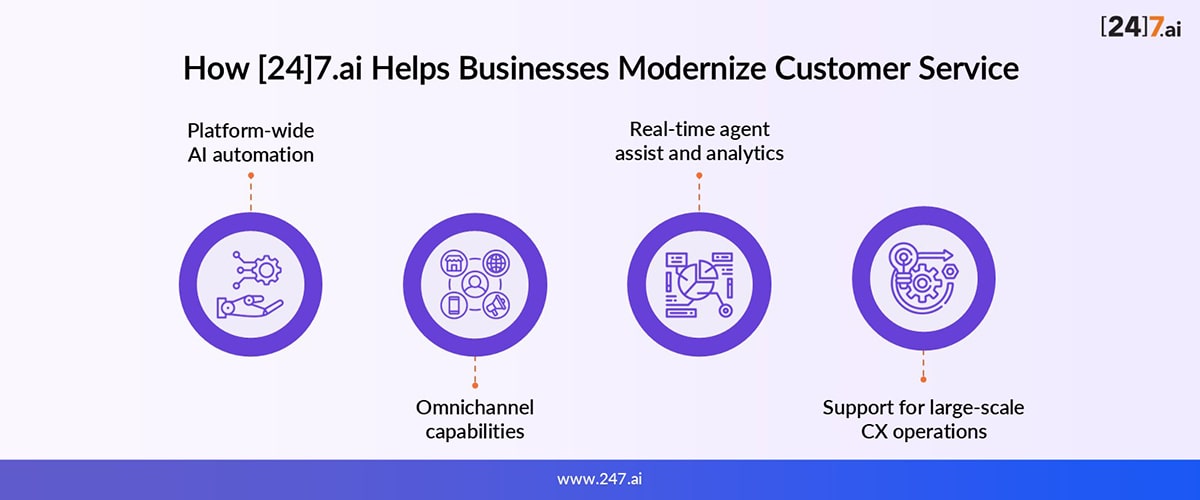
How [24]7.ai Helps Businesses Modernize Customer Service
- End-to-end AI automation for self-service and workflow optimization
- Omnichannel engagement across voice and digital channels
- Real-time agent assist and sentiment intelligence for better resolution outcomes
- Scalable architecture that supports large, complex customer service operations
Explore how [24]7.ai can help you deliver smarter, faster, and more personalized customer experiences.
Frequently Asked Questions
To support customers throughout their journey and ensure satisfaction.
No, AI handles routine tasks while agents focus on complex, high-value interactions.
Voice, chat, messaging, email, social media, and more.
Through CSAT, NPS, resolution time, and other operational metrics.
Yes. Automation and self-service help even smaller teams deliver efficient support.