![[24]7.ai](https://www.247.ai/wp-content/uploads/2021/07/247ai-Black.svg)
![[24]7.ai](https://www.247.ai/wp-content/uploads/2024/09/247ai-Black.svg)
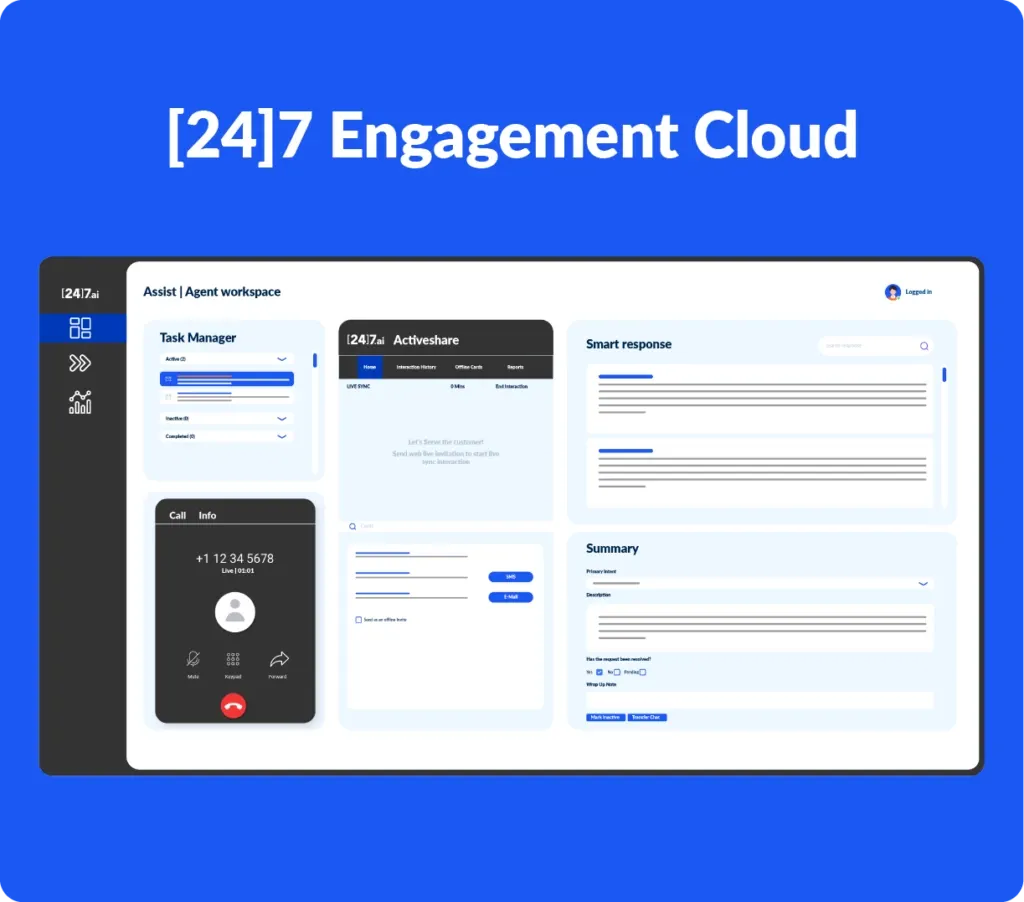
Table of contents
- What is a Customer Experience Platform?
- Why Customer Experience Platforms Matter
- Key Features of a Customer Experience Platform
- Types of Customer Experience Platform
- 5 Best Customer Experience Platforms for Enterprises
- How to Choose the Right CX Platform
- How to Implement a Customer Experience Platform
- Real Results From [24]7 Engagement Cloud
- Frequently Asked Questions About CX Platforms
Customers now expect every interaction with a brand — a support chat, a returns call, a product question on social media — to feel like part of one continuous relationship. Delivering that consistently, at scale, is exactly what a customer experience platform is built to do.
Below, we break down what a CX platform actually does, how the five leading options for enterprises compare, and how to roll one out without disrupting the team you already have.
What is a Customer Experience Platform?
A customer experience platform (CXP) is software that brings together the tools, data, and workflows a business needs to manage customer interactions across every channel — email, phone, chat, social media, and web — in one connected system. Instead of agents and marketers working out of separate, disconnected tools, a CXP gives every team the same real-time view of who the customer is, what they’ve asked for before, and what they need now.
According to Harvard Business Review, winning a new customer typically costs five to 25 times more than keeping an existing one. That single fact is why CX platforms have moved from a support add-on to a core piece of the enterprise technology stack — they’re built specifically to protect the customer relationships companies have already paid to earn.
Why Customer Experience Platforms Matter
- Omnichannel consistency — Customers get the same accurate answer whether they're on chat, phone, or Instagram, because every channel pulls from the same system.
- One unified customer view — Sales, support, and marketing stop working from separate spreadsheets and finally see the same customer history.
- Higher satisfaction — Agents resolve issues faster when customers aren't repeating themselves at every handoff.
- Real-time insight — Leaders see behavior and sentiment trends as they happen, not weeks later in a quarterly report.
Key Features of a Customer Experience Platform
- Omnichannel engagement — one consistent conversation across every channel a customer uses.
- Customer data integration — every touchpoint feeds a single, unified customer profile.
- Personalization — content, offers, and responses tailored to each customer's history and intent.
- Analytics and insights — real-time reporting that turns raw interactions into decisions.
- Automation and AI — AI-driven routing, virtual agents, and copilots that speed up resolution.
- Application integrations — plugs into the CRM, helpdesk, and telephony tools already in use.
- Survey and feedback tools — built-in NPS and CSAT capture that closes the feedback loop automatically.
- Revenue impact — better experiences translate directly into retention, upsell, and lifetime value.
Types of Customer Experience Platforms

- Cloud-based experience platforms — SaaS platforms built for distributed teams to manage CX from anywhere, scaling up or down as the business grows.
- Contact center platforms — purpose-built for support teams handling high call and message volumes, with routing, history, and analytics built in.
- Self-service platforms — chatbots and knowledge bases that let customers resolve routine questions, like order status or return policy, without an agent.
- AI-powered experience platforms — virtual agents and agentic AI that understand intent, resolve issues, and personalize interactions with minimal human input.
5 Best Customer Experience Platforms for Enterprises
| Rank | Platform | Best For | Key Capabilities |
| 1 | [24]7.ai Engagement Cloud | AI-native omnichannel CX built on contact center expertise | Conversational AI & intent prediction, [24]7 Copilot for agents, campaign management, conversational intelligence, pre-built CRM/telephony integrations |
| 2 | Genesys Cloud CX | Large-scale omnichannel contact centers | AI-powered routing, workforce engagement management, journey orchestration, cloud-native architecture |
| 3 | Salesforce (Agentforce Service) | Enterprises already standardized on Salesforce CRM | Native voice, Agentforce AI agents, CRM-embedded case management, Data Cloud personalization |
| 4 | Qualtrics XM | Enterprise experience-management programs centered on feedback | Omnichannel feedback collection, text/sentiment analytics, 128+ data source integrations, role-based dashboards |
| 5 | Zendesk | Support teams wanting fast deployment and a large app ecosystem | AI agents (Autonomous Service Workforce), unified agent workspace, SLA/routing controls, 1,000+ integrations |
1. [24]7.ai Engagement Cloud
[24]7 Engagement Cloud is the only major CX platform built from the ground up on contact center expertise, and that shows up in how it’s designed: every feature is built around what actually shortens a customer’s time to resolution. Its conversational AI understands intent across voice and digital channels, so customers rarely have to repeat themselves, and [24]7 Copilot gives agents real-time suggested responses, training, and coaching without pulling them into a separate tool. Campaign management and conversational intelligence sit on the same platform as the agent console, so marketing, service, and analytics teams work from one shared view of the customer instead of stitching data together after the fact.
It plugs directly into Salesforce, Microsoft, Zendesk, and other systems already in use, meets enterprise security standards including PCI DSS and HIPAA, and has driven measurable results for enterprise brands — including an 84% CSAT increase and a 32% containment rate for one U.S. retailer. For enterprises that want AI-driven CX without months of custom integration work, it’s the strongest all-around fit on this list.
Learn more or schedule a demo of [24]7.ai Engagement Cloud.
Genesys Cloud CX is built for enterprises running large, high-volume contact centers — think hundreds or thousands of agents across voice, chat, and email. Its workforce engagement management tools forecast staffing needs and auto-generate schedules, while AI-powered predictive routing matches each customer to the agent most likely to resolve their issue on the first try.
Salesforce’s CX offering, now branded Agentforce Service (formerly Service Cloud), builds customer experience directly on top of the Salesforce CRM. Case management, interaction history, and Agentforce’s AI agents all live in the same data model as sales and marketing, which makes it a natural choice for organizations already running Salesforce. Native voice capabilities, added in 2026, cut down on the need for separate telephony integrations.
Qualtrics XM leans into the measurement side of customer experience. It collects feedback across more than 128 sources, applies AI-driven text and sentiment analysis to open-ended responses, and rolls everything into role-based dashboards built for enterprise-scale reporting. It’s a strong fit for organizations running structured, survey-driven experience programs across customer, employee, and brand experience at once.
Zendesk’s reputation is built on ease of deployment: its unified agent workspace, ticketing system, and 2026 rollout of AI agents (branded the Autonomous Service Workforce) let support teams get up and running faster than most enterprise alternatives, backed by one of the largest app marketplaces in the category. It covers email, chat, voice, and social in one workspace with granular SLA and routing controls.
How to Choose the Right CX Platform
- Business objectives — confirm the platform solves today's problem and can scale for tomorrow's.
- Feature parity — check it matches, or beats, what competitors in your category already offer.
- Customer data mapping — data from every touchpoint should surface in one place for agents.
- Track record — look for proven deployments in your industry, not just companies your size.
- AI capabilities — native AI, not a bolt-on, determines how much automation you'll actually get.
- Reporting depth — dashboards should serve agents, supervisors, and executives differently.
- Cost — compare total cost of ownership, not just the sticker price.
- Scalability — confirm it can add channels, users, and integrations as you grow.
How to Implement a Customer Experience Platform
- Define clear goals and KPIs — decide upfront whether you're optimizing for CSAT, containment, cost per contact, or all three, so success is measurable from day one.
- Audit your current journey and stack — map every existing touchpoint and tool before migrating anything, so you know exactly what the new platform needs to replace or connect to.
- Build a phased rollout plan — break the deployment into stages with clear owners and deadlines rather than attempting a single "big bang" launch.
- Migrate and integrate data — connect the CXP to your CRM, helpdesk, and telephony systems, and clean up customer data as it moves rather than migrating errors along with it.
- Train agents and stakeholders — run hands-on training before go-live and gather feedback early; adoption fails more often from a lack of buy-in than from bad software.
- Pilot before you scale — launch with one team, channel, or region first, fix what breaks, then expand.
- Monitor and optimize continuously — track your KPIs from step one and keep tuning workflows, routing rules, and AI models after launch, not just before it.
Real Results From [24]7 Engagement Cloud
Introducing [24]7 Engagement Cloud

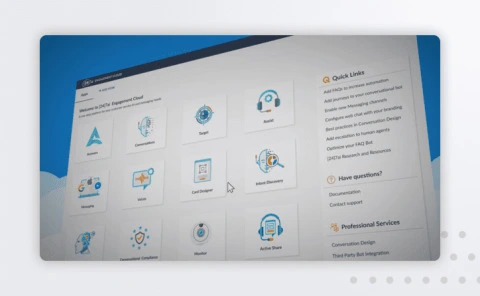
[24]7 Engagement Cloud is a Customer Care As A Service (CCaaS) platform built on deep contact center expertise, leveraging intelligent AI that delivers frictionless customer and agent experiences. The result: peak performance, elevated brand image, and lasting customer loyalty. It’s the perfect platform for delivering on your CX promises.
Success By Numbers
Customer Experience Platform Examples

A U.S. warehouse club operator achieved an 84% CSAT score and a 32% containment rate after adopting [24]7.ai's managed customer engagement.

A sportswear brand saved $1.3 million annually after streamlining its customer service with [24]7.ai's digital CX solutions.
Customer experience is now a competitive differentiator, not a back-office support function. Forbes contributor Michael Podolsky has pointed out that 89% of consumers say a bad experience shapes their purchasing decisions, while only 49% believe companies are actually delivering good ones (Forbes) — a gap most competitors still haven’t closed.
The organizations that close it first, with the right platform and a clear rollout plan, are the ones that turn one-time buyers into long-term customers. [24]7 Engagement Cloud was built to help enterprise teams do exactly that — from the first interaction to the tenth renewal.