![[24]7.ai](https://www.247.ai/wp-content/uploads/2021/07/247ai-Black.svg)
![[24]7.ai](https://www.247.ai/wp-content/uploads/2024/09/247ai-Black.svg)
Each customer engagement, whether in a voice call, chat or email, is filled with opportunity. Every customer engagement, be it a voice call, chat, or email, holds immense opportunity. Every interaction goes beyond words; it carries emotion, intent, and expectation. Given that almost 80% of customer touchpoints nowadays are digital, companies are sitting on unknown insights, and the biggest risk of not understanding these insights leads to opportunities being missed to better the experience, loyalty and/or growth.
What is Conversation Analytics?

Conversation analytics uses Artificial Intelligence and Natural Language Processing (NLP) to understand what customers want, how they feel, and their expectations as they engage with brands. Fundamentally, it’s about understanding what might otherwise go unnoticed, such as why someone says, “I’m not happy.” It also involves finding the signal in a conversation about buying a product or recognizing tension in a service call before it spirals out of control.
This covers all channels – voice calls, live chat, messaging apps, social media, and email. Because it is omnichannel, it ensures nothing will go unnoticed, and there is no way to do a manual review to keep up with pure volume today. In comes AI – scalable, tireless, and attuned to subtle signals.
How Conversation Analytics Works
Let’s zoom in on the process step by step:
- Data Capture: All engagements, from phone calls to digital conversations, are either recorded or transcribed into text. Advanced recorders will convert content (or conversations) into text allowing searching of content for later analysis.
- NLP & Sentiment Analysis: Natural Language processing goes deeper than simply coded key phases and captures the emotional state of callers and customers for example, whether they signal frustration or excitement or confusion while on the line or in the text-base chat.
- Pattern Recognition: Machine learning analyzes millions of lines of dialogue, identifying patterns of repeated behavior and patterns or cues that a key phase search could miss altogether. Patterns could be pacing of a call or phrases that are favorable or unfavorable or phrases or words that have contextual meaning have significance.
- Insight Generation: The magic happens here. Data transforms into crystal-clear dashboards, surfacing high-impact insights around agent performance, customer trends, and emerging friction points. With seamless CRM and contact center integration, those findings drive dynamic changes, fast.
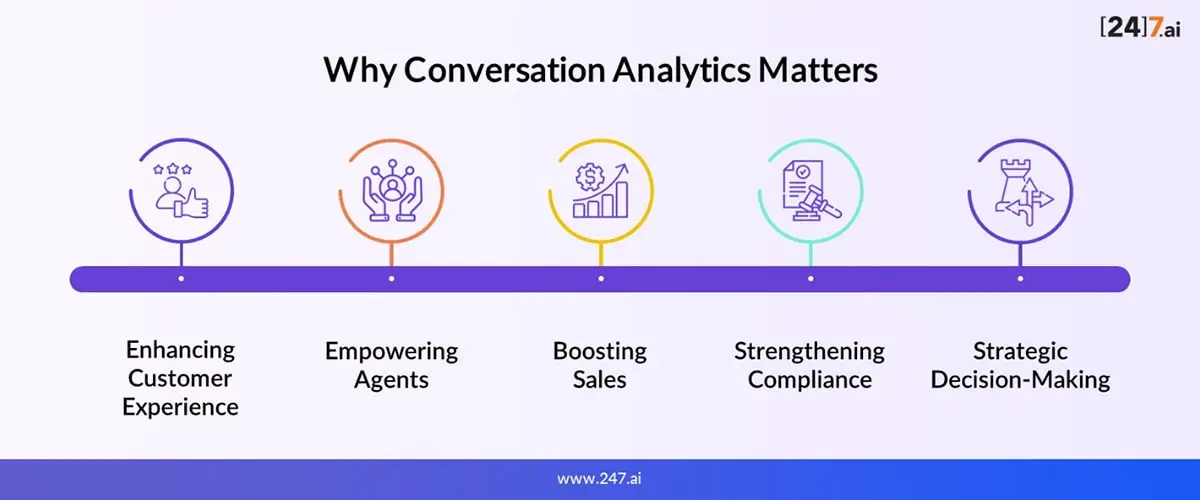
Why Conversation Analytics Matters
What conversation analytics does for brands looking for an authentic CX advantage:
- Enhancing Customer Experience: Pinpointing pain points immediately provides businesses the capability to deliver proactive, personalized support. The customer feels heard; frustrations get addressed prior to escalation.
- Empowering Agents: By analyzing empathy, tone, and phrasing, AI can coach agents to be more human and effective and spotlighting what works and where improvement will truly matter, not just box-ticking performance reviews.
- Boosting Sales: The right conversation reveals buying intent. Conversation analytics helps surface upsell chances and tailor scripts for straight-up conversion gains.
- Strengthening Compliance: Automatic flagging for policy breaches and sensitive topics means reduced risk and regulatory peace of mind.
- Strategic Decision-Making: CX executives see the full story; 360° sentiment, emerging trends, actionable feedback to build better products and smarter strategies.

Real-World Applications
Brands across industries are leveraging conversation analytics for competitive advantage:
- Banking & Finance: Fraud signals jump out in call patterns and tone, allowing early intervention.
- Retail & E-commerce: Post-purchase conversations inform delivery enhancements and support models.
- Healthcare: Sentiment cues alert teams to patient distress before it escalates.
- Travel & Hospitality: Guest feedback steers loyalty programs and personalizes next-stay perks.
How [24]7.ai is Raising the Bar
At [24]7.ai, conversation analytics is foundational, not just a shiny add-on. Proprietary AI and NLP fuel analysis of millions of exchanges across voice and digital. The platform instantly detects sentiment and intent, equipping agents to respond with empathy, accuracy, and genuine context.
Prediction is another win: Pinpointing churn risks or identifying new cross-sell opportunities as the conversation unfolds.

Getting Started: Your Roadmap
Unlocking the value of conversation analytics isn’t complex:
- Audit your interactions: Track your customer interactions across video recordings, chat logs, and social media posts to understand the conversations.
- Define success metrics: Nail down which numbers move the needle, CSAT, NPS, resolution time, customer intent trends.
- Integrate intelligent tools: AI-powered CX Platforms can bridge gaps seamlessly, feeding insights directly to your CX ecosystem.
- Put insights to work: Use data for focused agent training, CX boost, and revenue acceleration, not just reports for reports’ sake.
Final Thoughts
Every customer conversation tells a story if you’re ready to listen with more than just ears. AI in conversation analytics doesn’t replace people, it amplifies their power to understand, anticipate, and act. Businesses that embrace this shift are stacking empathy and intelligence into every customer touchpoint. With [24]7.ai’s platform, those stories turn into action and action turns into measurable impact.
Frequently Asked Questions
Voice calls, chats, emails, social messages, essentially any customer interaction channel.
Absolutely not. Marketing, sales, and product teams all benefit from understanding customer sentiment and intent.
AI and NLP enable near real-time delivery often as the conversation is happening.
No, conversation analytics empowers agents, guiding them to sound more empathetic and make smarter choices that boost CX.
Yes. [24]7.ai’s platform seamlessly connects with leading CRM and contact center tools such as Salesforce, Microsoft, Zendesk, Twilio, Blueprism, TensorFlow, Deepgram, Dialogflow, Calabrio, and more.