![[24]7.ai](https://www.247.ai/wp-content/uploads/2021/07/247ai-Black.svg)
![[24]7.ai](https://www.247.ai/wp-content/uploads/2024/09/247ai-Black.svg)
Do you recollect how customer experience used to be pretty straightforward.
You asked a question, someone replied, problem solved.
Well, that doesn’t cut it anymore.
Now people expect quick replies, smooth conversations, and something that actually feels personal. They don’t want to wait. They don’t want to explain things twice. And they definitely don’t want copy-paste answers.
This is where generative ai customer experience really starts to matter.

What does generative AI actually mean here?
In simple terms, generative AI creates responses on the spot. It doesn’t just pull from a fixed script. It looks at the situation and builds an answer that fits.
Think of it like a really sharp assistant who understands context and responds instantly.
When it’s done right, generative ai customer experience feels natural. Like you’re having a real conversation, not talking to a system.
Why customer experience needs a reset
A lot of companies are still doing things the old way. Long wait times, generic replies, and systems that don’t talk to each other.
You have seen it, maybe you have even dealt with it recently.
The truth is, teams can’t keep up manually. There are too many customers and too many interactions.
That’s where generative ai customer experience comes in. It helps teams handle scale without making things feel cold or robotic.
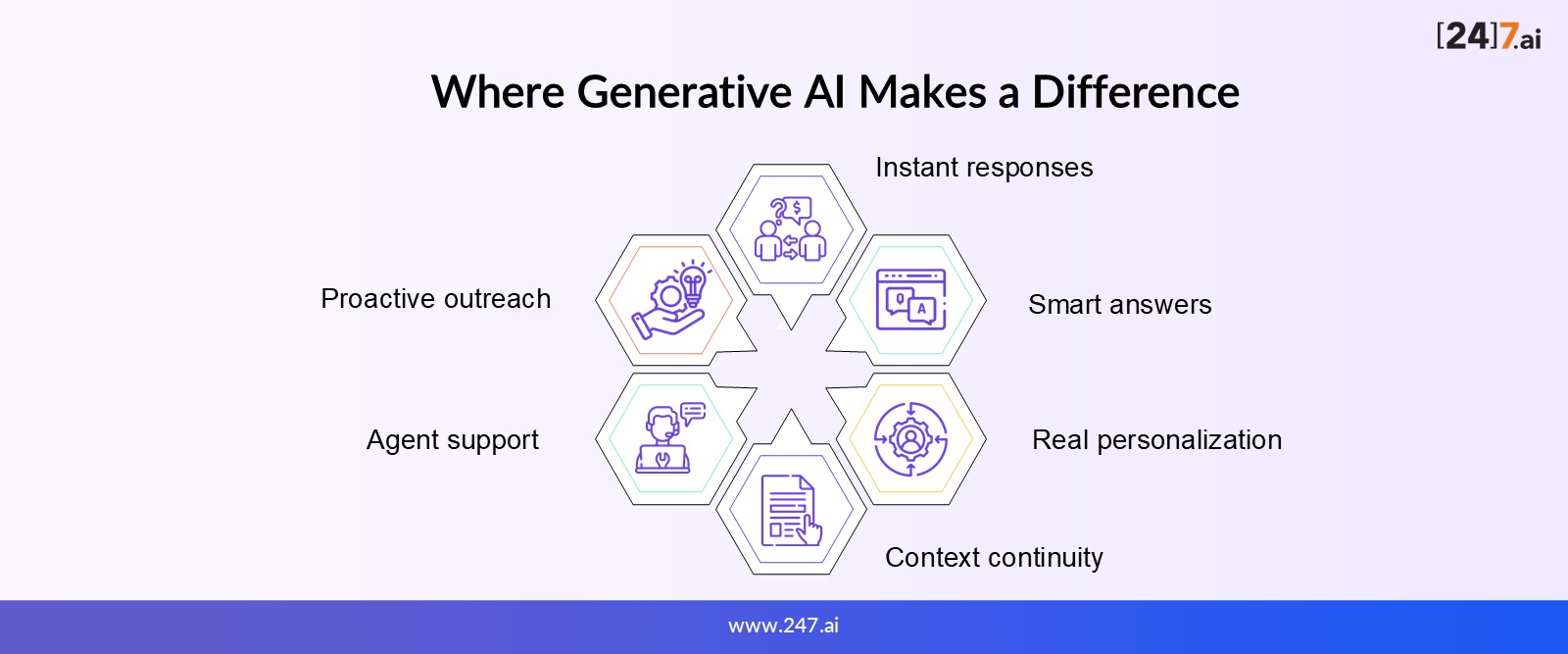
Where generative AI actually makes a difference
The first thing you notice is speed. You ask something, and you get a response right away. But it’s not just fast. It’s useful. It answers your question clearly. That alone makes generative ai customer experience feel better.
Then there’s personalization!
Not the fake kind where your name is added to a generic message. Real personalization. The kind where the response actually reflects your situation. That’s a big shift, and it’s one of the strongest parts of generative ai customer experience.
It also fixes a common frustration. Switching channels. You start on chat, then move to email, and suddenly you have to explain everything again. With generative AI, that context can carry over. The conversation just continues. That makes the whole generative ai customer experience feel smoother.
Support teams benefit too. Instead of typing the same answers all day or digging through systems, they get suggestions and summaries instantly. That frees them up to focus on solving real problems. And when that happens, customers feel the difference.
Another big change is being proactive. Instead of waiting for customers to complain, businesses can reach out first. A delayed update, helpful reminder or a quick solution before things go wrong. This is where generative ai customer experience starts to feel almost effortless.
What makes it work (and what doesn’t)
Not every AI setup works well. You have probably come across some that feel frustrating. The ones that work keep things simple. They focus on real use cases instead of trying to do everything at once.
They also don’t remove people from the process completely. Sometimes you need a human. That balance matters.
And then there’s data. If the system isn’t trained properly, the responses won’t be helpful. Good input leads to better output. That’s the backbone of any strong generative ai customer experience.
Common mistakes to avoid
A lot of companies rush into this. They try to automate everything in one go, and it ends up feeling messy.
Another mistake is ignoring feedback. If customers aren’t happy, that’s the first signal something needs fixing.
And then there’s over-automation. Some interactions need empathy. You can’t automate everything. Knowing where to draw the line is key to building a good generative ai customer experience.
What this looks like in real life
Imagine, you ask about a delayed order. Instead of a vague reply, you get a clear update, a new delivery date, and maybe even a small gesture to make up for it.
It takes seconds. No follow-ups. No frustration.
That’s what a good generative ai customer experience feels like. Easy, clear, and helpful.

The bigger picture
Customer experience isn’t just about support anymore. It shapes how people see your brand.
If the experience is smooth, people come back. If it’s frustrating, they don’t.
Generative AI doesn’t replace human connection. It supports it. It removes friction so conversations can actually flow. That’s why generative ai customer experience is quickly becoming the new normal.
Final thoughts
This isn’t about chasing trends or jumping on the next big thing. It’s really about making life easier for your customers in ways they actually notice. When replies are quick, conversations feel natural, and there’s less effort on their side, the whole experience just feels right.
That’s what people remember. And when you get it right, generative ai customer experience quietly does exactly that. It removes friction, improves interactions, and makes everything flow the way it should.