![[24]7.ai](https://www.247.ai/wp-content/uploads/2021/07/247ai-Black.svg)
![[24]7.ai](https://www.247.ai/wp-content/uploads/2024/09/247ai-Black.svg)
- Introduction
- What Are AI-Powered BPO Services?
- How AI-Powered BPO Services Work
- Key Benefits of AI-Powered BPO Services for Medium Enterprises
- What to Look for in an AI-Powered BPO Provider
- AI-Powered BPO vs. Traditional Outsourcing
- Common Use Cases of AI-Powered BPO Services
- Challenges Medium Enterprises Should Consider
- How to Choose the Right AI-Powered BPO Partner
- Why [24]7.ai Is a Strong Choice for AI-Powered BPO Services
- Final Thoughts
- Frequently Asked Questions
Top AI-Powered BPO Service Providers for Medium Enterprises
If you’re an IT or operations manager at a mid-sized company, you already know the pressure. Your support systems are being asked to do more. Your team is stretched. And leadership wants results without a bigger budget.
The traditional outsourcing model was never really built for this situation. You’d hand things off to a BPO vendor, get a team of agents reading from a script, and spend more time managing the vendor than actually improving anything. It was frustrating, and deep down everyone knew it wasn’t sustainable.
That’s why AI-powered BPO has become such a practical option for companies like yours. It’s not a silver bullet. But when it’s set up properly, it genuinely takes pressure off your team, improves the customer experience, and gives you more control, not less.
What Are AI-Powered BPO Services?
At its core, it’s outsourcing that runs on intelligent technology rather than just headcount. With a traditional vendor, more volume meant more agents, more cost, and more things to manage on your end. AI-powered providers work differently. The technology handles a large chunk of the workload automatically, and you’re measured on actual outcomes. Was the issue resolved? How quickly?
Did the customer have to call back?
For ops and IT teams, this matters because you’re not just offloading work. You’re getting a system that connects to your existing infrastructure, gives you real visibility into what’s happening, and doesn’t require you to hire three new people every time volume goes up.
How AI-Powered BPO Services Work
- Intelligent Automation: The repetitive, rules-based stuff gets handled without anyone touching it. Data entry, routine back-office tasks, standard requests. It just gets done.
- Conversational AI and Virtual Agents: Not the frustrating bots that send customers in circles. These actually understand what someone is asking and can resolve most common issues across chat and voice without escalating. Your team stops being the first line for everything.
- Human and AI Collaboration: When something genuinely needs a person, the handoff happens naturally. The human agent picks up with full context already in front of them. No dropped information, no starting over. Customers barely notice the transition.
- System Integration: This is where IT teams tend to have the most questions, and rightly so. A proper AI BPO connects directly into your CRM, helpdesk, billing platform, whatever you're running. It's not a separate island. It works with what you already have.
Key Benefits of AI-Powered BPO Services for Medium Enterprises
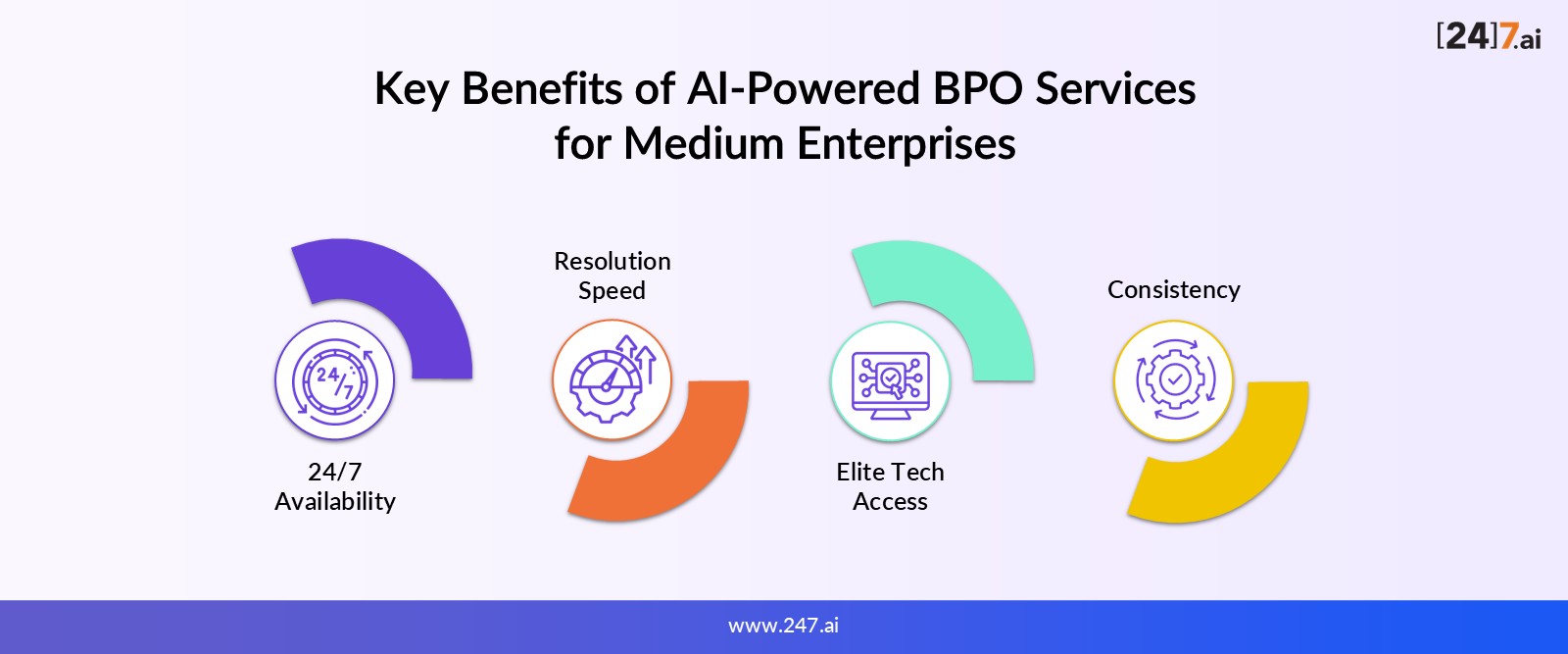
- 24/7 Availability: Coverage across time zones without building out a shift structure yourself or dealing with offshore staffing logistics. The system handles it.
- Resolution Speed: When AI responds instantly instead of putting someone in a queue, customers notice. Your CSAT numbers reflect it pretty quickly.
- Elite Tech Access: The AI infrastructure behind a good BPO partner is genuinely sophisticated. Building something equivalent in-house isn't realistic for most mid-sized companies. This gives you access without the multi-year build.
- Consistency: Your team has good days and bad days. Processes drift over time. AI doesn't have that problem. Every interaction follows the same standard, which makes quality a lot easier to maintain.
What to Look for in an AI-Powered BPO Provider
- Maturity: Ask for case studies from companies of similar size and complexity. A good demo is easy to produce. Real results from real deployments are what tell you if the technology actually works.
- Pricing Flexibility: Your needs will change over the next year or two. A contract that doesn't account for that will become a problem. Look for something that can flex as your business does.
- Security and Compliance: Know exactly what standards apply to your data and make sure the vendor meets them. SOC2, HIPAA, GDPR. Confirm it in writing, not just in a sales conversation.
- Integration Ease: Ask for a realistic timeline on how long their integration actually takes. This is where vendor estimates and reality often diverge the most. Push for specifics.
AI-Powered BPO vs. Traditional Outsourcing
Traditional outsourcing scales by adding people. That means costs go up linearly with volume, quality gets harder to control as teams grow, and you end up spending more time managing the vendor than you expected.
AI-powered BPO breaks that pattern. The metric shifts entirely. Old providers asked how long each call took. AI-first providers ask how many issues were resolved without a call at all. For ops managers, that distinction changes everything about how you measure and manage the relationship.
Common Use Cases of AI-Powered BPO Services
- Omnichannel Support: Chat, email, social media, voice all flowing into one unified system instead of being managed as separate queues. Ops teams tend to find this one particularly relieving.
- Order and Billing Servicing: High volume, mostly straightforward. Automating returns, tracking updates, and payment queries frees up a significant chunk of your team's time without any drop in quality.
- Lead Qualification: AI screens inbound leads before they reach your sales team. Your salespeople spend time on conversations that are actually worth having.
- Technical Troubleshooting: Step-by-step issue resolution for common problems, without routing every single request to a live agent. Reduces ticket volume noticeably.
Challenges Medium Enterprises Should Consider
- Data Governance: You're giving a third party access to customer data. As the IT or ops manager, you need to understand exactly how that data is handled, where it lives, and what happens if something goes wrong. Read the fine print.
- System Silos: If your internal data is inconsistent or siloed, the AI will struggle to perform well. Cleaning that up before you start pays off significantly.
- The Hand-Off Point: Getting the balance right between automation and human involvement takes some tuning. Too much automation and customers hit a wall at the wrong moment. Too little and you're not getting the efficiency you're paying for. Plan for iteration.
How to Choose the Right AI-Powered BPO Partner
Start with a pilot, and pick something specific. Order status queries, billing questions, something that comes up constantly but doesn’t require a lot of judgment to resolve. Run it properly, measure it honestly, and use it to evaluate not just the technology but how the vendor actually operates when things don’t go perfectly.
Pay attention to whether the AI is genuinely improving over time. A system that learns and adapts is fundamentally different from one running static scripts. That difference shows up clearly within the first few months of a pilot.
Why [24]7.ai Is a Strong Choice for AI-Powered BPO Services
We built [24]7.ai for companies that are past the startup stage but still moving fast. Not enterprises with decades of legacy infrastructure, and not small teams figuring things out as they go. Businesses in the middle, where the operational complexity is real and the margin for error is smaller.
Our platform connects to what you already have. It improves with use. And it gives IT and ops teams actual visibility into what’s happening rather than just a monthly report from a vendor. We’ve been through enough of these implementations to know where things tend to break down, and we’ve built the process around avoiding those moments.
Final Thoughts
AI-powered BPO has moved well past being a buzzword. For mid-sized companies, it’s becoming one of the more sensible operational decisions you can make when you’re trying to grow without everything getting harder to manage at the same time.
The right partner matters more than most people realize going in. Not just for how your support operation runs today, but for how your whole team handles the next stage of growth. That’s worth getting right.
Frequently Asked Questions
You handle more volume without adding proportional headcount. The efficiency you gain gets reinvested in the parts of the business that actually drive growth.