![[24]7.ai](https://www.247.ai/wp-content/uploads/2021/07/247ai-Black.svg)
![[24]7.ai](https://www.247.ai/wp-content/uploads/2024/09/247ai-Black.svg)
Customer support has traditionally been managed with one goal in mind: greater efficiency at lower cost. Keep handle times down. Deflect more calls. Reduce the number of people needed to manage the queue. But that way of thinking is becoming outdated. The better question today is: How much revenue and growth are businesses leaving on the table when poor support forces customers to repeat themselves, chase answers, and work too hard to get issues resolved?
PwC found that 52% of consumers have stopped using or buying from a brand after a bad experience with its products or services, while 29% have walked away because of poor customer experience specifically. So, support isn’t just what happens after a sale. It influences whether there’s another sale, whether a customer stays, and whether a frustrating moment turns into lost revenue or a stronger relationship.
AI makes this shift from service function to revenue driver particularly important. Businesses can now improve the economics of service while using customer interactions to protect revenue, strengthen loyalty, uncover opportunities, and create growth.
How Is AI Turning Customer Support into a Growth Driver?
We’ve clearly moved beyond the chatbot stage. AI is now showing up across the service journey end-to-end: self-service, agent assistance, conversation intelligence, and increasingly, autonomous orchestration.
But adopting more AI isn’t the goal. Customers don’t care how sophisticated the technology behind the interaction is. They care about getting an answer quickly, avoiding repetition, resolving their problem, and feeling like the brand understands what they need. That makes the business case for AI bigger than cost reduction.
Remove a point of friction and you help protect a relationship. Speed up a resolution and the odds of losing that customer go down. Give a conversation better context, and it can become a chance to retain, cross-sell, renew, or convert. The real opportunity is to use AI to make service easier for customers while increasing the value of each interaction for the business.
How Can Conversation Automation Drive Customer Growth?
Good self-service should feel like the shortest route to an answer. That requires more than an FAQ bot matching keywords. Customers describe problems in their own words. They switch channels, change direction, ask follow-up questions, and expect the system to understand their intent and context. This is where conversation automation earns its value.
Across voice and digital channels, conversational and generative AI can handle routine requests, guide customers through common journeys, and resolve more issues without making people wait for an agent. The operational benefits are clear: greater containment, lower service costs, and less repetitive work for agents.
For example:
- One global airline uses [24]7.ai’s natural-language IVR across more than 36.6 million annual voice interactions, achieving a 35% containment rate and a 60% resolution rate. Customers can self-serve across journeys including flight information, loyalty programs, and baggage inquiries.
- A leading U.S. insurer automated routine journeys including claims filing, deductible checks, and policy queries, reaching 25% containment while freeing agents to concentrate on more complex, higher-value interactions.
Done well, conversation automation removes friction from customer journeys at scale, helping protect loyalty while making it easier for customers to keep doing business with you.
How Do AI Copilots Help Customer Service Agents Drive Growth?
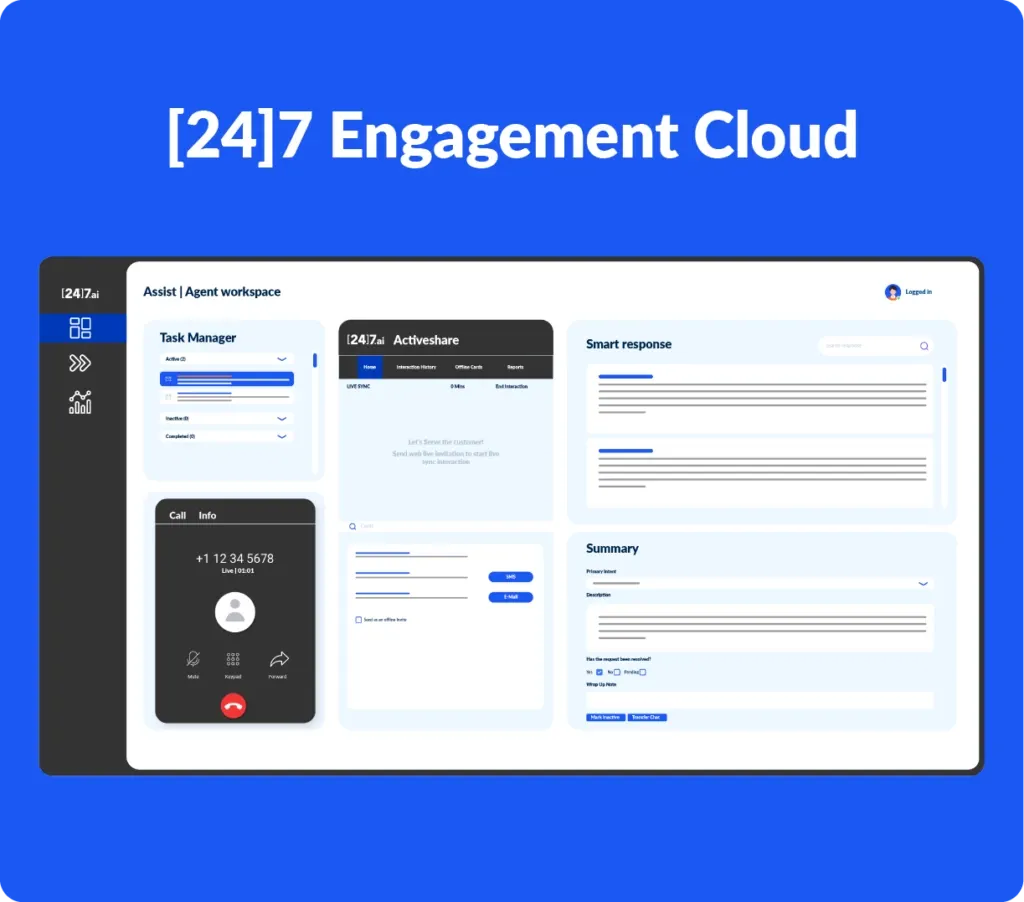
Some conversations need judgement, empathy, or creative problem-solving. When those interactions reach a human agent, AI can work alongside them. An AI copilot can bring together customer context, surface relevant knowledge, recommend next-best actions, summarize conversations, and help agents respond faster and more consistently. That improves productivity. But the bigger opportunity is what better-equipped agents can do with the interaction. A customer calling about a billing issue might also be considering cancellation. Someone asking about a product could be ready to buy. A frustrated subscriber may be recoverable if the agent understands their history and has the right retention option available immediately.
Without context, those are just support contacts. With the right AI assistance, they can become retention, conversion, and relationship-building opportunities. Copilots can help agents recognize those moments and respond appropriately, whether that means saving a customer at risk, recommending a relevant product, resolving a problem before it becomes churn, or giving a high-value customer a better experience.
That’s a different way of looking at agent productivity. The question is no longer just, “How many interactions can an agent handle?” It becomes, “How much customer value can each conversation create or protect?” That’s where the old boundary between the contact center as a cost center and as a growth channel starts to disappear.
How Can Conversation Intelligence Turn Support Data into Growth Insight?
There’s another part of customer support that businesses routinely underestimate: the conversations themselves. Customers are constantly telling companies what’s confusing, what’s broken, why they’re cancelling, what competitors are offering, where a purchase journey failed, and what they wish the product did differently. That’s valuable growth intelligence hiding inside everyday service interactions.
Conversation intelligence analyzes interactions at scale and identifying intent, sentiment, recurring friction points, emerging customer needs, and patterns in agent performance across voice and digital channels. By turning thousands of conversations into actionable insight, AI can help businesses pinpoint where poor experiences are putting revenue at risk and where unmet needs signal new opportunities for growth. Every conversation becomes a source of business intelligence, and the contact center becomes one of the richest sources of real-time customer insight in the organization.
How Can Agentic AI Make CX a Growth and Revenue Driver?
This is where the next phase gets interesting. Traditional automation can answer a question. A copilot can recommend an action. Agentic AI can go further: it can resolve issues autonomously by taking action across multiple systems, coordinating steps across channels, and owning the outcome rather than simply providing an answer. That ability creates growth opportunities well beyond faster service.
- Recover lost revenue: Agentic AI can complete interrupted transactions, resolve payment issues, or remove blockers before customers abandon a purchase.
- Improve retention and loyalty: It can identify signs of frustration or churn risk and take the next best action – resolving recurring issues, applying eligible benefits, or escalating customers to the right specialist.
- Create upsell and cross-sell opportunities: By understanding customer context, eligibility, and intent in real time, agentic AI can identify relevant offers, explain their value, and complete the necessary workflow rather than simply making a recommendation.
- Increase conversions: When customers are ready to buy, renew, upgrade, or make a change, agentic AI can move them from intent to completion without forcing them to navigate multiple teams, channels, or systems.
In other words, agentic AI can help close the gap between what the customer wants to do and what the business needs to do to make it happen. That can mean more completed transactions, stronger retention, greater customer lifetime value, and more room for growth.
But autonomy only creates value when the foundations are right. Connected data, reliable knowledge, clear governance, carefully designed permissions, and sensible human oversight matter more than simply adding another AI tool to the stack. Without those foundations, greater autonomy can create more ways for an experience to fail. With them, agentic AI can turn customer service from a sequence of disconnected interactions into coordinated journeys that protect revenue, deepen loyalty, and create new paths to growth.
What Does an AI-Led Customer Support Growth Strategy Look Like?
The strongest AI-led customer support strategies don’t depend on one breakthrough technology.
They connect capabilities across automation, agent assistance, conversation intelligence, and analytics – using each to reduce service costs, improve resolution quality, uncover customer needs, and create more opportunities to retain and grow revenue. TIf your support strategy is still measured mainly by how much it costs, it’s time to start measuring something bigger: how much growth does it create?
Talk to our team about building an AI-led customer experience strategy that can reduce unnecessary service costs while helping the business protect revenue, retain customers, increase conversion, uncover new opportunities, and grow customer lifetime value