![[24]7.ai](https://www.247.ai/wp-content/uploads/2021/07/247ai-Black.svg)
![[24]7.ai](https://www.247.ai/wp-content/uploads/2024/09/247ai-Black.svg)
- What Is Call Center Software & How It Works?
- What Is a Call Center?
- What Are the Different Types of Call Centers?
- What Is Call Center Software?
- How Does Call Center Software Work?
- What Are the Key Features of Call Center Software?
- What Are the Benefits of Call Center Software?
- Top Call Center Software Platforms in the US in 2026
- How to Choose the Right Call Center Software
- Final Thoughts
- Frequently Asked Questions
What Is Call Center Software & How It Works?
There’s a version of customer service most people have experienced and nobody enjoyed. Waiting on hold for twenty minutes. Getting transferred three times. Explaining the same problem to three different people. It’s frustrating, and the businesses still running that way are losing customers to competitors who figured out a better approach.
That better approach runs on call center software. Not the basic phone routing systems of ten years ago, but platforms that combine AI, automation, customer data, and real-time analytics into one connected operation. The difference between getting it right and getting it wrong shows up in every single customer interaction.
This piece breaks down what call center software actually is, how it works, what to look for, and which platforms are worth evaluating in 2026.
What Is a Call Center?
A call center is a team built to handle customer interactions at volume, traditionally over the phone. Inbound centers take support requests, account queries, and complaints. Outbound centers make calls for sales, follow-ups, and surveys. Most enterprise operations run some version of both.
The distinction worth knowing is between a call center and a contact center. A call center handles voice. A contact center handles voice alongside chat, email, messaging, and social. The software powering both has converged significantly, but the scope is different.
What Are the Different Types of Call Centers?
- Inbound: Focused on incoming customer calls, support requests, and inquiries.
- Outbound: Makes calls for sales outreach, customer follow-ups, and surveys.
- Blended: Combines inbound and outbound within the same operation and team.
- Virtual: Distributed agents working remotely through cloud-based systems with no physical center required.
- Automated: Uses IVR, AI, and self-service tools to handle routine interactions without agent involvement.
What Is Call Center Software?
Call center software is the platform that manages how customer interactions are received, routed, handled, and analyzed across an operation.
It started as basic call routing. Today it pulls together voice infrastructure, customer data, AI assistance, workflow automation, and reporting into one connected system. The shift from on-premise PBX hardware to cloud-based platforms made the whole category faster to deploy, easier to scale, and significantly more capable than anything that existed a decade ago.
How Does Call Center Software Work?
A customer calls in or an outbound interaction is triggered. Before anyone picks up, the platform identifies the caller and retrieves available account information.
IVR or AI then gathers context about what the customer needs. Routing logic directs the interaction to the right agent, team, or automated service based on skills, availability, and business rules.
Once connected, the agent sees relevant customer history surfaced through CRM integration. AI assist tools provide real-time recommendations, knowledge suggestions, and live transcription during the conversation. When the interaction closes, data is captured for reporting, quality management, and future improvement.
The whole flow, from first contact to resolution, runs through one system.
What Are the Key Features of Call Center Software?
- ACD and Call Routing: Gets customers to the right place based on availability, skills, and defined business rules, without manual transfers slowing things down.
- IVR: Guides callers through self-service or gathers intent before connecting to an agent, cutting handle time significantly on routine queries.
- Automatic Dialers: Power outbound calling campaigns and sales operations without agents manually dialing each number.
- Call Recording: Captures every interaction for quality assurance, agent training, and compliance purposes.
- CRM Integration: Surfaces customer history and account data inside the agent interface so no one starts a conversation blind.
- AI Agent Assist: Delivers real-time recommendations, knowledge retrieval, and suggested responses while the interaction is happening.
- Transcription and Summarization: Converts conversations into searchable records and post-call summaries automatically, saving agents significant admin time.
- Analytics and Reporting: Tracks call volume, handle time, agent performance, and customer experience KPIs across the operation.
- Workforce Management: Forecasts demand and optimizes scheduling so staffing matches actual need rather than best guesses.
- Omnichannel Support: Extends the same capability into chat, email, messaging, and digital channels so customers get consistent service wherever they reach out.
What Are the Benefits of Call Center Software?
- Faster call handling: Routing automation gets customers where they need to go without the hold music and manual transfers eating up their time.
- Better customer experiences: Agents walk into every conversation with full context rather than asking customers to repeat information they already provided.
- Higher agent productivity: AI assist and integrated data mean agents spend less time searching for answers and more time actually resolving things.
- Improved scalability: Cloud platforms absorb volume changes without a capital infrastructure investment every time the business grows.
- Greater operational visibility: Real-time and historical analytics surface what's happening across the operation before small problems compound into bigger ones.
- Lower operating costs: Automation handling routine interactions brings cost per contact down in a way that manual operations simply can't match.
Top Call Center Software Platforms in the US in 2026
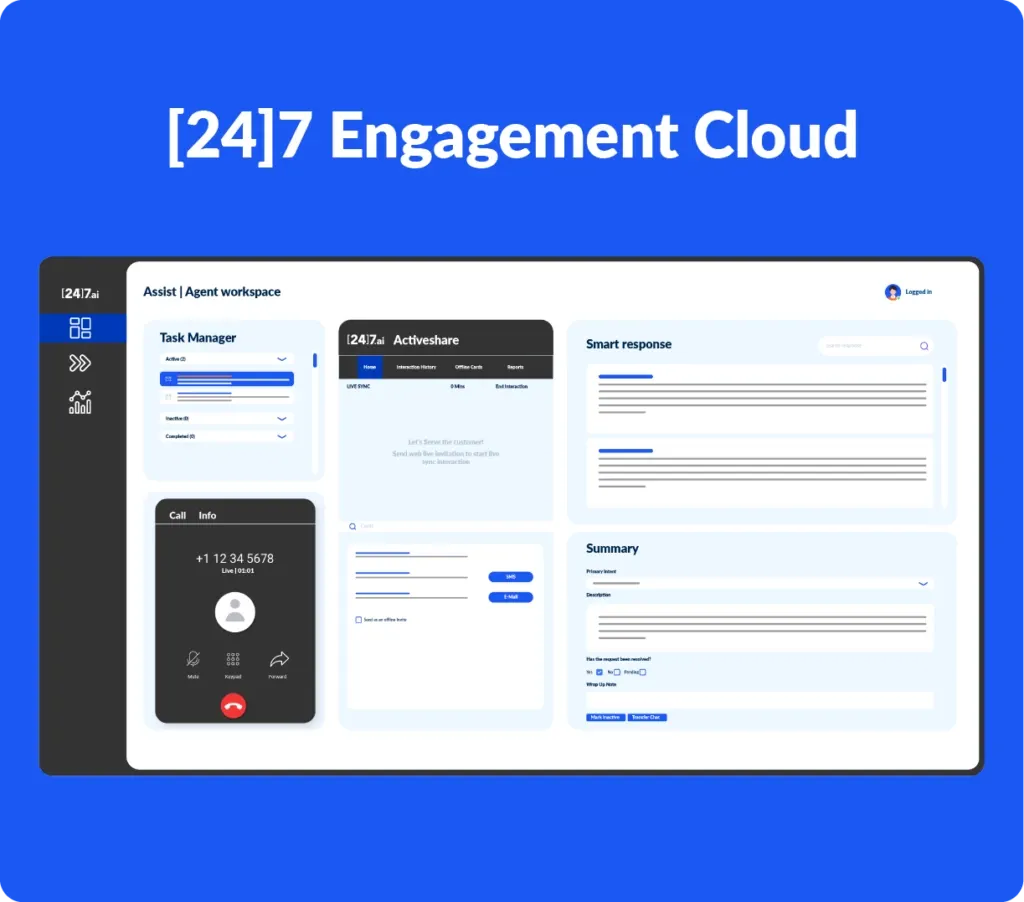
- [24]7.ai is built for enterprise AI-powered operations. Intelligent routing, AI agent assist, omnichannel engagement, conversation analytics, and deep CRM integration come built into the platform from the ground up rather than bolted on afterward. Particularly strong for telecom, banking, retail, and healthcare where compliance and scale both matter.
- Five9 is a cloud-based platform with solid AI, automation, workforce management, and analytics for enterprise contact centers.
- Genesys covers enterprise omnichannel orchestration with AI-powered routing, journey analytics, and workforce engagement tools.
- NICE focuses on AI and automation with strong quality management and workforce engagement capability.
- Talkdesk is cloud-native with AI agents, agent assist tools, and solid enterprise integration options.
- RingCentral combines cloud communications with contact center capability across voice and digital channels.
- Zendesk suits support-focused operations with AI, ticketing, voice, and knowledge management in one place.
- Salesforce Service Cloud is the natural fit for businesses already running Salesforce, with CRM-connected AI, workflow automation, and omnichannel support.
- Nextiva covers business communications and call management with CRM integrations and customer engagement tools.
How to Choose the Right Call Center Software
Start with what the operation actually needs. Inbound, outbound, or blended. Current volume and realistic growth projections. Which channels your customers use and expect support on.
Evaluate AI and automation capability against real production metrics, not what a vendor demo shows in a controlled environment. Confirm that integrations with your existing CRM and business systems work cleanly before committing to anything.
Review security and compliance standards relevant to your industry. In banking, healthcare, or any regulated vertical, this isn’t something to revisit after go-live.
And don’t overlook agent experience. Software that’s difficult to use creates its own operational drag regardless of how capable it looks in a pitch deck.
Final Thoughts
Call center software has moved well past basic call routing. The platforms enterprises run today combine voice, AI, customer data, automation, and analytics into one connected operation. Getting that combination right has a direct and measurable impact on customer experience, agent performance, and what it costs to run support at scale.
Explore how [24]7.ai helps enterprises enhance customer service with AI-powered automation, intelligent customer engagement, and scalable contact center capabilities.