- What Are the Best AI Chatbots for Customer Service in 2026?
- What Are AI Chatbots for Customer Service?
- What Are the Best AI Chatbots for Customer Service in 2026?
- How to Choose the Right AI Chatbot for Customer Service
- What Trends Will Shape AI Customer Service Chatbots in 2026?
- How [24]7.ai Supports Enterprise Customer Service
- Conclusion
- Frequently Asked Questions
What Are the Best AI Chatbots for Customer Service in 2026?
Customer service requests and inquiries are increasing at an alarming rate, with demands for 24/7 availability. Adding more agents to meet demand is not a long-term solution, and agent productivity and quality are often lower when they have to handle too many requests.
AI chatbots can help by handling some of the simplest requests, so agents can save their time for more complex matters. The primary challenge is selecting the best-fit vendor, as enterprise-readiness, integration options, security, and cost are much more important factors than cool demos. Below are eight essential solutions in 2026, along with their key capabilities and use cases.
What Are AI Chatbots for Customer Service?
An AI chatbot understands the user’s request and extracts the relevant information from the connected systems (usually helpdesk or order management) in natural language and responds appropriately. Most chatbots use NLP (natural language processing) to understand the user’s intent. Some use generative AI to respond more naturally.
Chatbots can be rule-based (follow specific predefined scenarios) or use machine learning algorithms to recognize patterns better. More advanced autonomous chatbots can perform various actions, such as refunding a purchase.
A good chatbot can escalate the conversation to a human agent, providing the conversation history and context, and often has integrations with other enterprise systems, such as CRM, helpdesk, and contact center software.
What Are the Best AI Chatbots for Customer Service in 2026?
The best AI chatbot for customer service will be determined by the required channels, integrations, and complexity of conversations. The table below provides an overview of the solutions and use cases.
Solution | Best For | Standout Features | Channels |
[24]7.ai | Enterprise CX and contact centers | Conversation automation, agent support | Omnichannel |
Ada | Customer service automation | AI agents, human escalation | Chat, messaging |
Cresta | Contact center AI | Real-time agent guidance | Voice, chat |
Freshdesk | AI-powered ticketing | Ticket triage, reply assistance | Email, chat, phone |
Tidio | Website chat and ecommerce | Chatbot workflows | Chat, messaging |
Netomi | Customer support automation | Automated resolutions | Chat, email |
Intercom | Messaging and AI support | Automated resolution | Chat, email, messaging |
Zendesk AI | Customer support workflows | Automated replies, ticketing | Email, chat, voice |
1. [24]7.ai
Pros:
- Supports omnichannel customer service operations.
- Combines AI technology with CX expertise.
Cons:
- Implementation and integrations can be resource-intensive.
- Pricing details are not publicly disclosed.
2. Ada
Pros:
- Offers flexible customer service automation.
- Supports human assistance when needed.
Cons:
- Implementation can take time.
- Maybe more than smaller businesses need.
3. Cresta
Pros:
- Helps agents improve customer interactions.
- Provides conversation analytics and agent performance insights.
Cons:
- Implementation can be complex.
- Costs may be high for some businesses.
4. Freshdesk
Pros:
- Brings customer support tasks together in one platform.
- Scales with growing support teams.
Cons:
- Some features require higher-tier plans.
- Complex operations may need additional tools.
5. Tidio
Pros:
- Easy to set up and use.
- Helps automate common customer questions.
Cons:
- May lack the depth needed for enterprise operations.
- Advanced workflows may require additional tools.
6. Netomi
Pros:
- Focuses on enterprise customer support automation.
- Supports automated self-service and system integrations.
Cons:
- Pricing details are not publicly available.
- Complex implementations may take longer.
7. Intercom
Pros:
- Unifies customer communication and support.
- Automates routine customer requests.
Cons:
- Costs can rise as AI resolution volumes increase.
- Total costs depend on the features and usage required.
8. Zendesk AI
Pros:
- A convenient option for existing Zendesk users.
- Automates support workflows and routine responses.
Cons:
- Some features require higher-tier plans.
- Add-ons and usage charges can increase costs.
How to Choose the Right AI Chatbot for Customer Service
Start by identifying the tasks you want the AI chatbot to handle. Frequent, repetitive questions are usually a good starting point. Then, decide which channels it should support, such as phone, email, live chat, and social media.
Next, check the available integrations. A customer service chatbot needs access to your CRM, knowledge base, and other relevant systems to provide accurate answers. Review the vendor’s security measures, including access controls, permission audits, and options for human agents to review or correct responses.
Set clear success metrics before implementation. Resolution rate, customer satisfaction (CSAT), containment rate, and cost per resolution can help you measure performance.
Finally, compare pricing models. Some vendors charge per agent, while others base their fees on usage. Estimate your expected interaction volume to understand the likely costs and choose a solution that fits your budget.
What Trends Will Shape AI Customer Service Chatbots in 2026?
How [24]7.ai Supports Enterprise Customer Service
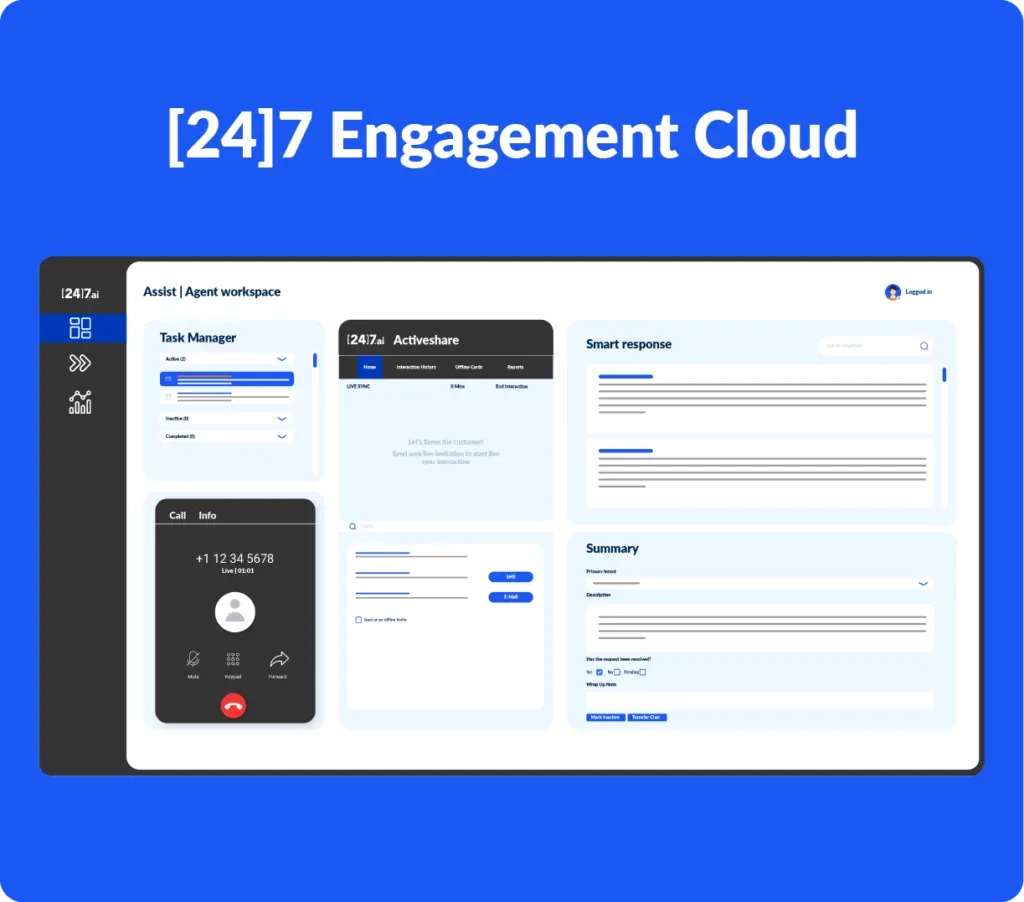
[24]7.ai has been specializing in the contact center sector for years, offering solutions to improve the first call resolution rates and agent performance. Their Engagement Cloud product uses conversation automation, agent support and assistance features, conversation intelligence, and generative AI to design productive and cost-effective multichannel communication for enterprises.
In essence, this technology helps customer service departments deflect high-volume, low-complexity requests to self-service, while routing more involved or delicate issues to live agents with the benefit of conversation analysis and suggested responses.