![[24]7.ai](https://www.247.ai/wp-content/uploads/2021/07/247ai-Black.svg)
![[24]7.ai](https://www.247.ai/wp-content/uploads/2024/09/247ai-Black.svg)
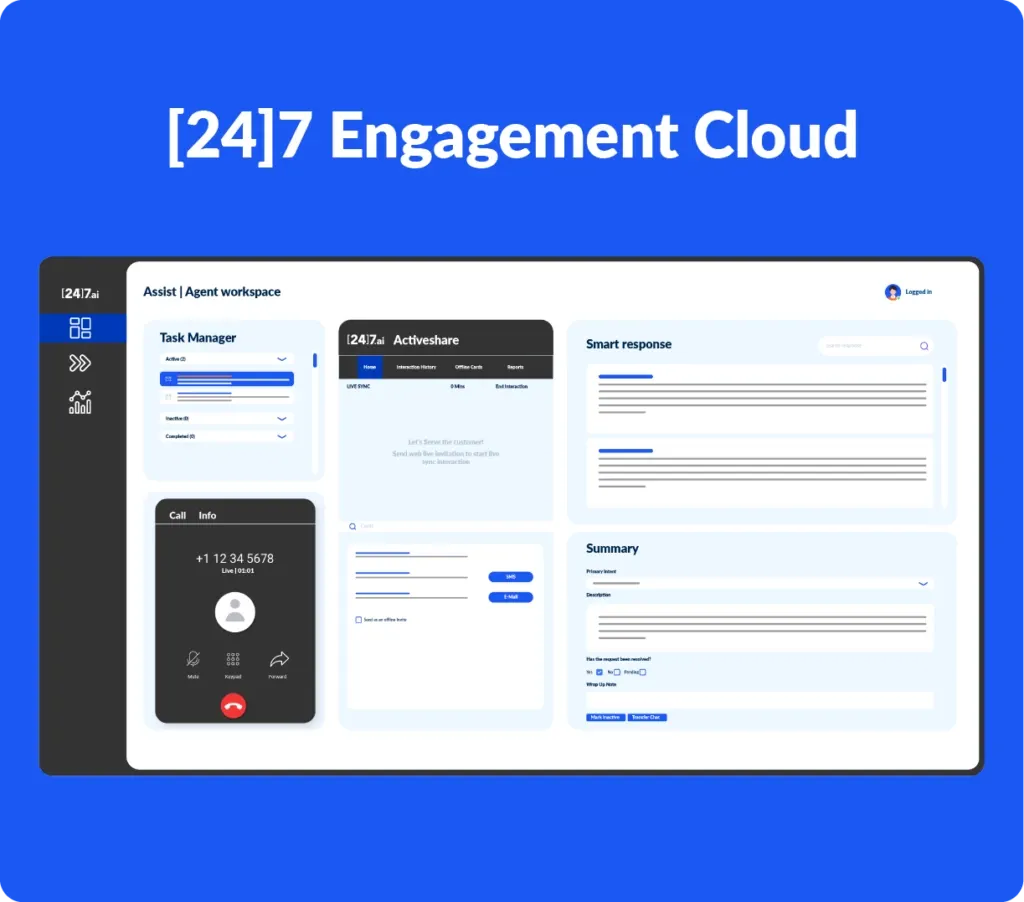
Enterprise CX has reached a critical stage. AI adoption is accelerating, but the systems beneath many customer journeys remain fragmented. BCG found that roughly nine in ten customer service leaders struggle to navigate the growing mix of technology vendors and system integrators. The same research notes that generative and agentic AI require strong orchestration across platforms, systems, and workflows to deliver meaningful results.
That creates a clear risk: organizations may add smarter tools without creating a more connected experience. An AI agent may understand the request, but it cannot resolve it reliably when customer data is siloed, workflows break across departments, or human escalation is poorly designed. As customers increasingly expect every interaction to feel connected and complete, delivering on that expectation requires a strong, integrated CX foundation.
Why Consistent CX Is the Next Imperative
CX has become a primary competitive battleground for most companies. Every inconsistent interaction now carries a direct cost to growth, not just to customer satisfaction.
PwC’s 2025 Customer Experience Survey found that 52% of consumers stopped buying from or using a brand because of a bad experience with its products or services. Nearly 29% left specifically because of poor online or in-person customer experience.
The takeaway is clear: inconsistency does not remain confined to a service metric. It affects loyalty, retention, and revenue. Companies must therefore create connected experiences across every touchpoint, supported by a foundation that keeps people, processes, and technology working together.
The Foundation That Makes CX Work
A CX foundation combines trained people, defined processes, and AI-powered technology so every touchpoint feels consistent across channels:
- Technology understands intent and automates routine work.
- Processes remove friction from the customer journey.
- People know when to step in and how to handle moments that require empathy or judgment.
Together, they function like an operating system beneath the experience, keeping every interaction connected and moving toward the right outcome.
Why Agentic AI Needs a Strong CX Foundation
Traditional conversational AI responds to a request. Agentic AI interprets the customer’s goal, coordinates across systems, and completes the steps needed to resolve it. At enterprise scale, this can reduce handle time, improve resolution rates, and allow agents to focus on situations where judgment, empathy, or escalation matters most.
But agentic AI can only perform as well as the foundation supporting it. According to Forrester, three-quarters of enterprise leaders say they are adopting agentic AI, yet only a small minority have moved beyond “agentish” chatbots into meaningful production, and scaled multiagent systems remain rare.
That gap reflects a foundation problem as much as a technology problem. Agentic AI depends on connected data, reliable integrations, clear workflows, governance, and human oversight. When those elements are engineered well, agentic AI becomes more than another automation tool. It becomes an extension of the CX foundation, helping the organization deliver faster, more consistent, and more proactive customer experiences.
Why Is Human-in-the-Loop Oversight Essential?
Deloitte’s research found that trust in company-provided generative AI fell 31% in a single quarter of 2025, while trust in AI systems acting independently fell 89% over the same period.
What employees and customers resist is not necessarily AI. It is AI acting without visible oversight or accountability. Human-in-the-loop design keeps people involved where judgment, empathy, risk, or regulatory considerations matter most. Employees can review, correct, approve, or override decisions when necessary, allowing agentic AI to extend the team rather than replace it. This makes human oversight an essential part of the CX foundation, because trust, accountability, and customer confidence must be built into how AI operates.
How [24]7.ai Builds the Foundation
Years of operating contact centers for enterprise brands shape the CX foundation we build. It brings together:
- Omnichannel engagement that carries context across channels
- Agentic AI that resolves complex queries without constant human intervention
- Human-in-the-loop workflows that route interactions to the right people
- Real-time analytics that surface performance gaps before customers feel them
- CX experts who optimize outcomes rather than simply deploy software
Every component works together so agents have the context they need, AI operates within the right guardrails, and customers receive the consistency they expect. When the foundation holds, consistency follows. A customer who begins in self-service and finishes with an agent does not need to repeat the issue. A frontline employee has the context to resolve the moment that matters instead of guessing. Leaders gain one connected view across channels rather than ten fragmented ones. [24]7.ai builds the foundation. You deliver the experience.
Talk to our team to see what a stronger CX foundation looks like for your enterprise.