- What Are the Best AI Chatbots for Customer Service in 2026?
- What Is AI for Customer Care?
- What Are the Benefits of Using AI for Customer Care?
- Why Is AI for Customer Care Important in 2026?
- What Are Real-World Examples of AI in Customer Care?
- How 24/7.ai Supports AI-Powered Customer Care
- Conclusion
- Frequently Asked Questions
What Are the Benefits of Using AI for Customer Care?
You have probably sat on hold for twenty minutes just to change a delivery address. One line of text, twenty minutes. Most of us have a story like that, and it’s why support teams are under so much pressure. Customers want quick, personal answers on chat, email and the phone, and budgets haven’t kept up.
AI won’t fix all of it, but it handles more than you’d expect. Here are the key benefits of AI for customer care, where it earns its keep, and what to think through before you start in 2026.
What Is AI for Customer Care?
Put simply, it’s software that reads what a customer is asking and helps sort it out. You’ve almost certainly used the basic version: the little chat bubble on a shopping site.
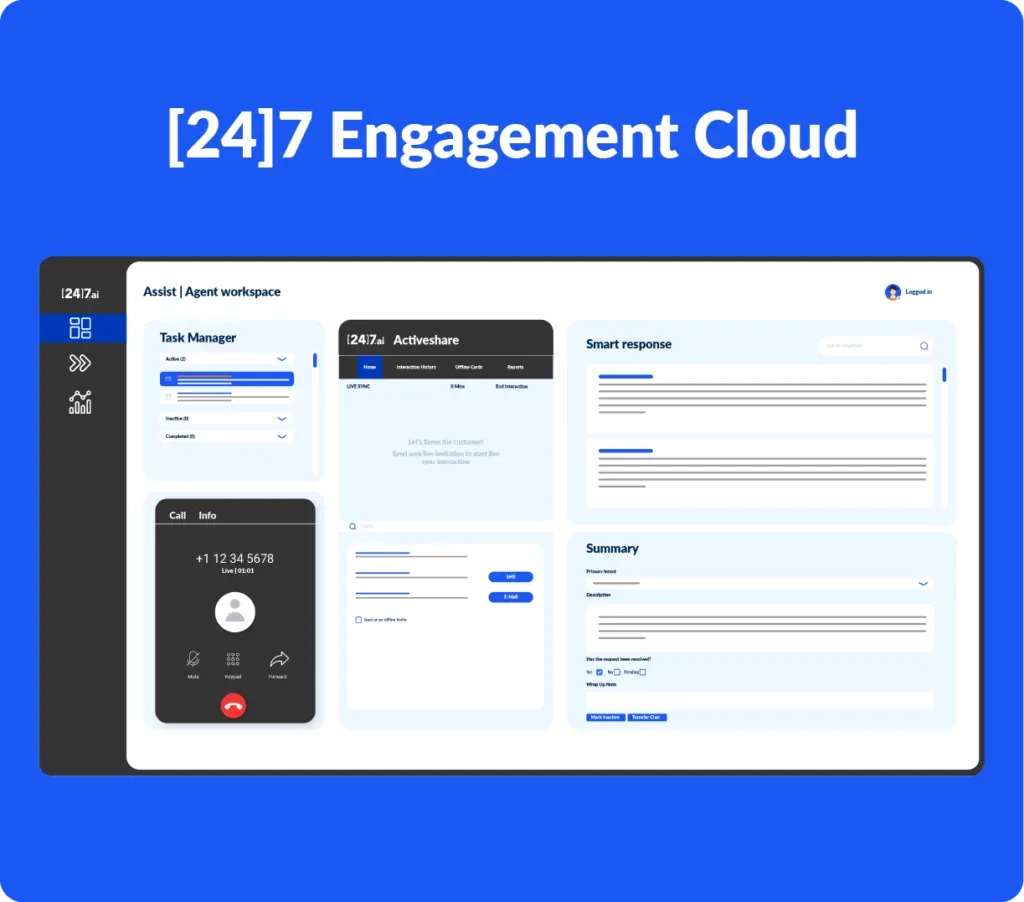
Behind that bubble, several things are happening at once. Conversational AI makes sense of “wheres my parcel” typed in a hurry with no punctuation. Virtual agents take it from there and do the work, say rebooking a delivery that got missed. Generative AI handles the writing, from customer replies to boiling a ten-message email chain down to two lines. Agent-assist is the odd one out since customers never see it. It’s there for the human rep, finding the right policy or the last order while the call is still on.
So who’s actually talking? Sometimes it’s only the customer and the AI. Other times it’s a person, with the AI searching the knowledge base in the background so they don’t have to. Most companies run both, and trickier requests tend to land with a human.
What Are the Benefits of Using AI for Customer Care?
1. Provide Faster Customer Support
2. Deliver More Personalized Customer Experiences
3. Improve Contact Center Efficiency
4. Enable 24/7 Customer Assistance
5. Support Human Agents and Improve Service Quality
6. Gain Actionable Customer Insights
Why Is AI for Customer Care Important in 2026?
Remember the chatbots from a few years ago? You typed a question, the bot didn’t recognize one word, and you landed back on the same menu. Most people gave up and asked for a human.
That has changed. Generative AI follows normal, messy language, so customers don’t have to guess the ‘right’ phrasing anymore. Agentic tools go further and can do things, like cancel an order or rebook an appointment, instead of pointing you to a help page. Once people get used to that, going back feels painful. It’s a big reason the benefits of AI for customer care are easier to get now than they were two years ago.
There’s a flip side. The more the AI can do, the more it can get wrong. Somebody has to read what it tells customers, watch what data it can reach, and check whether people are actually getting their problems solved. A high automation rate means little if customers call back the next day. Companies that plan for the long run usually come out ahead of the ones that bought AI only to cut costs.
What Are Real-World Examples of AI in Customer Care?
Self-service: A customer asks where their refund is. The virtual agent checks the order and gives the status. It pulls only from approved sources, so it isn’t a guess.
Agent assistance: Mid-call, the agent doesn’t have to hunt for the return policy or scroll through three months of history. The AI has already put both on screen.
Routing: A message about a double charge goes straight to billing instead of landing in general support first. That’s one fewer transfer, and one fewer “let me pass you along.”
Proactive support: Say an outage hits and complaints start stacking up. The AI spots the pattern and can message affected customers before they all pick up the phone.
How 24/7.ai Supports AI-Powered Customer Care
Conclusion
The benefits of AI for customer care come down to a few plain things. Support is easier to reach, agents get more done, and operations cost less to run. None of that happens by itself. You need the right use cases, decent data and people watching the output.
If you lead CX, start small. Pick two or three high-impact areas, measure them against real outcomes, then build from there. To see what that could look like for your team, explore 24/7.ai’s customer experience solutions.