![[24]7.ai](https://www.247.ai/wp-content/uploads/2021/07/247ai-Black.svg)
![[24]7.ai](https://www.247.ai/wp-content/uploads/2024/09/247ai-Black.svg)
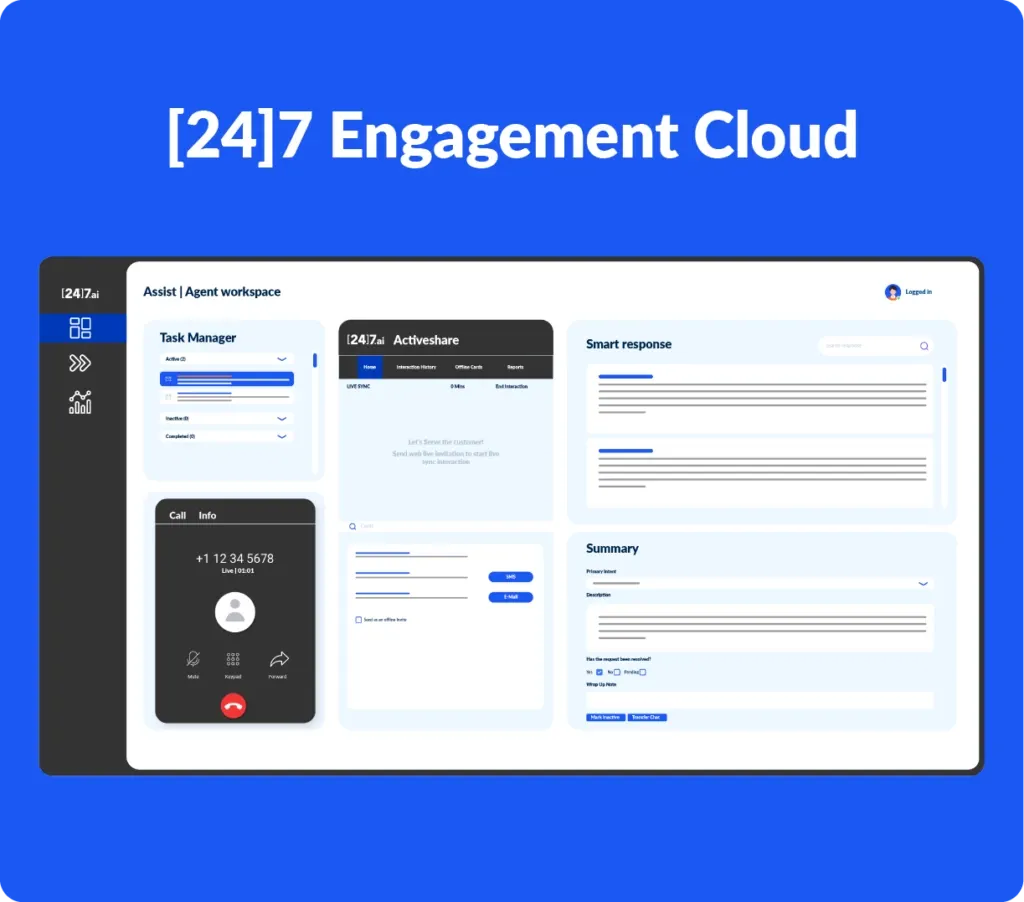
Table of contents
- Introduction
- What is Conversational AI for Customer Service?
- How Does Conversational AI Work in Customer Service?
- What are the Key Features of Conversational AI in Customer Service?
- What are the Benefits of Conversational AI for Customer Service?
- What are the Common Use Cases of Conversational AI?
- How is Conversational AI Different from Chatbots?
- Can Conversational AI Replace Human Agents?
- What Industries Use Conversational AI for Customer Service?
- What are the Challenges of Implementing Conversational AI?
- What is the Future of Conversational AI in Customer Service?
- How [24]7.ai Enables Conversational AI for Customer Service
- Final Thoughts
- FAQs
Customer service has always been a people problem. Too many queries, not enough hands, and somewhere in the middle, good customers having bad experiences because the system wasn’t built to keep up.
Conversational AI doesn’t fix everything. But it fixes the part that was never really a people problem to begin with.
What is Conversational AI for Customer Service?
Conversational AI is technology that handles customer interactions automatically, across every channel, using natural language processing and live integration with your business systems.
It understands what someone is actually asking, not just the words they used to ask it. It responds, it acts, it resolves. A human gets involved when the situation genuinely calls for one, not because the system ran out of options.
How Does Conversational AI Work in Customer Service?
Someone reaches out. Maybe it’s a chat message at midnight, maybe it’s a call during lunch when your queue is backed up. Doesn’t matter.
The system works out what they need, pulls their history, checks what’s happening with their account right now, and figures out the best path forward. If it can close the issue, it does. If it can’t, it passes to a human agent with everything already loaded, so the customer picks up exactly where they left off without repeating a single word.
That handoff, when it’s done properly, is the part customers actually remember.
What are the Key Features of Conversational AI in Customer Service?
- Natural language understanding: People don't talk in clean, structured sentences. They type fast, skip words, and say things in ten different ways. The system handles all of it.
- Omnichannel support: Chat, voice, WhatsApp, email, social. Not a separate tool bolted onto each channel. One consistent capability running across all of them.
- Context and memory: It knows what was said five messages ago and uses it. Customers don't have to repeat themselves every time the conversation moves forward.
- Automation and workflows: It doesn't just reply. It does things. Updates accounts, processes requests, sends confirmations. The customer gets an outcome, not a case number.
- Agent assist: When a human takes over, the AI stays in the room. Quietly surfacing information, suggesting next steps, making the agent faster and sharper in real time.
- Continuous learning: Every conversation makes it slightly better at the next one. Not through manual updates but through actual use, day after day.
What are the Benefits of Conversational AI for Customer Service?
Customers stop waiting. That sounds simple but it changes everything about how they feel by the end of the interaction.
Your team stops spending most of their day on questions they’ve answered a thousand times. The repetitive stuff gets handled before it reaches them. What’s left is work that actually needs a person, and they’re better at it because they’re not already exhausted from the other stuff.
Costs stop being fixed. You’re not maintaining a full team through quiet periods just to survive the busy ones. Volume goes up, capacity follows. Volume drops, costs adjust.
And the experience becomes consistent. Not dependent on who picked up, what day it is, or whether the floor is understaffed that shift.
What are the Common Use Cases of Conversational AI?
Routine queries that used to land as tickets, FAQs, account questions, status updates, get resolved the moment they come in.
Order tracking, billing, payments, account changes. High volume, predictable, exactly what this technology was built for.
Appointment scheduling that used to take three emails. Technical troubleshooting that follows a known path but was eating agent time anyway.
And proactive outreach. Not waiting for customers to discover a problem, reaching them before they do. That one tends to surprise businesses with how much goodwill it quietly builds.
How is Conversational AI Different from Chatbots?
A chatbot is a flowchart. It works when customers follow the path. The moment someone phrases something differently than expected, it falls apart.
Conversational AI actually understands language. It follows the thread of a conversation across multiple messages, handles the way real people communicate, and doesn’t break when things go slightly off script.
The difference isn’t subtle. Customers feel it immediately. One leaves them more frustrated than when they started. The other actually gets somewhere.
Can Conversational AI Replace Human Agents?
No. And honestly, trying to use it that way tends to make things worse.
What it does is take the work off your team that didn’t need them in the first place. Repetitive, predictable, low-judgment queries that were consuming hours every day. What stays with your people is complex, sensitive, high stakes. Situations where experience and judgment genuinely matter.
Better technology doesn’t mean fewer people. It means the people you have are doing the work they’re actually good at.
What Industries Use Conversational AI for Customer Service?
- Banking and financial services: Account management, fraud queries, loan support, compliance-sensitive conversations that need to be handled carefully and at scale.
- Telecom and utilities: Billing disputes, outage updates, plan changes, basic troubleshooting that doesn't need to touch an agent.
- E-commerce and retail: Orders, returns, product questions, post-purchase support that customers expect to be instant.
- Healthcare: Scheduling, insurance, patient follow-up, administrative load that was always too heavy for the staff available to carry it.
- Travel and hospitality: Booking changes, cancellations, loyalty queries, disruption handling at volumes that would overwhelm any manual operation.
What are the Challenges of Implementing Conversational AI?
The system is only as good as what’s behind it. Messy, outdated, or incomplete data doesn’t stay hidden. It shows up in every interaction and customers notice straight away.
Integration is harder than it looks in a demo. Connecting to the platforms that actually hold customer data and process real transactions takes planning and it takes time.
Not every conversation can be automated and the system needs to know that. A clean escalation to a human is always better than a bad automated resolution that leaves someone more frustrated than before.
Security and compliance aren’t things you come back to later, especially in regulated industries. They need to be part of the design from the start.
And getting internal teams to actually work with the system, to trust it, takes more than a launch email. That part needs as much attention as the technology itself.
What is the Future of Conversational AI in Customer Service?
Generative AI is making these systems meaningfully better. More natural in how they respond, more flexible in what they can handle, capable of managing conversations that would have needed a human a year ago.
The bigger shift coming is agentic AI. Systems that don’t just talk but act. Conversational AI holds the dialogue. Agentic AI handles the execution. Together they move customer service from something that reacts to problems toward something that gets ahead of them entirely.
How [24]7.ai Enables Conversational AI for Customer Service
We build for businesses where it genuinely has to work. Not proof of concept scale. Real volume, real channels, real compliance requirements, real consequences when something breaks.
Our platform understands intent accurately, integrates with the systems that actually drive resolution, and holds up as things scale. We’ve deployed across telecom, banking, retail, and healthcare. We’ve seen what goes wrong in production and we’ve built around it.
Explore how [24]7.ai can help you build customer service that works the way your customers expect it to.
Final Thoughts
Conversational AI isn’t a feature you add to customer service. It changes how the operation runs, what your team spends their time on, and what customers experience every time they reach out.
The businesses seeing real results from it aren’t just handling queries faster. They’re building something that scales without everything getting harder as it grows. That’s the version worth building toward.