![[24]7.ai](https://www.247.ai/wp-content/uploads/2021/07/247ai-Black.svg)
![[24]7.ai](https://www.247.ai/wp-content/uploads/2024/09/247ai-Black.svg)
- Global Customer Support Services: A Complete Guide for Businesses
- What is global customer support service?
- How does global customer support service work?
- What are the benefits of global customer support?
- What are the top global customer support companies in the US?
- What should businesses look for in a global customer support services provider?
- [24]7.ai's Approach to Global Customer Support Services
- Final Thoughts
- Frequently Asked Questions
Global Customer Support Services: A Complete Guide for Businesses
A customer in Manila emails your support team at 2am (their time). Another one calls from Toronto during their lunch break. A third sends a WhatsApp message from Berlin asking why their order hasn’t shipped. If your support team is five people in one office, you’re already losing two of these three people before anyone even picks up the conversation.
This is the problem global customer support services actually solve. Not “customer service, but bigger.” Coverage that doesn’t fall apart the moment your customer base stops fitting inside one time zone.
Here’s what businesses tend to ask before making the switch.
What is global customer support service?
It’s outsourcing your customer interactions, calls, chats, emails, and social media, to a provider that can handle them across multiple countries and languages instead of just one head office.
The “global” part isn’t marketing flourishing. It means actual local-language agents, actual round-the-clock shifts, actual familiarity with how customers in different regions tend to phrase complaints (which, it turns out, varies more than people expect).
What it isn’t: a single overseas call center pretending to be everywhere. A customer in Tokyo and a customer in Dallas should both feel like they reached someone who gets their context, not someone reading the same script translated badly.
How does global customer support service work?
Honestly, the mechanics are less interesting than people assume. A query comes in. AI triages it first, most routine stuff (order status, password resets, basic FAQs) gets closed out in seconds. Anything messier gets routed to a human who’s trained on your product and has your customer’s history already pulled up.
What makes it “global” is the routing logic underneath. The system knows which language, which region, which time it is locally, and sends the conversation to whoever’s actually awake and qualified, not whoever happens to be next in the queue.
The provider is also watching the whole thing from above: how fast things get resolved, where complaints cluster, which region is starting to lag. That feedback loop is really the difference between a provider that improves over six months and one that just stays the same size forever.
What are the benefits of global customer support?
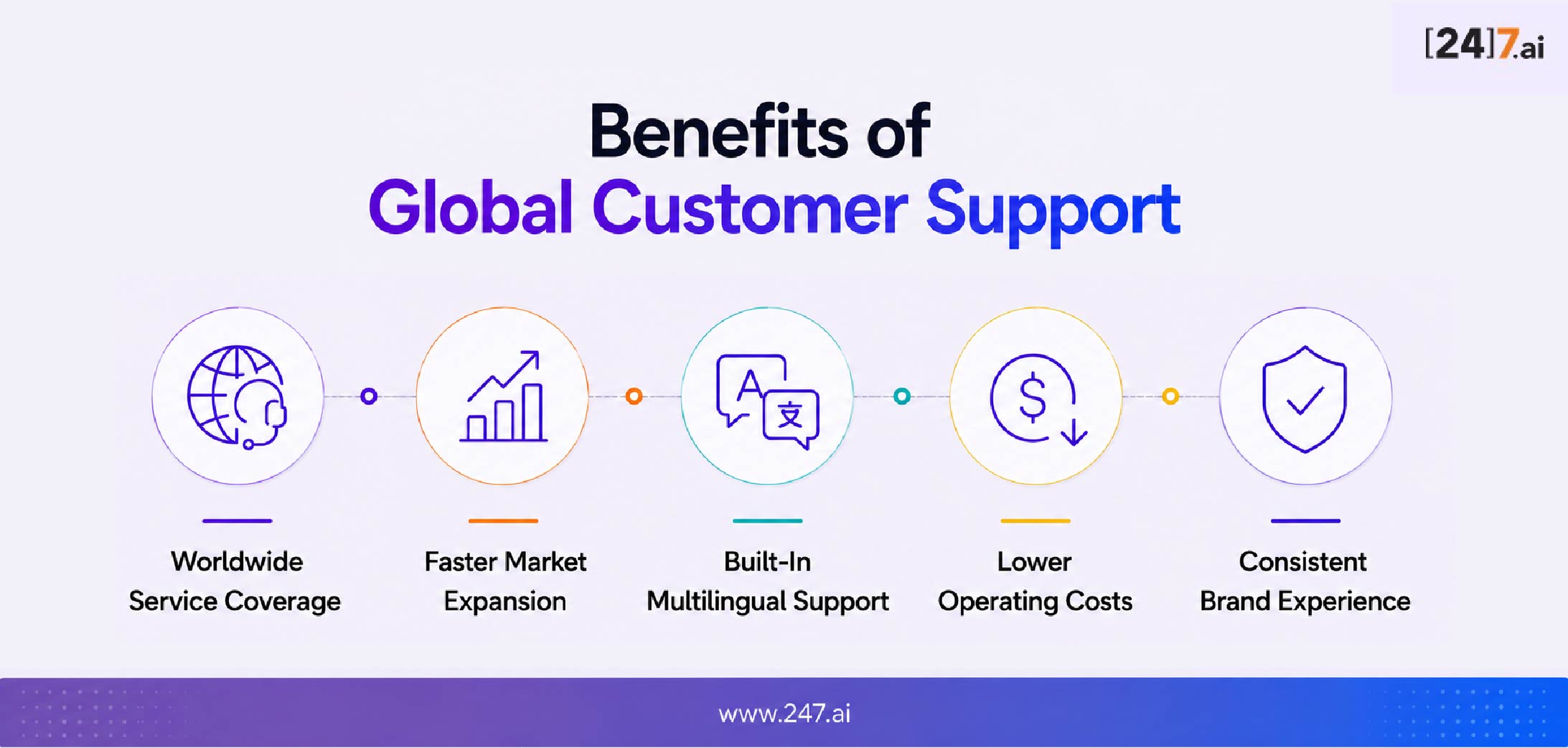
Coverage, obviously, that’s the headline one. But the more useful benefits show up later:
You stop hiring for every market you enter. Expanding into a new country used to mean a hiring sprint, training, ramp time. With a provider already running global customer support services, that capability already exists. You’re plugging in, not building from zero.
Multilingualism stops being a project. Native speakers are already on staff. Nobody’s running customer complaints through a translation tool and hoping nothing gets lost.
The cost actually goes down, not just feels like it should. Five small regional teams cost more, individually, than one provider running shared infrastructure across all five.
And the one nobody mentions enough: consistency. A customer who contacts you from two different countries in the same week shouldn’t get two different brand experiences. Global customer support, done properly, removes that gap.
What are the top global customer support companies in the US?
There isn’t one answer here, because the market splits into a few real categories.
The big legacy outsourcers have scale, no argument there. But a lot of them are running AI as something stapled onto a twenty-year-old call center model. You can usually tell, the automation feels clunky, handoffs to humans are slow, and “global” sometimes just means “we have a few more office locations.”
Then there are smaller, boutique providers. More personal, more flexible, sometimes genuinely better at customer experience on a small scale. The tradeoff is depth, language coverage and compliance maturity tend to thin out fast once you need more than two or three markets.
And then there’s a third category, which is where [24]7.ai operates: providers built around AI-first, global-scale support from the ground up. Not AI added later, but AI as the actual architecture, with human teams layered in for judgment calls.
What tends to separate the third category from the first two isn’t really the AI itself, it’s whether that AI was designed for multi-region, multi-language complexity from day one, or retrofitted to survive it.
What should businesses look for in a global customer support services provider?
A few things matter more than the sales deck will suggest.
Real fluency, not translation software wearing a human costume. There’s a difference customers notice immediately.
Compliance that’s already regional, not regional “soon.” Data privacy rules in the EU aren’t the same as in the US or APAC. A provider should already know this cold, not be learning it on your account.
Ask, specifically, how the AI was built. If the answer sounds like it was bolted onto something older, it probably was.
Integration matters more than people budget for. If onboarding means ripping out your CRM, that’s a red flag, not a feature.
And ask for reporting broken out by region, not one global number. A blended average can hide a market that’s quietly failing.
[24]7.ai's Approach to Global Customer Support Services
We didn’t build this as an add-on. Multi-region, multi-language support was the starting design, not a feature we shipped later.
Our AI handles volume and the routine stuff, in the language the customer actually speaks, not a translated approximation of it. Human agents step in where judgment actually matters, the complaints, the edge cases, the things AI shouldn’t be making the final call on. And all of it sits directly on top of the CRM and CCaaS tools businesses already run, no rebuild required.
We have run this across telecom, banking, retail, and healthcare, industries where getting compliance wrong in even one region is expensive. That’s not a claim, it’s just where the experience actually comes from.
Final Thoughts
Global customer support services aren’t really about being everywhere at once. They’re about a customer in any country getting the same quality of help your best local agent would give them, without you having to build five versions of your support team to make that happen.
The providers worth choosing aren’t the cheapest ones. They’re the ones where the AI was actually built for this scale, not patched together to survive it.
Talk to [24]7.ai about what global customer support services could look like for your business.
Frequently Asked Questions
No. Even a business expanding into one or two new markets uses it, mainly to avoid hiring a local team from scratch for each one.
Depends on the provider, but the established ones usually cover dozens, through a mix of native-speaking agents and AI-assisted translation for the long tail.
Not if SLAs and reporting are set up per region from the start. You're trading direct oversight for scale, not losing oversight altogether.
Yes, that's the whole point. Follow-the-sun staffing and AI-first triage mean coverage doesn't depend on any single office's hours.
Telecom, banking, retail, and healthcare, mostly because they combine high volume with the kind of regional compliance rules that punish a sloppy setup.