Table of contents
- Introduction
- What Is an Inbound Call Center?
- How Does an Inbound Call Center Work?
- Inbound Call Center vs. Outbound Call Center: What’s the Difference?
- Who Needs an Inbound Call Center?
- What Technology Makes an Inbound Call Center More Efficient?
- How Can [24]7.ai Support Inbound Call Center Services?
- Conclusion
- FAQs
What are Inbound Call Centers?
What Is an Inbound Call Center?
An inbound call center is a contact center that focuses on answering customer inquiries. First of all, there are no cold calls, since the communication is initiated by a client, not an agent. There may be several reasons for calling – the customer wants to clarify the status of an order, have a billing question, log in, or reschedule a medical examination. The primary objective of an inbound center is to solve the problem of a caller.
Thus, the company gets post-sale support to improve customer satisfaction and retention. Inbound call centers function through a customer waiting line, and the quality of communication affects the likelihood of a repeat call. The main indicator here is CSA – customer satisfaction at first contact. Therefore, if the call was successful, the interaction ends with the client cheerful, and if not, they remain dissatisfied.
How Does an Inbound Call Center Work?
Contact center inbound works by taking a customer call and routing it to an appropriate agent via an automated interactive voice response or a queue. Once the communication is established, the agent sees the caller’s profile on-screen, including the history of previous calls. This removes the need for the customer to reiterate the problem, which is certainly a significant pain point during the support process.
After the resolution or a promise of the resolution, the call center has specific metrics to measure the performance, such as average speed of answer, first-contact resolution, and customer satisfaction. The next step in the inbound call center workflow is to collect and analyze this information using dashboards or specialized tools.
Inbound Call Center vs. Outbound Call Center: What’s the Difference?
As mentioned above, inbound call centers deal with incoming calls, whereas outbound ones initiate the contact. The purposes are also different, with the former being focused on customer support and the latter on sales, collections, and surveys. As a result, while inbound agents concentrate on resolving issues, outbound ones have a specific list of customers to contact. The metrics monitored by inbound and outbound call centers are different as well, with the former measuring CSA and first-contact resolution and the latter – contact rate and conversion.
Thus, if the need is to address the customers’ requests, an inbound call center is a suitable choice, while outbound services are required for initiating outreach. Many companies utilize both inbound and outbound services provided by a contact center provider.
Who Needs an Inbound Call Center?
There are several types of organizations that can benefit from inbound call center services, which is primarily determined by the customers’ needs. Thus, retail and e-commerce have a variety of billing and order-related questions to address, financial services deal with account-related issues, healthcare organizations handle scheduling and patient support, tech and SaaS companies assist with product-related concerns, and enterprise businesses provide round-the-clock account management.
The demand for an inbound call center emerges when the organization wants to ensure better customer experience through accessible and reliable support. The choice of a particular type of contact center depends on the average call volume, customer expectations, complexity of the issues, and hours of operation.
What Technology Makes an Inbound Call Center More Efficient?
Essential Contact Center Technologies
The basic technologies of an inbound call center include intelligent routing, CRM integration, workforce management, and analytics. The first two ensure that the customer is directed to the right agent and receives the required information without any confusion. The other two tools monitor the performance of the call center to identify strengths and weaknesses.
The Role of AI and Automation
The application of AI and automation in inbound call centers allows addressing a high volume of simple, repetitive questions through self-service options. This way, customers get quick responses, and agents are available for more complex issues. AI can also assist during the conversation with information retrieval, and analytics can be used to detect frequently occurring problems.
When considering which technology to adopt, it is vital to keep in mind a few questions. First, will this technology be compatible with the existing infrastructure? Second, is customer data secure? Lastly, can the client always reach a real person if AI-based automation fails to comprehend the issue?
How Can [24]7.ai Support Inbound Call Center Services?
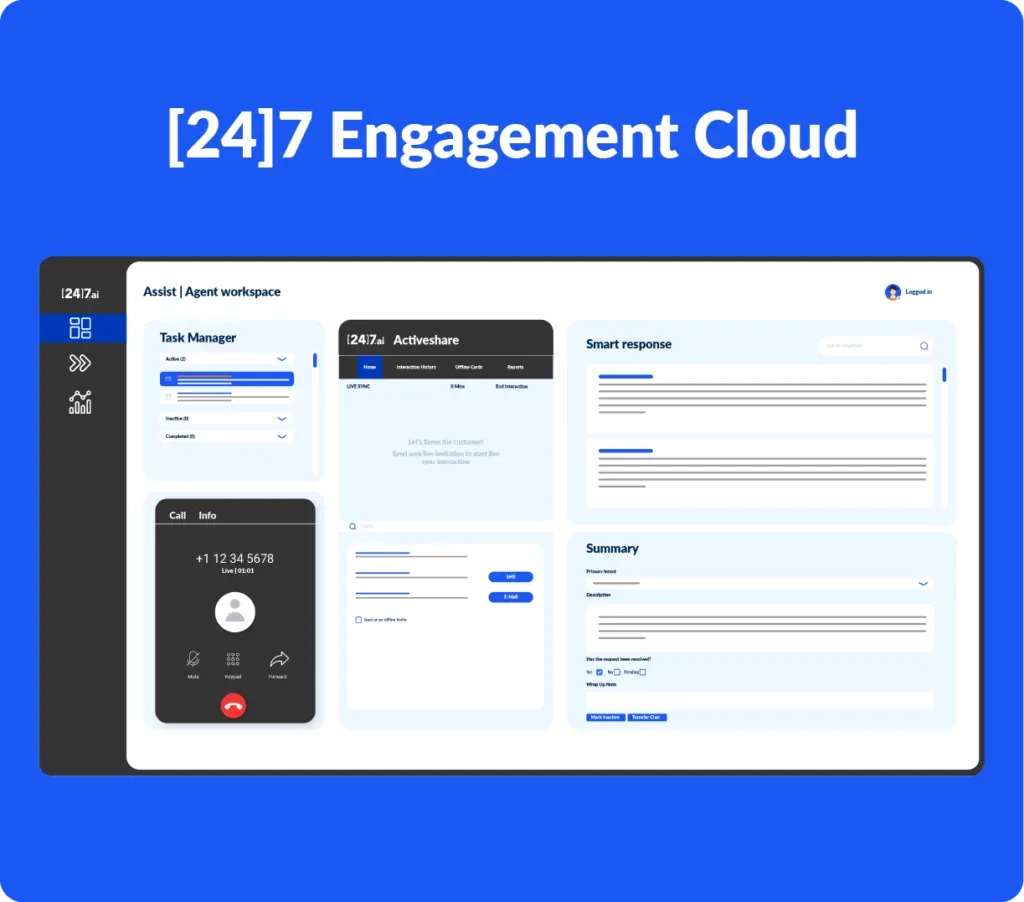
[24]7.ai has more than 25 years of experience in the contact center industry, which has impacted the development of their technology. Their Engagement Cloud is driven by AI to offer conversation design, agent enablement, and conversational analytics with the option for CX services and managed customer engagement. As an inbound call center provider, [24]7.ai offers tools for automating routine tasks, enhancing agent performance, and analyzing the data.
This technology is recommended for enterprise-level businesses due to the increased volume of communications and the need for consistent, uniform experiences across multiple channels, which is possible with their omnichannel solutions. The actual impact depends on the caller base, the channels used, and the complexity of the task.
Conclusion
Inbound call centers are the place where customers come to ask questions. For this reason, the organization should optimize its operations to ensure a positive experience so that the client returns to shop again. The key to success is to offer a comprehensive approach and consider the customer’s journey, inbound call center technologies, and the available resources. Pay attention to the CSA scores, average speed of answer, and first-contact resolution. Companies that want to use AI to transform their inbound call centers into omnichannel ones should contact [24]7.ai to see how this technology can benefit their business.