![[24]7.ai](https://www.247.ai/wp-content/uploads/2021/07/247ai-Black.svg)
![[24]7.ai](https://www.247.ai/wp-content/uploads/2024/09/247ai-Black.svg)
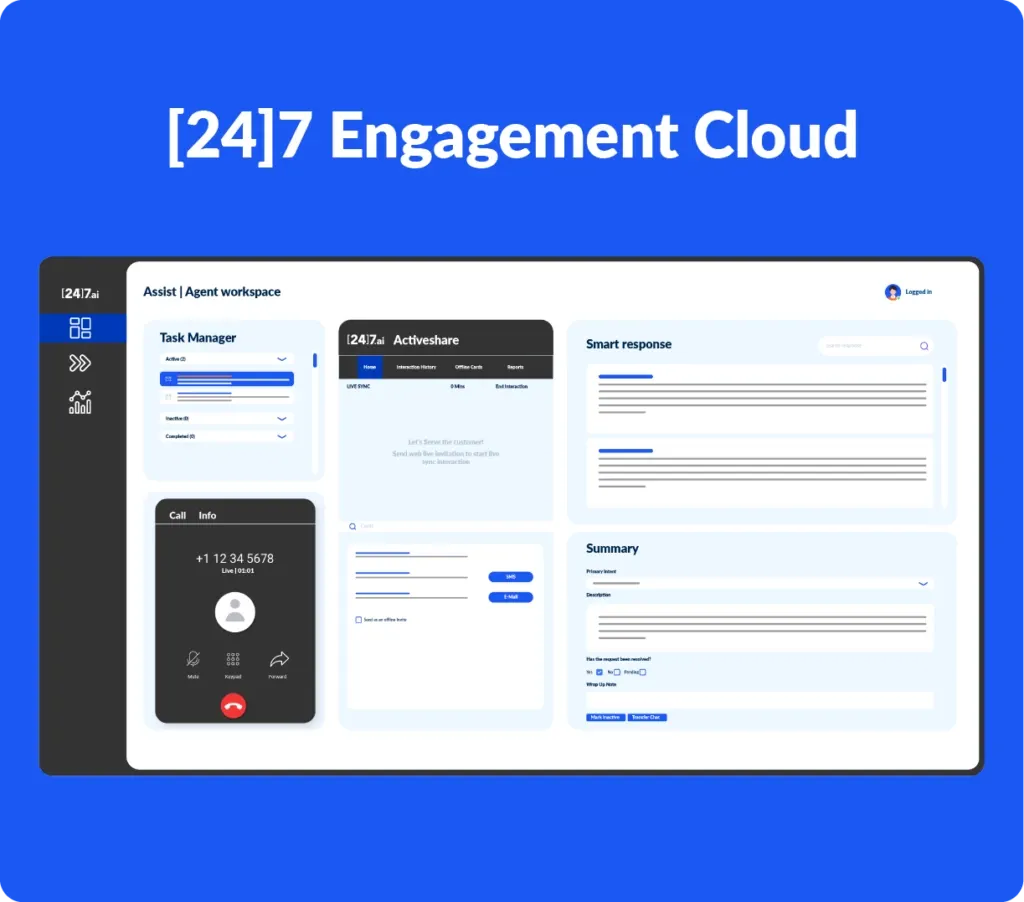
You know that feeling when you have explained the same problem to three different people at a company, and none of them seem to know what the last person said? That’s basically the whole reason omnichannel customer experience platforms exist. Someone got tired of hearing that complaint enough times to build software around fixing it.
This guide covers ten omnichannel customer experience platforms that US enterprises commonly evaluate, and what each brings to the table.
What Are Omnichannel Customer Experience Platforms
Simplest way to put it, everything stays connected. Chat, phone, email, text, social, WhatsApp, whatever you’re using. Message on Monday, call on Tuesday, and whoever picks up already knows your story. Nobody’s making you start over.
People mix this up with multichannel, and it’s an easy mistake. Multichannel just means a company’s got a bunch of ways to reach them, not that those channels talk to each other. Your chat history and your phone call might as well belong to two different companies. Omnichannel fixes that, keeping the thread going no matter how you bounce around.
For small support teams, this isn’t a major concern. Once you’re managing thousands of customer interactions across time zones, it becomes a necessity.
Benefits
Honestly, most of this comes down to one thing, nobody has to repeat themselves anymore. Sounds small until you have explained your issue to the third agent in a row. Agents get the full picture the moment a conversation starts, no fumbling to reconstruct what already happened while the customer waits.
There’s a speed thing too. Less digging means faster resolutions. But the part people underestimate is what it does for leadership, one dashboard instead of five tools spitting out five reports somebody has to stitch together by hand
Cost works out better in most cases as well, since running one connected system tends to beat maintaining a stack of tools that don’t talk to each other, once you tally up what training agents on all of them actually costs.
And customers who get helped without a fight? They stay. The ones who get bounced around three times before anyone actually solves anything, a lot of them don’t come back.
Key Features
- Smart Routing: Directs each query to the right agent, team, or AI capability based on the customer’s needs, rather than simply assigning it to whoever is available.
- CRM & Backend Integration: Connects customer conversations with CRM and backend systems, so agents can access the information they need without working across disconnected tools.
- Analytics & Reporting: Tracks metrics such as resolution time, customer sentiment, and where conversations tend to break down, giving teams a clearer view of what needs attention.
- Workforce Management: Helps larger teams plan staffing based on actual demand instead of relying on guesswork, especially when conversation volumes fluctuate.
- Self-Service & AI Agents: Handles routine requests such as password resets and order lookups automatically, allowing human agents to focus on issues that need more attention.
Here's how the ten platforms that come up most in these conversations actually compare.
| Platform | Key Features | Pricing Model | Key Indicators |
| [24]7.ai | Conversational and agentic AI, deep CRM/CCaaS integration, omnichannel routing built for high-volume enterprise environments | Custom enterprise pricing, quoted per deployment | Strong fit for telecom, banking, retail, and healthcare with strict compliance needs |
| NICE CXone | Full CCaaS suite, workforce management, AI-assisted routing | Custom enterprise pricing | Broad channel coverage, mature analytics stack |
| Genesys Cloud CX | Omnichannel orchestration, journey mapping, AI-driven predictive routing | Tiered per-agent pricing, scales with add-ons | Popular with large, multi-region contact centers |
| Five9 | Cloud contact center with AI-powered virtual agents and workforce engagement tools | Per-agent monthly pricing, custom for enterprise | Known for fast deployment and solid voice capability |
| Talkdesk | AI-native workspace, prebuilt industry workflows, CRM integrations | Tiered per-agent pricing | Strong in retail and financial services |
| Zendesk | Unified agent workspace, AI-powered triage, extensive app marketplace | Per-agent pricing starting around $55/month, rising with enterprise tiers | Popular with SMB and mid-market teams scaling up |
| Salesforce Service Cloud | Omnichannel case management tied directly to Salesforce CRM data | Per-user pricing, increases with add-on modules | Best where sales, marketing, and service already run on Salesforce |
| Twilio Flex | Fully customizable contact center built on programmable APIs | Usage-based pricing | Suited to teams wanting to build a bespoke stack |
| LivePerson | Conversational AI focused on messaging-first engagement | Custom enterprise pricing | Strong in messaging-heavy industries like telecom and retail |
| Verint | Workforce engagement, analytics, and omnichannel orchestration for large enterprises | Custom enterprise pricing | Deep analytics depth, common in regulated industries |
How To Choose The Right Omnichannel CX Platform
Be honest with yourself about your channel mix before you do anything else. Mostly voice? Then telephony strength should carry more weight than a flashy AI demo. Mostly messaging? Flip that around.
Integration depth matters way more than people give it credit for. A platform can look incredible in a sales pitch and still be a mess in practice if it doesn’t plug cleanly into your CRM and backend systems.
Don’t just take a vendor’s word on the AI either. Make them show you, live, how it handles a genuinely confusing question, and where it actually decides to bring in a human.
If you’re in a regulated space, compliance needs to be built in from the start, not something they add because you asked. Ask a few pointed questions and you’ll figure out pretty quickly which is which.
And talk to actual customers at your scale, not just the case studies on the website. What works great for a 50-person team can fall apart completely at 5,000 seats.
Frequently Asked Questions
[24]7.ai Omnichannel CX Platform For US Enterprises
[24]7.ai is built for the big players, enterprises pushing huge volumes of customer conversations daily under strict compliance rules. Not a small support desk’s tool.
It treats every conversation as one thread, not a new case each time. Chat to voice to messaging, context follows along. Nobody repeats themselves.
The AI handles routine, repetitive requests, freeing agents for the judgment calls and messier conversations. Faster response times without quality slipping.
It plugs into existing CRM, CCaaS, and workflow tools, not ripping anything out. Already running across telecom, banking, retail, and healthcare, where customer experience is tied directly to loyalty and revenue.