![[24]7.ai](https://www.247.ai/wp-content/uploads/2021/07/247ai-Black.svg)
![[24]7.ai](https://www.247.ai/wp-content/uploads/2024/09/247ai-Black.svg)
Gartner predicts “none” of the Fortune 500 Companies will have fully eliminated human customer service by 2028.
In an industry that has spent the last few years trying to automate everything from customer care to claims, that number is worth contemplating. It doesn’t mean AI isn’t working. It means companies are starting to understand where AI works best, and where people still matter. Companies that learn where AI should stop and a human should step in (for example, during regulatory, emotional, or high-risk interactions), will likely deliver better customer experiences than companies trying to automate everything.
Where AI Works Best in Customer Service: Routine, High-Volume Requests
The economics of AI-driven support are hard to ignore. Gartner predicts that by 2029, agentic AI will autonomously resolve 80% of common customer service issues without any human involvement, cutting operational costs by roughly 30% along the way. For routine, well-defined requests, AI is faster, cheaper, and available 24/7.
The important word there is “common”. When a customer simply needs to check an order, reset a password, or update an account, AI can often handle the job quickly. But customer service gets harder when the situation is unusual, emotional, sensitive, or high risk. That’s where people come in.
Where Humans Work Best: Complex, Emotional, and High-Stakes Interactions
As AI takes on more routine requests, the work reaching human agents is becoming more complex. Gartner notes that with simpler issues increasingly resolved through self-service, assisted-service interactions now tend to require more judgment and expertise. Organizations are responding accordingly: nearly 80% plan to transition customer service agents into new roles, while 84% are adding new skills to agent profiles, with an emphasis on higher-value, more complex, and empathetic customer interactions.
The goal shouldn’t be “no human agents”
Gartner predicts that by 2027, 50% of organizations expecting major customer service workforce reductions because of AI will abandon those plans. The same article also says 95% of customer service leaders plan to retain human agents to strategically define AI’s role and maintain a digital-first, but not digital-only, customer service model. Customers also agree with this. Gartner Survey Finds 87% of customers say companies using GenAI for customer service must provide access to a human agent. The message is clear: customers are open to AI, but they do not want to be trapped in an automated experience when they need real help.
The Hybrid Workforce Model
Think of AI and human agents as one team. McKinsey’s research on Agentic AI in customer care frames it as a hybrid workforce model: human and AI agents as complementary partners inside one system, not two competing ones. And customer care is being redefined as an intelligent, orchestrated system where AI resolves routine matters while humans elevate relationships and experiences. Leading organizations are already adapting their CX operations for AI, with changes spanning KPIs, tools, compensation, training, talent, and call-routing strategies.
Forrester’s predictions point to something else happening in parallel: about 30% of enterprises will stand up parallel AI functions alongside their human teams, with new roles like AI agent managers, managers to onboard and coach AI agents, operational teams to optimize AI performance, and specialists whose job is fixing what the AI gets wrong. The workforce is changing shape. It is not disappearing.
How Can Companies Build a Better Human + AI Customer Support Model?
- Let AI handle predictable requests.
Use automation for high-volume questions and tasks with clear answers and processes. - Bring in people when judgment matters.
If a customer is frustrated, the issue is unusual, or the stakes are high, make it easy to reach a human. - Give human agents the full story.
When AI hands off a conversation, the agent should know what the customer asked, what the AI already tried, and what happened before. Customers shouldn’t have to start over. - Measure the whole experience.
Don’t judge AI only by cost and humans only by customer satisfaction. McKinsey recommends thinking about AI and human agents as one workforce with aligned performance measures. - Use automation to make human agents better, not simply fewer.
When AI takes care of repetitive work, agents have more time for complex problems, retention conversations, compliance-sensitive interactions, and opportunities that benefit from empathy and judgment.
The Takeaway
None of these argue against automation. It argues against treating “fully automated” as the finish line. The data from all the leading analysts point to the same direction: AI brings speed, scale, and consistency. Humans bring empathy, judgment, flexibility, and the ability to deal with situations that don’t fit neatly into a workflow. Companies shouldn’t force customers to choose between the two. They should design an experience where AI handles what it does well and brings in a person when that person can make the experience better.
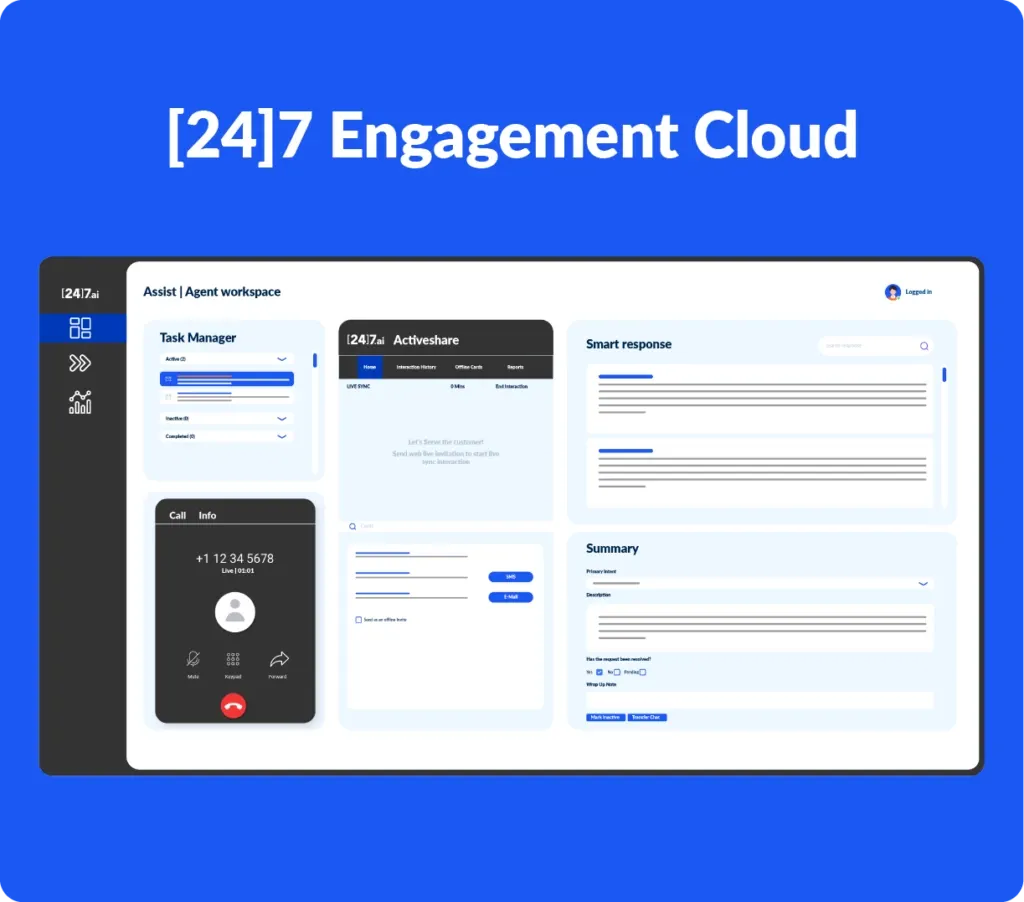
That’s the model [24]7.ai believes in: use AI to make human agents more effective, not obsolete. When technology handles the volume, people can focus on the moments that matter most. Ready to see what human + AI collaboration can look like in your customer experience?
FAQs
1. What is a hybrid workforce model in customer service?A hybrid workforce model pairs AI and human agents inside one system, with AI resolving high-volume, well-defined requests and humans stepping in for complex, emotional, or high-risk ones, both measured against the same performance goals.
2. Will AI replace human customer service agents?Not according to the leading analysts. Gartner predicts that none of the Fortune 500 companies will have fully eliminated human customer service by 2028, and 95% of customer service leaders plan to retain human agents even as AI takes on more routine work.
3. When should a human agent take over from AI?When the situation is unusual, emotional, sensitive, or high risk, or when the customer is frustrated and simply wants to reach a person. 87% of customers say companies using GenAI must still provide access to a human agent.